Hammer-headed Fruit Bat

Hammer-headed Fruit Bat

Hypsignathus monstrosus

Silhouette: Steven Traver · PhyloPic

LCLeast ConcernNTVUENCR
Daily sighting probability ~20% · Possible
at Odzala-Kokoua National Park

In 3 days ~40% in a week ~70%

5 Verified sightings at Odzala-Kokoua National Park From 2019 to 2026
5 In 1 park
October Best month
☀️🌙 Day & Night When it's spotted

About the Hammer-headed Fruit Bat

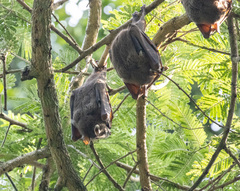
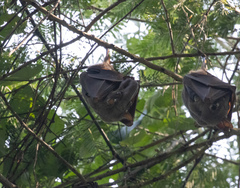
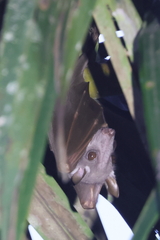
The hammer-headed bat (Hypsignathus monstrosus), also known as hammer-headed fruit bat, big-lipped bat, and hammerhead bat, is a megabat widely distributed in West and Central Africa. It is the only member of the genus Hypsignathus, which is part of the tribe Epomophorini along with four other genera. It is the largest bat in continental Africa, with wingspans approaching 1 m (3.3 ft), and males are almost twice as heavy as females. Males and females also greatly differ in appearance, making it the most sexually dimorphic bat species in the world. These differences include several adaptations that help males produce and amplify vocalizations: the males' larynges (vocal cords) are about three times as large as those of females, and they have large resonating chambers on their faces. Females appear more like a typical megabat, with foxlike faces.

The hammer-headed bat is frugivorous, consuming a variety of fruits such as figs, bananas, and mangoes, though a few instances of carnivory have been noted. Females tend to travel a consistent route to find predictable fruits, whereas males travel more to find the highest quality fruit. It forages at night, sleeping during the day in tree roosts. Individuals may roost alone or in small groups. Unlike many other bat species that segregate based on sex, males and females will roost together during the day. It has two mating seasons each year during the dry seasons. It is believed to be the only bat species with a classical lek mating system, wherein males gather on a "lek", which in this case is a long and thin stretch of land, such as along a river. There, they produce loud, honking vocalizations to attract females. Females visit the lek and select a male to mate with; the most successful 6% of males are involved in 79% of matings. Offspring are born five or six months later, typically a singleton, though twins have been documented. Its predators are not well-known, but may include hawks. Adults are commonly affected by parasites such as flies and mites.

The hammer-headed bat is sometimes considered a pest due to its frugivorous diet and its extremely loud honking noises at night. In Nigeria and the Democratic Republic of the Congo, it is consumed as bushmeat. It has been investigated as a potential reservoir of the Ebola virus, with several testing positive for antibodies against the virus. It is not considered a species of conservation concern due to its large range and presumably large population size. Wikipedia →

Sounds

Song1:03

Congo (Democratic Republic) · 2026

© Deville Tanguy · XC1182134 · CC BY-NC-SA 4.0

Song0:05

Ivory Coast · 2024

© Étienne Leroy · XC1007982 · CC BY-NC-SA 4.0

Song0:30

Zambia · 2024

© Frank Willems · XC940587 · CC BY-NC-SA 4.0

Global Distribution

Parks Where Found

# Park Country Daily sighting probability
1 Odzala-Kokoua National Park 🇨🇬 Republic of the Congo
~20%

More parks will be added in future updates.

Closest Relatives at Odzala-Kokoua National Park

No species of the same family or order lives in Odzala-Kokoua National Park, so these are its closest relatives here: other mammals.

Before you go

What are the chances of seeing a Hammer-headed Fruit Bat in Odzala-Kokoua National Park?

Possible

About 20% of wildlife watchers report a Hammer-headed Fruit Bat sighting in Odzala-Kokoua National Park on a given day, based on 5 verified sightings from GBIF citizen-science data from 2019 to 2026. It is the 28th most-seen of the 32 mammals we can rate there. Over three days the chance rises to about 40%, and over a week to about 70%, if each day is a fresh chance.

When is the best time to see a Hammer-headed Fruit Bat in Odzala-Kokoua National Park?

October

In that month about 40% of wildlife watchers report a Hammer-headed Fruit Bat in Odzala-Kokoua National Park on a given day, against under 5% in August–September and December–June, the lowest months. That is one of Odzala-Kokoua National Park's wettest months, with about 240 mm of rain against 50 mm in January.

What time of day is best to see a Hammer-headed Fruit Bat?

Between 6 and 9 pm

Across all the parks we cover, that three-hour window holds the most Hammer-headed Fruit Bat sightings with a recorded time, and about half of them come between 6 pm and 6 am: it is seen both by day and at night.

Where else can you see a Hammer-headed Fruit Bat?

Only Odzala-Kokoua National Park, in our data

Odzala-Kokoua National Park is the only park on Wallace's Line with enough records to rate Hammer-headed Fruit Bat sightings: about 20% of wildlife watchers there report one on a given day.

Where does the Hammer-headed Fruit Bat sighting chance come from?

GBIF citizen-science records

It is estimated from how often the Hammer-headed Fruit Bat is recorded against all the mammals logged in Odzala-Kokoua National Park (5 verified sightings from 2019 to 2026), calibrated against known sighting rates. Figures are rounded to the nearest 10% because citizen-science data supports honest approximations, not decimals, and months with records from fewer than five people show "—". How it works.

← Back to Odzala-Kokoua National Park