About the Atlantic Stingray
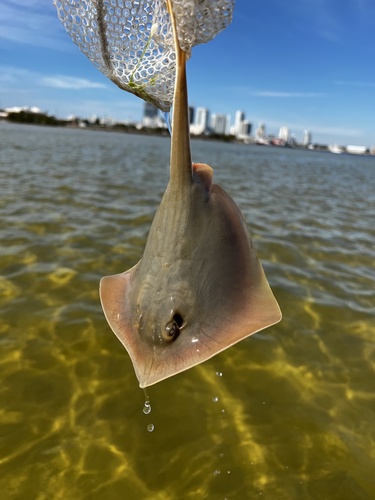
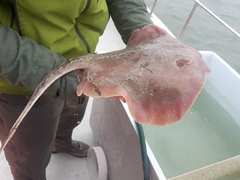
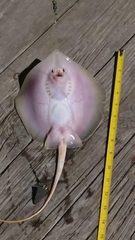
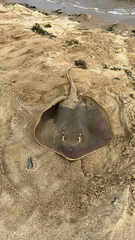
The Atlantic stingray (Hypanus sabinus) is a species of stingray in the family Dasyatidae, common along the Atlantic coast of North America from the Chesapeake Bay to Mexico, including brackish and freshwater habitats. It may be distinguished from other stingrays in the area by its relatively elongated snout. This species is of little commercial importance, other than for sale in the aquarium industry.
The Atlantic stingray was described by French naturalist Charles Alexandre Lesueur as Trygon sabina, in an 1824 volume of the Journal of the Academy of Natural Sciences of Philadelphia. He based his account on a damaged male specimen collected by American naturalist Titian Ramsay Peale during the Academy's 1817 expedition to Florida. Since then, various authors have included this species in the obsolete genera Pastinaca, Dasybatus (or the variants Dasibatis and Dasybatis), and Amphotistius, all of which were eventually synonymized with the genus Dasyatis.
A 2001 phylogenetic analysis by Lisa Rosenberger, based on morphology, found that the Atlantic stingray is one of the more basal members of its genus. It is the outgroup to a large clade that contains, amongst... Wikipedia →