


Completed


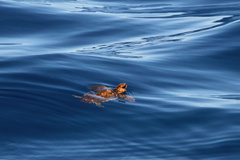

Loggerhead Sea Turtle
Caretta caretta
Silhouette: James R. Spotila and Ray Chatterji · PhyloPic
- KingdomAnimalia (Animals)
- PhylumChordata (Chordates)
- ClassTestudines
- FamilyCheloniidae (Typical Sea Turtles)
- GenusCaretta (Loggerhead sea turtles)
- SpeciesCaretta caretta (Loggerhead Sea Turtle)
In 3 days ~20% in a week ~30%
20 Verified sightings at Padre Island National Seashore From 2019 to 2026
207 In all 8 parks
May Best month
☀️ Diurnal When it's spotted


Completed
About the Loggerhead Sea Turtle
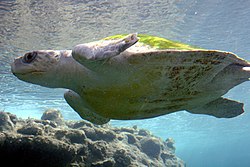
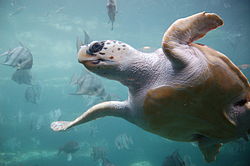
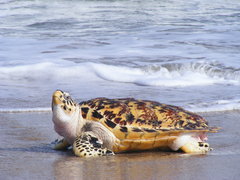
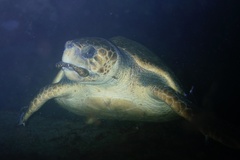
The loggerhead sea turtle (Caretta caretta), loggerhead turtle or loggerhead, is a species of sea turtle distributed throughout the world. It is a marine reptile, belonging to the family Cheloniidae. The average loggerhead measures around 90 cm (35 in) in carapace length when fully grown. The adult loggerhead sea turtle weighs approximately 135 kg (298 lb), with the largest specimens weighing about 200 kg (440 lb). The skin ranges from yellow to brown in color, and the shell is typically reddish brown. No external differences in sex are seen until the turtle becomes an adult, the most obvious difference being the adult males have thicker tails and shorter plastrons (lower shells) than the females.
The loggerhead sea turtle is found in the Atlantic, Pacific, and Indian Oceans, as well as the Mediterranean Sea. It spends most of its life in saltwater and estuarine habitats, with females briefly coming ashore to lay eggs. The loggerhead sea turtle has a low reproductive rate; females lay an average of four egg clutches and then become quiescent, producing no eggs for two to three years. The loggerhead reaches sexual maturity within 17–33 years and has a lifespan of 47–67 years.
The loggerhead sea turtle is omnivorous, feeding mainly on bottom-dwelling invertebrates. Its large and powerful jaws serve as an effective tool for dismantling its prey. Young loggerheads are exploited by numerous predators; the eggs are especially vulnerable to terrestrial organisms. Once the turtles reach adulthood, their formidable size limits predation to large marine animals, such as large sharks.
The loggerhead sea turtle is considered a vulnerable species by the International Union for Conservation of Nature. In total, nine distinct population segments are under the protection of the Endangered Species Act of 1973, with four population segments classified as "threatened" and five classified as "endangered".
Commercial international trade of loggerheads or derived products is prohibited by CITES Appendix I. Untended fishing gear is responsible for many loggerhead deaths. The greatest threat is loss of nesting habitat due to coastal development, predation of nests, and human disturbances (such as coastal lighting and housing developments) that cause disorientations during the emergence of hatchlings. Turtles may also suffocate if they are trapped in fishing trawls. Turtle excluder devices have been implemented in efforts to reduce mortality by providing an escape route for the turtles. Wikipedia →
Recent sightings of Loggerhead Sea Turtle in Padre Island National Seashore
LIVEiNaturalistGlobal Distribution
Parks Where Found
| # | Park | Country | Daily sighting probability |
|---|---|---|---|
| 1 | Ningaloo Marine Park | 🇦🇺 Australia | |
| 2 | iSimangaliso Wetland Park | 🇿🇦 South Africa | |
| 3 | Arrecifes de Cozumel National Park | 🇲🇽 Mexico | |
| 4 | Merritt Island National Wildlife Refuge | 🇺🇸 United States | |
| 5 | Sian Ka'an Biosphere Reserve | 🇲🇽 Mexico | |
| 6 | Padre Island National Seashore | 🇺🇸 United States | |
| 7 | Everglades National Park | 🇺🇸 United States | |
| 8 | Table Mountain National Park | 🇿🇦 South Africa |
Zoos & Centres Where Found
Closest Relatives at Padre Island National Seashore


Before you go
What are the chances of seeing a Loggerhead Sea Turtle in Padre Island National Seashore?
With luck
About 10% of wildlife watchers report a Loggerhead Sea Turtle sighting in Padre Island National Seashore on a given day, based on 20 verified sightings from GBIF citizen-science data from 2019 to 2026. It is the 15th most-seen of the 15 reptiles we can rate there. Over three days the chance rises to about 20%, and over a week to about 30%, if each day is a fresh chance.
When is the best time to see a Loggerhead Sea Turtle in Padre Island National Seashore?
January, May, August and November
In those months about 10% of wildlife watchers report a Loggerhead Sea Turtle in Padre Island National Seashore on a given day, against under 5% in February–April, June–July, September–October and December, the lowest months.
What time of day is best to see a Loggerhead Sea Turtle?
Between 10 am and 1 pm
Across all the parks we cover, that three-hour window holds the most Loggerhead Sea Turtle sightings with a recorded time, and about 8 in 10 of them come between 6 am and 6 pm: it is a daytime animal.
Is Padre Island National Seashore the best place to see a Loggerhead Sea Turtle?
6th of 8
Of the 8 parks where we can rate Loggerhead Sea Turtle sightings, Padre Island National Seashore ranks 6th at about 10%. The best odds are in Ningaloo Marine Park (Australia, about 20%), iSimangaliso Wetland Park (South Africa, about 10%) and Arrecifes de Cozumel National Park (Mexico, about 10%).
Which relatives of the Loggerhead Sea Turtle live in Padre Island National Seashore?
Same family: Cheloniidae
The closest relatives of the Loggerhead Sea Turtle that you can see in Padre Island National Seashore (family Cheloniidae, Typical Sea Turtles) are Kemp's Ridley (about 30%) and Green Sea Turtle (about 10%), with each one's daily chance of a sighting.
Where does the Loggerhead Sea Turtle sighting chance come from?
GBIF citizen-science records
It is estimated from how often the Loggerhead Sea Turtle is recorded against all the reptiles logged in Padre Island National Seashore (20 verified sightings from 2019 to 2026), calibrated against known sighting rates. Figures are rounded to the nearest 10% because citizen-science data supports honest approximations, not decimals, and months with records from fewer than five people show "—". How it works.
