Slender Hognose Viper

Slender Hognose Viper

Porthidium ophryomegas

Silhouette: Steven Traver · PhyloPic

LCLeast ConcernNTVUENCR
Daily sighting probability ~20% · Possible
at Palo Verde National Park

In 3 days ~40% in a week ~70%

9 Verified sightings at Palo Verde National Park From 2019 to 2026
69 In all 2 parks
September Best month
🌅 Crepuscular When it's spotted

About the Slender Hognose Viper

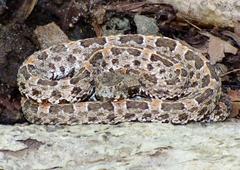
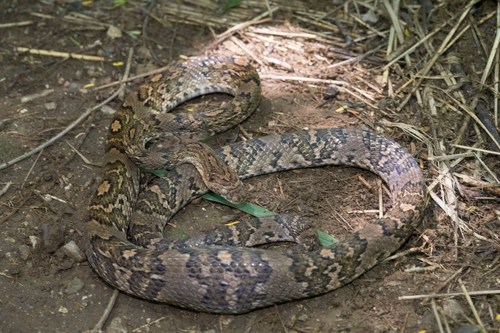
Common names: slender hognosed pitviper, western hog-nosed viper. Porthidium ophryomegas is a venomous pitviper species found in Central America. No subspecies are currently recognized. Adults usually grow to a length of 40–60 cm (16–24 in) and have a relatively slender build. Females grow larger than males and are often more than 60 cm (24 in) in length, while males are usually about 45 cm (18 in). One exceptional specimen, a female, was reported to measure 77 cm (30 in).

The color pattern consists of a tan, brown, gray or grayish-brown ground color overlaid with a narrow white, yellow or rust brown vertebral stripe and 24–40 dark brown to almost black blotches that oppose or alternate across the vertebral line. The blotches have thin white borders that extend at roughly a right angle from the vertebral line.

Found in Central America in Guatemala, El Salvador, Honduras, Nicaragua and Costa Rica. The type locality given is "les terres chaudes du versant occidental de la Cordillère Escuintla (Guatémala)" (= warm regions on western slope of Cordillera, Escuintla, Guatemala).

Occurs in seasonally dry forests, including tropical dry... Wikipedia →

Global Distribution

Parks Where Found

# Park Country Daily sighting probability
1 Santa Rosa National Park 🇨🇷 Costa Rica
~50%
2 Palo Verde National Park 🇨🇷 Costa Rica
~20%

Zoos & Centres Where Found

# Zoo / Centre Country
1 La Paz Waterfall Gardens 🇨🇷 Costa Rica In captivity
2 Reptile Gardens 🇺🇸 United States In captivity

Closest Relatives at Palo Verde National Park

No species of the same family or order lives in Palo Verde National Park, so these are its closest relatives here: other reptiles.

Before you go

What are the chances of seeing a Slender Hognose Viper in Palo Verde National Park?

Possible

About 20% of wildlife watchers report a Slender Hognose Viper sighting in Palo Verde National Park on a given day, based on 9 verified sightings from GBIF citizen-science data from 2019 to 2026. It is the 16th most-seen of the 21 reptiles we can rate there. Over three days the chance rises to about 40%, and over a week to about 70%, if each day is a fresh chance.

When is the best time to see a Slender Hognose Viper in Palo Verde National Park?

September

In that month about 50% of wildlife watchers report a Slender Hognose Viper in Palo Verde National Park on a given day, against under 5% in July–August and December–April, the lowest months. That is one of Palo Verde National Park's wettest months, with about 360 mm of rain against almost none in February.

What time of day is best to see a Slender Hognose Viper?

Between 6 and 9 pm

Across all the parks we cover, that three-hour window holds the most Slender Hognose Viper sightings with a recorded time, and about half of them come between 6 pm and 6 am: it is most active around dawn and dusk.

Is Palo Verde National Park the best place to see a Slender Hognose Viper?

2nd of 2

Of the 2 parks where we can rate Slender Hognose Viper sightings, Palo Verde National Park ranks 2nd at about 20%. The best odds are in Santa Rosa National Park (Costa Rica, about 50%).

Where does the Slender Hognose Viper sighting chance come from?

GBIF citizen-science records

It is estimated from how often the Slender Hognose Viper is recorded against all the reptiles logged in Palo Verde National Park (9 verified sightings from 2019 to 2026), calibrated against known sighting rates. Figures are rounded to the nearest 10% because citizen-science data supports honest approximations, not decimals, and months with records from fewer than five people show "—". How it works.

← Back to Palo Verde National Park