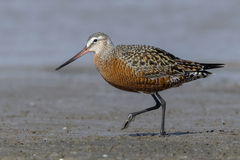
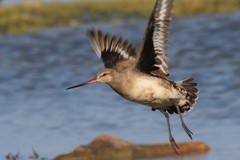
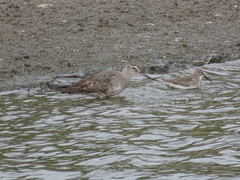
The Hudsonian godwit (Limosa haemastica) is a large shorebird in the sandpiper family, Scolopacidae. It is an extreme long-distance migrant, breeding at remote sites in Subarctic North America and flying nonstop in the fall to wintering sites in southern South America. Due to its remote breeding and wintering grounds and rapid, direct migration, it was a poorly-known species and was considered very rare until the mid-20th century, when major staging sites were discovered around James Bay and breeding sites were found around Churchill, Manitoba. Since then, the Hudsonian godwit has become the target of conservation attention due to its fragmented and localized distribution and small population, as well as an important scientific system for migration biology research.
The Hudsonian godwit was formally described in 1758 by the Swedish naturalist Carl Linnaeus in the tenth edition of his Systema Naturae. He placed it in the genus Scolopax and coined the binomial name Scolopax haemastica. Linnaeus based his entry on the "red-breasted godwit" that had been described and illustrated in 1750 by the English naturalist George Edwards in the third volume of his...