
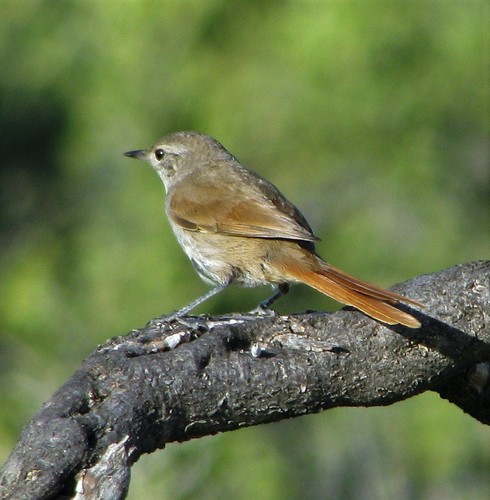
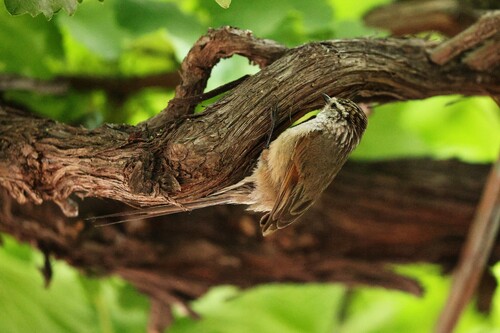
Band-tailed Earthcreeper

Band-tailed Earthcreeper

Eremobius phoenicurus

Silhouette: Abraão B. Leite · PhyloPic

Daily sighting probability <5% · Rare
at Península Valdés

In 3 days ~10% in a week ~30%

18 Verified sightings at Península Valdés From 2019 to 2026
23 In all 2 parks
September Best month
☀️ Diurnal When it's spotted

About the Band-tailed Earthcreeper

The band-tailed earthcreeper (Ochetorhynchus phoenicurus) is a species of bird in the Furnariinae subfamily of the ovenbird family Furnariidae. It is found in Argentina and Chile. The band-tailed earthcreeper was originally described as Eremobius phoenicurus. In the early 1900s at least one publication put it in genus Enicornis. Since the early 2000s has been in its present genus.

The band-tailed earthcreeper is monotypic. The band-tailed earthcreeper is 16 to 17 cm (6.3 to 6.7 in) long and weighs 28 to 34 g (0.99 to 1.2 oz). It is a smallish earthcreeper whose medium-length bill is thin and straight. The sexes are alike. Adults have a white supercilium, a dark stripe behind the eye, and rufescent cheeks. Their crown and upperparts are plain dull gray-brown. Their tail's central pair of feathers are fuscous blackish with dull gray-brown bases and the rest have a sharp line between dark rufous bases and black ends. Their wings are dull gray-brown. Their throat is whitish with grayer edges, their breast and belly pale dull gray-brown with paler streaks on the breast and flanks, and their undertail coverts whitish. Their iris is dark brown... Wikipedia →

Sounds

Recording0:25

Argentina · 2022

© Nicolas Olejnik · iNaturalist · CC BY 4.0

Global Distribution

Parks Where Found

# Park Country Daily sighting probability
1 Península Valdés 🇦🇷 Argentina
<5%
2 Torres del Paine National Park 🇨🇱 Chile
<5%

Before you go

What are the chances of seeing a Band-tailed Earthcreeper in Península Valdés?

Rare

Under 5% of wildlife watchers report a Band-tailed Earthcreeper sighting in Península Valdés on a given day, based on 18 verified sightings from GBIF citizen-science data from 2019 to 2026. It is the 74th most-seen of the 96 birds we can rate there. Over three days the chance rises to about 10%, and over a week to about 30%, if each day is a fresh chance.

When is the best time to see a Band-tailed Earthcreeper in Península Valdés?

September

In that month about 20% of wildlife watchers report a Band-tailed Earthcreeper in Península Valdés on a given day, against under 5% in February, April–May and October–December, the lowest months. June and July have too few records to rate.

What time of day is best to see a Band-tailed Earthcreeper?

Between 10 am and 1 pm

Across all the parks we cover, that three-hour window holds the most Band-tailed Earthcreeper sightings with a recorded time, and about 8 in 10 of them come between 6 am and 6 pm: it is a daytime animal.

Is Península Valdés the best place to see a Band-tailed Earthcreeper?

Yes

Of the 2 parks where we can rate Band-tailed Earthcreeper sightings, Península Valdés has the highest daily chance: under 5%. Next come Torres del Paine National Park (Chile, under 5%).

Which relatives of the Band-tailed Earthcreeper live in Península Valdés?

Same family: Furnariidae

The closest relatives of the Band-tailed Earthcreeper that you can see in Península Valdés (family Furnariidae, Ovenbirds and Woodcreepers) are Sharp-billed Canastero (about 30%), Plain-mantled Tit-Spinetail (about 20%) and Common Miner (about 20%), with each one's daily chance of a sighting.

Where does the Band-tailed Earthcreeper sighting chance come from?

GBIF citizen-science records

It is estimated from how often the Band-tailed Earthcreeper is recorded against all the birds logged in Península Valdés (18 verified sightings from 2019 to 2026), calibrated against known sighting rates. Figures are rounded to the nearest 10% because citizen-science data supports honest approximations, not decimals, and months with records from fewer than five people show "—". How it works.

← Back to Península Valdés