Darwin's Nothura

Darwin's Nothura

Nothura darwinii

Silhouette: George Edward Lodge · PhyloPic

LCLeast ConcernNTVUENCR
Daily sighting probability ~10% · With luck
at Península Valdés

In 3 days ~40% in a week ~60%

60 Verified sightings at Península Valdés From 2019 to 2026
60 In 1 park
November Best month
☀️ Diurnal When it's spotted

About the Darwin's Nothura

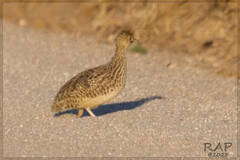
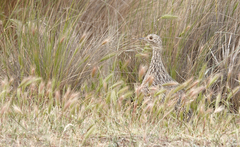
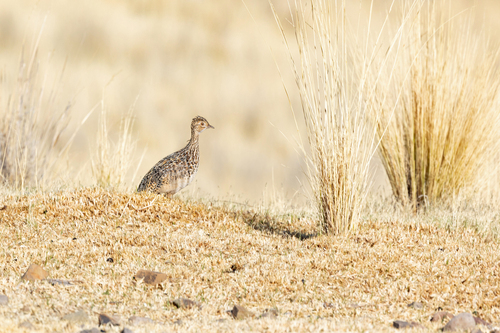
Darwin's nothura (Nothura darwinii) is a type of tinamou commonly found in high-altitude grassland in the southern Andes in South America. The name of the species is named after Charles Darwin, an eminent English naturalist, to commemorate him.

All tinamou are from the family Tinamidae, and in the larger scheme are also ratites. Unlike other ratites, tinamous can fly, although in general, they are not strong fliers. All ratites evolved from prehistoric flying birds, and tinamous are the closest living relative of these birds.

N. d. darwinii, the nominate subspecies, occurs in the Patagonian steppes of south-central Argentina N. d. peruviana occurs in southern Peru, in the Urubamba Valley in Cusco Region N. d. agassizii occurs in the altiplano of southeastern Peru and western Bolivia

N. d. boliviana occurs in the highlands of western Bolivia; Cochabamba, Chuquisaca, Potosí, Oruro, and Tarija Departments The Darwin's nothura is approximately 26 cm (10 in) in length. It is similar to spotted nothura but more rufous with broader streaking below. Its upper parts are brown and streaked... Wikipedia →
Sounds

Flight call0:12

Bolivia · 2016

© Dan Lane · XC335768 · CC BY-NC-SA 4.0

Song0:15

Peru · 2022

© Jaime J. Valenzuela Trujillo · XC711169 · CC BY-NC-SA 4.0

Song1:14

Argentina · 2006

© Rosendo Fraga · XC444040 · CC BY-NC-SA 4.0

Global Distribution

Parks Where Found

# Park Country Daily sighting probability
1 Península Valdés 🇦🇷 Argentina
~10%

More parks will be added in future updates.

Zoos & Centres Where Found

# Zoo / Centre Country
1 Zoológico de Oruro 🇧🇴 Bolivia In captivity

Before you go

What are the chances of seeing a Darwin's Nothura in Península Valdés?

With luck

About 10% of wildlife watchers report a Darwin's Nothura sighting in Península Valdés on a given day, based on 60 verified sightings from GBIF citizen-science data from 2019 to 2026. It is the 47th most-seen of the 96 birds we can rate there. Over three days the chance rises to about 40%, and over a week to about 60%, if each day is a fresh chance.

When is the best time to see a Darwin's Nothura in Península Valdés?

August and November

In those months about 20% of wildlife watchers report a Darwin's Nothura in Península Valdés on a given day, against under 5% in March, the lowest month. June and July have too few records to rate.

What time of day is best to see a Darwin's Nothura?

Between 8 and 11 am

Across all the parks we cover, that three-hour window holds the most Darwin's Nothura sightings with a recorded time, and about 8 in 10 of them come between 6 am and 6 pm: it is a daytime animal.

Where else can you see a Darwin's Nothura?

Only Península Valdés, in our data

Península Valdés is the only park on Wallace's Line with enough records to rate Darwin's Nothura sightings: about 10% of wildlife watchers there report one on a given day.

Where does the Darwin's Nothura sighting chance come from?

GBIF citizen-science records

It is estimated from how often the Darwin's Nothura is recorded against all the birds logged in Península Valdés (60 verified sightings from 2019 to 2026), calibrated against known sighting rates. Figures are rounded to the nearest 10% because citizen-science data supports honest approximations, not decimals, and months with records from fewer than five people show "—". How it works.

← Back to Península Valdés