Olrog's Gull

Olrog's Gull

Larus atlanticus

Silhouette: Sharon Wegner-Larsen · PhyloPic

LCNTNear ThreatenedVUENCR
Daily sighting probability <5% · Rare
at Península Valdés

In 3 days ~10% in a week ~20%

15 Verified sightings at Península Valdés From 2019 to 2026
15 In 1 park
February Best month
☀️ Diurnal When it's spotted

About the Olrog's Gull

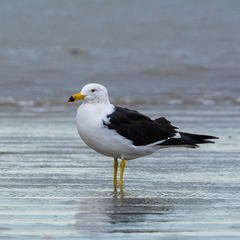
Olrog's gull (Larus atlanticus) is a species of gull found along the Atlantic coast of southern Brazil, Uruguay, and northern Argentina. It was formerly considered a subspecies of the very similar L. belcheri. It is a large gull with a black back and wings, white head and underparts, a black band in the otherwise white tail, and a yellow bill with a red and black tip. Nonbreeding adults have a blackish head and a white eye ring. The species is named after Swedish-Argentine biologist Claes C. Olrog. It has a rather restricted breeding range and is threatened by habitat loss, and the IUCN has rated it as being "near threatened".

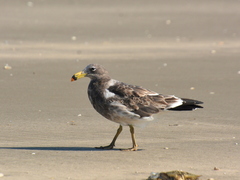
Olrog's gull is a large gull with a white head, neck, rump, breast, and belly. The back and wings are black except for a white trailing edge to the wings. The tail is white with a broad black band at the back. The beak is yellow with a black band and red tip. The eyes are brown with a red orbital ring and the legs and feet are dull yellow. The length of this gull is 50 to 60 cm (20 to 24 in) and it has a wingspan of 130 to 140 cm (51 to 55 in). Males are a little larger than females. Juveniles have black heads and brownish plumage. Wikipedia →

Sounds

Alarm call0:35

Argentina · 2014

© Pablo Petracci · XC393314 · CC BY-NC-SA 4.0

Song0:11

Argentina · 2005

© Bernabe Lopez-Lanus · XC51186 · CC BY-NC-SA 3.0

Global Distribution

Parks Where Found

# Park Country Daily sighting probability
1 Península Valdés 🇦🇷 Argentina
<5%

More parks will be added in future updates.

Cities Where Found

# City Country Daily sighting probability
1 Buenos Aires 🇦🇷 Argentina
<5%

Before you go

What are the chances of seeing an Olrog's Gull in Península Valdés?

Rare

Under 5% of wildlife watchers report an Olrog's Gull sighting in Península Valdés on a given day, based on 15 verified sightings from GBIF citizen-science data from 2019 to 2026. It is the 83rd most-seen of the 96 birds we can rate there. Over three days the chance rises to about 10%, and over a week to about 20%, if each day is a fresh chance.

When is the best time to see an Olrog's Gull in Península Valdés?

February, August and October

In those months about 10% of wildlife watchers report an Olrog's Gull in Península Valdés on a given day, against under 5% in March–May, September and November–January, the lowest months. June and July have too few records to rate.

What time of day is best to see an Olrog's Gull?

Between 2 and 5 pm

Across all the parks we cover, that three-hour window holds the most Olrog's Gull sightings with a recorded time, and about 9 in 10 of them come between 6 am and 6 pm: it is a daytime animal.

Where else can you see an Olrog's Gull?

Only Península Valdés, in our data

Península Valdés is the only park on Wallace's Line with enough records to rate Olrog's Gull sightings: under 5% of wildlife watchers there report one on a given day.

Where does the Olrog's Gull sighting chance come from?

GBIF citizen-science records

It is estimated from how often the Olrog's Gull is recorded against all the birds logged in Península Valdés (15 verified sightings from 2019 to 2026), calibrated against known sighting rates. Figures are rounded to the nearest 10% because citizen-science data supports honest approximations, not decimals, and months with records from fewer than five people show "—". How it works.

← Back to Península Valdés