Crimson-backed Sunbird

Crimson-backed Sunbird

Leptocoma minima

Silhouette: Sheatherius · PhyloPic

LCLeast ConcernNTVUENCR Endemic
Daily sighting probability ~20% · Possible
at Periyar National Park

In 3 days ~50% in a week ~80%

1,390 Verified sightings at Periyar National Park From 2019 to 2026
1,772 In all 5 parks
February Best month
🌅 Crepuscular When it's spotted

About the Crimson-backed Sunbird

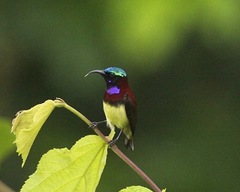
The crimson-backed sunbird or small sunbird (Leptocoma minima) is a sunbird endemic to the Western Ghats of India. Like other sunbirds, they feed mainly on nectar although they take insects, especially to feed their young. They are tiny birds that are resident and are found in forests but are particularly attracted to gardens at the edge of the forest where people grow suitable flower-bearing plants. They usually perch while taking nectar.

Crimson-backed sunbirds are tiny, even by sunbird standards, and are only 8 cm long. They have medium-length thin down-curved bills and brush-tipped tubular tongues, both adaptations for nectar feeding. The adult male is velvety red on the mantle and wing coverts and there is a broad red breast band. The crown is shiny green and there are pink-violet patches on the throat and rump. The underside from the breast below is yellowish. There is a black edge to the bib that separates the yellow of the underside. The larger purple-rumped sunbird can appear very similar but this sunbird has a darker maroon on the upper side while the flanks and vent are whitish. The eclipse plumage (non-breeding) of the male has more olive on the head and... Wikipedia →

Sounds

Call0:24

India · 2023

© JISHNU KIZHAKKILLAM · XC792296 · CC BY-NC-SA 4.0

Song0:41

India · 2023

© Sathyan Meppayur · XC786580 · CC BY-NC-SA 4.0

Song0:27

India · 2020

© Vijay Ramesh · XC619723 · CC BY-NC-SA 4.0

Global Distribution

Parks Where Found

# Park Country Daily sighting probability
1 Periyar National Park 🇮🇳 India
~20%
2 Mudumalai National Park 🇮🇳 India
~10%
3 Nagarhole National Park 🇮🇳 India
~10%
4 Bandipur National Park 🇮🇳 India
~10%
5 Eravikulam National Park 🇮🇳 India
~10%

Cities Where Found

# City Country Daily sighting probability
1 Mumbai 🇮🇳 India
<5%
2 Pune 🇮🇳 India
<5%

Before you go

What are the chances of seeing a Crimson-backed Sunbird in Periyar National Park?

Possible

About 20% of wildlife watchers report a Crimson-backed Sunbird sighting in Periyar National Park on a given day, based on 1,390 verified sightings from GBIF citizen-science data from 2019 to 2026. It is the 66th most-seen of the 227 birds we can rate there. Over three days the chance rises to about 50%, and over a week to about 80%, if each day is a fresh chance.

When is the best time to see a Crimson-backed Sunbird in Periyar National Park?

February

In that month about 40% of wildlife watchers report a Crimson-backed Sunbird in Periyar National Park on a given day, against under 5% in August, the lowest month. That is one of Periyar National Park's driest months, with about 15 mm of rain against 410 mm in August.

What time of day is best to see a Crimson-backed Sunbird?

Between 3 and 6 am

Across all the parks we cover, that three-hour window holds the most Crimson-backed Sunbird sightings with a recorded time, and about half of them come between 6 am and 6 pm: it is most active around dawn and dusk.

Is Periyar National Park the best place to see a Crimson-backed Sunbird?

Yes

Of the 5 parks where we can rate Crimson-backed Sunbird sightings, Periyar National Park has the highest daily chance: about 20%. Next come Mudumalai National Park (India, about 10%) and Nagarhole National Park (India, about 10%).

Where does the Crimson-backed Sunbird sighting chance come from?

GBIF citizen-science records

It is estimated from how often the Crimson-backed Sunbird is recorded against all the birds logged in Periyar National Park (1,390 verified sightings from 2019 to 2026), calibrated against known sighting rates. Figures are rounded to the nearest 10% because citizen-science data supports honest approximations, not decimals, and months with records from fewer than five people show "—". How it works.

← Back to Periyar National Park


