Veraguan Mango

Veraguan Mango

Anthracothorax veraguensis

Silhouette: Ferran Sayol · PhyloPic

LCLeast ConcernNTVUENCR
Daily sighting probability <5% · Rare
at Piedras Blancas National Park

In 3 days ~10% in a week ~20%

53 Verified sightings at Piedras Blancas National Park From 2019 to 2026
60 In all 2 parks
May Best month
☀️ Diurnal When it's spotted

About the Veraguan Mango

The Veraguan mango (Anthracothorax veraguensis) is a species of hummingbird in the family Trochilidae. It is found in Panama and recently in Costa Rica. It was considered conspecific with the Green-breasted Mango (Anthracothorax prevostii) but was separated due to morphological and geographical differences in 1995.

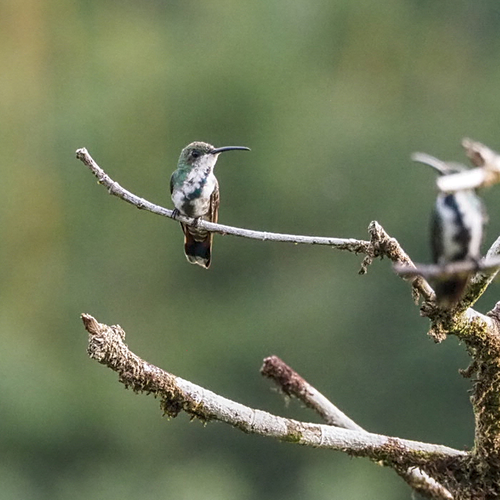
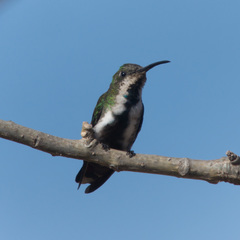
The Veraguan mango is a medium-sized hummingbird species, reaching lengths of 11–12 cm. Both sexes are metallic green with a slightly decurved, dark grey beak, and black tail feathers with a red circle central to each feather. This species exhibits sexual dimorphism. Males have a blueish breast and belly, whilst females have a white-cream belly with a dark teal stripe running down the breast. The morphology of the Veraguan mango is very similar to that of the Green-breasted mango, however it differs by the lack of black plumage on the throat. The black ventral stripe seen in the Green-breasted mango is teal coloured in female Veraguan mangos.

The species is named for the region it was first discovered in, Veraguas Province in Panama. However, it is common throughout much of the Pacific coastline of Panama and into Costa Rica... Wikipedia →
Sounds

Song0:16

Panama · 2013

© Andrew Spencer · XC124528 · CC BY-NC-SA 3.0

Flight call0:10

Costa Rica · 2017

© Albert Lastukhin · XC894947 · CC BY-NC-ND 4.0

Call0:08

Panama · 2015

© Peter Boesman · XC271064 · CC BY-NC-ND 4.0

Global Distribution

Parks Where Found

# Park Country Daily sighting probability
1 Piedras Blancas National Park 🇨🇷 Costa Rica
<5%
2 Corcovado National Park 🇨🇷 Costa Rica
<5%

Before you go

What are the chances of seeing a Veraguan Mango in Piedras Blancas National Park?

Rare

Under 5% of wildlife watchers report a Veraguan Mango sighting in Piedras Blancas National Park on a given day, based on 53 verified sightings from GBIF citizen-science data from 2019 to 2026. It is the 230th most-seen of the 344 birds we can rate there. Over three days the chance rises to about 10%, and over a week to about 20%, if each day is a fresh chance.

When is the best time to see a Veraguan Mango in Piedras Blancas National Park?

May and September

In those months about 10% of wildlife watchers report a Veraguan Mango in Piedras Blancas National Park on a given day, against under 5% in June–August and October–April, the lowest months.

What time of day is best to see a Veraguan Mango?

Between 7 and 10 am

Across all the parks we cover, that three-hour window holds the most Veraguan Mango sightings with a recorded time, and about 9 in 10 of them come between 6 am and 6 pm: it is a daytime animal.

Is Piedras Blancas National Park the best place to see a Veraguan Mango?

Yes

Of the 2 parks where we can rate Veraguan Mango sightings, Piedras Blancas National Park has the highest daily chance: under 5%. Next come Corcovado National Park (Costa Rica, under 5%).

Which relatives of the Veraguan Mango live in Piedras Blancas National Park?

Same family: Trochilidae

The closest relatives of the Veraguan Mango that you can see in Piedras Blancas National Park (family Trochilidae, Hummingbirds) are Rufous-tailed Hummingbird (about 50%), Charming Hummingbird (about 40%) and Long-billed Hermit (about 40%), with each one's daily chance of a sighting.

Where does the Veraguan Mango sighting chance come from?

GBIF citizen-science records

It is estimated from how often the Veraguan Mango is recorded against all the birds logged in Piedras Blancas National Park (53 verified sightings from 2019 to 2026), calibrated against known sighting rates. Figures are rounded to the nearest 10% because citizen-science data supports honest approximations, not decimals, and months with records from fewer than five people show "—". How it works.

← Back to Piedras Blancas National Park

