Chestnut-rumped Thornbill

Chestnut-rumped Thornbill

Acanthiza uropygialis

Silhouette: Matt Wilkins (photo by Patrick Kavanagh) · PhyloPic

LCLeast ConcernNTVUENCR Endemic
Daily sighting probability ~10% · With luck
at Pilliga National Park

In 3 days ~20% in a week ~40%

7 Verified sightings at Pilliga National Park From 2019 to 2026
989 In all 3 parks
September Best month
🌅 Crepuscular When it's spotted

About the Chestnut-rumped Thornbill

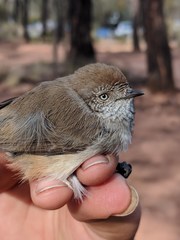
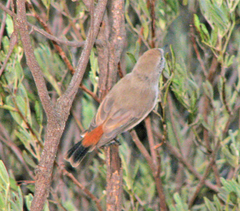
The chestnut-rumped thornbill (Acanthiza uropygialis) is a small passerine bird in the family Acanthizidae, endemic to Australia. Specially named for its pale-chestnut rump from mediaeval Latin uropygium, the rump. Its other names include chestnut-tailed or chestnut-backed thornbill, tit or tit-warbler, chestnut-rumped tit or tit-warbler.

A plain, pale thornbill, with pale eyes, it is widespread throughout inland Australia, west of the Great Dividing Range to the West Australian coast but is absent in the far north and humid southwest Western Australia. It is a cooperative breeder like some of the other thornbills

Described and classified by John Gould in 1838 in Synopsis of Birds of Australia, from a specimen collected in Liverpool Plains NSW. Type, male, No17602 (525) is in the Academy of Natural Sciences, Philadelphia, United States. A specimen from the Gould collection is in the British Museum.

Mathews (1912) recognised a number of different subspecies of Acanthiza Uropygialis: A.u.ruthergleni, mellori, augusta, nea, murchisoni and condora, with A.u.kycheringi added in 1922. Campbell (1925) added subspecies Geobasilus uropygialis moora and G.u. erema...

Wikipedia →

Sounds

Call0:25

Australia · 2021

© Marc Anderson · XC1001942 · CC BY-NC-ND 4.0

Song0:35

Australia · 2023

© Peter Boesman · XC859606 · CC BY-NC-ND 4.0

Song0:41

Australia · 2017

© Jonas Nordin · XC788202 · CC BY-NC-SA 4.0

Global Distribution

Parks Where Found

# Park Country Daily sighting probability
1 Hattah-Kulkyne National Park 🇦🇺 Australia
~50%
2 Flinders Ranges National Park 🇦🇺 Australia
~20%
3 Pilliga National Park 🇦🇺 Australia
~10%

Zoos & Centres Where Found

# Zoo / Centre Country
1 Alice Springs Desert Park 🇦🇺 Australia In captivity

Before you go

What are the chances of seeing a Chestnut-rumped Thornbill in Pilliga National Park?

With luck

About 10% of wildlife watchers report a Chestnut-rumped Thornbill sighting in Pilliga National Park on a given day, based on 7 verified sightings from GBIF citizen-science data from 2019 to 2026. It is the 44th most-seen of the 58 birds we can rate there. Over three days the chance rises to about 20%, and over a week to about 40%, if each day is a fresh chance.

When is the best time to see a Chestnut-rumped Thornbill in Pilliga National Park?

September

In that month about 20% of wildlife watchers report a Chestnut-rumped Thornbill in Pilliga National Park on a given day, against under 5% in February, June, August and November, the lowest months. January, March–May and October have too few records to rate.

What time of day is best to see a Chestnut-rumped Thornbill?

Between 1 and 4 am

Across all the parks we cover, that three-hour window holds the most Chestnut-rumped Thornbill sightings with a recorded time, and about 7 in 10 of them come between 6 pm and 6 am: it is most active around dawn and dusk.

Is Pilliga National Park the best place to see a Chestnut-rumped Thornbill?

3rd of 3

Of the 3 parks where we can rate Chestnut-rumped Thornbill sightings, Pilliga National Park ranks 3rd at about 10%. The best odds are in Hattah-Kulkyne National Park (Australia, about 50%) and Flinders Ranges National Park (Australia, about 20%).

Which relatives of the Chestnut-rumped Thornbill live in Pilliga National Park?

Same genus: Acanthiza

The closest relatives of the Chestnut-rumped Thornbill that you can see in Pilliga National Park (genus Acanthiza, Australasian Thornbills) are Yellow Thornbill (about 20%), Inland Thornbill (about 10%) and Yellow-rumped Thornbill (about 10%), with each one's daily chance of a sighting.

Where does the Chestnut-rumped Thornbill sighting chance come from?

GBIF citizen-science records

It is estimated from how often the Chestnut-rumped Thornbill is recorded against all the birds logged in Pilliga National Park (7 verified sightings from 2019 to 2026), calibrated against known sighting rates. Figures are rounded to the nearest 10% because citizen-science data supports honest approximations, not decimals, and months with records from fewer than five people show "—". How it works.

← Back to Pilliga National Park