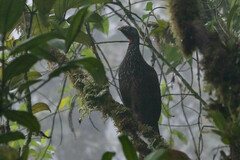
Bearded Guan

Bearded Guan

Penelope barbata

Silhouette: Sheatherius · PhyloPic

LCNTNear ThreatenedVUENCR
Daily sighting probability ~40% · Likely
at Podocarpus National Park

In 3 days ~80% in a week >90%

666 Verified sightings at Podocarpus National Park From 2019 to 2026
666 In 1 park
October Best month
☀️ Diurnal When it's spotted

About the Bearded Guan

The bearded guan (Penelope barbata) is a species of bird in the family Cracidae, the chachalacas, guans, and curassows. It is found in Ecuador and Peru. Its natural habitat is subtropical or tropical moist montane forest. It is threatened by habitat loss.

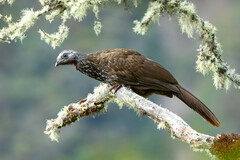
The bearded guan (Penelope barbata) is a small mostly brown bird that is about 55 cm large, and named for it red dewlap (or beard) While most of the bird is brown, it has dark grayish-brown upper parts and rear underparts as well as a silver crown and neck feathers. The bird also has white feathers edging its neck and breast, red legs, and a rufous tail.

The bearded guan (Penelope barbata) lives at an altitude of 1200–3000 m in a humid environment located in northwest Peru and southern Ecuador. The greatest threat to the bearded guan (Penelope barbata) is deforestation for agriculture and mining.

No information is known about the dietary habits of the bearded guan (Penelope barbata), however guans in general eat various fruits and berries and well as leaves, flowers and insects. Bearded guan (Penelope barbata) are a monogamous, territorial species that mate... Wikipedia →

Sounds

Alarm call1:06

Ecuador · 2019

© Leonardo Ordóñez-Delgado · XC513874 · CC BY-NC-SA 4.0

Call0:17

Ecuador · 2015

© Ross Gallardy · XC297219 · CC BY-NC-SA 4.0

Alarm calling0:58

Ecuador · 2009

© Manuel Sanchez N. · XC55386 · CC BY-NC-ND 2.5

Global Distribution

Parks Where Found

# Park Country Daily sighting probability
1 Podocarpus National Park 🇪🇨 Ecuador
~40%

More parks will be added in future updates.

Before you go

What are the chances of seeing a Bearded Guan in Podocarpus National Park?

Likely

About 40% of wildlife watchers report a Bearded Guan sighting in Podocarpus National Park on a given day, based on 666 verified sightings from GBIF citizen-science data from 2019 to 2026. It is the 9th most-seen of the 446 birds we can rate there. Over three days the chance rises to about 80%, and over a week to over 90%, if each day is a fresh chance.

When is the best time to see a Bearded Guan in Podocarpus National Park?

October

In that month about 50% of wildlife watchers report a Bearded Guan in Podocarpus National Park on a given day, against about 20% in July, the lowest month.

What time of day is best to see a Bearded Guan?

Between 4 and 7 pm

Across all the parks we cover, that three-hour window holds the most Bearded Guan sightings with a recorded time, and about 8 in 10 of them come between 6 am and 6 pm: it is a daytime animal.

Where else can you see a Bearded Guan?

Only Podocarpus National Park, in our data

Podocarpus National Park is the only park on Wallace's Line with enough records to rate Bearded Guan sightings: about 40% of wildlife watchers there report one on a given day.

Which relatives of the Bearded Guan live in Podocarpus National Park?

Same family: Cracidae

The closest relatives of the Bearded Guan that you can see in Podocarpus National Park (family Cracidae, Guans, Chachalacas, and Curassows) are Speckled Chachalaca (about 20%) and Sickle-winged Guan (about 10%), with each one's daily chance of a sighting.

Where does the Bearded Guan sighting chance come from?

GBIF citizen-science records

It is estimated from how often the Bearded Guan is recorded against all the birds logged in Podocarpus National Park (666 verified sightings from 2019 to 2026), calibrated against known sighting rates. Figures are rounded to the nearest 10% because citizen-science data supports honest approximations, not decimals, and months with records from fewer than five people show "—". How it works.

← Back to Podocarpus National Park