Sickle-winged Guan

Sickle-winged Guan

Chamaepetes goudotii

Silhouette: Natalia Ladino · PhyloPic

LCLeast ConcernNTVUENCR
Daily sighting probability ~10% · With luck
at Podocarpus National Park

In 3 days ~30% in a week ~50%

143 Verified sightings at Podocarpus National Park From 2019 to 2026
2,450 In all 4 parks
August Best month
☀️ Diurnal When it's spotted

About the Sickle-winged Guan

The sickle-winged guan (Chamaepetes goudotii) is a species of bird in the chachalaca, guan, and curassow family Cracidae. It is found in Bolivia, Colombia, Ecuador, and Peru. The sickle-winged guan shares the genus Chamaepetes with the black guan (C. unicolor) of southern Central America and may form a superspecies with it. It has the five subspecies listed in the box to the right.

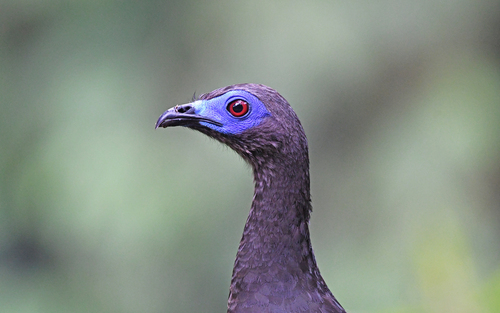
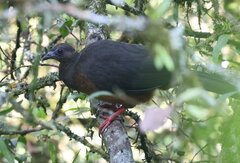
The sickle-winged guan is 50 to 65 cm (1.64 to 2.13 ft) long and weighs 550 to 800 g (1.21 to 1.76 lb). Adults of the nominate subspecies have a brown head and neck, dark upperparts, bright chestnut belly, pale blue facial skin, and red eyes. Wikipedia →

Sounds

Wing rattle0:29

Ecuador · 2014

© Leonardo Ordóñez-Delgado · XC467758 · CC BY-NC-SA 4.0

Song0:36

Colombia · 2016

© A Edwar H Guarín · XC311822 · CC BY-NC-SA 4.0

Alarm call0:17

Ecuador · 1997

© Olaf Jahn · XC261553 · CC BY-NC-SA 4.0

Global Distribution

Parks Where Found

# Park Country Daily sighting probability
1 Los Nevados National Natural Park 🇨🇴 Colombia
~30%
2 Farallones de Cali National Natural Park 🇨🇴 Colombia
~20%
3 Podocarpus National Park 🇪🇨 Ecuador
~10%
4 Chingaza National Natural Park 🇨🇴 Colombia
<5%

Cities Where Found

# City Country Daily sighting probability
1 Medellín 🇨🇴 Colombia
<5%

Zoos & Centres Where Found

# Zoo / Centre Country
1 Amaru 🇪🇨 Ecuador In captivity
2 Ecozoológico San Martín 🇪🇨 Ecuador In captivity

Before you go

What are the chances of seeing a Sickle-winged Guan in Podocarpus National Park?

With luck

About 10% of wildlife watchers report a Sickle-winged Guan sighting in Podocarpus National Park on a given day, based on 143 verified sightings from GBIF citizen-science data from 2019 to 2026. It is the 133rd most-seen of the 446 birds we can rate there. Over three days the chance rises to about 30%, and over a week to about 50%, if each day is a fresh chance.

When is the best time to see a Sickle-winged Guan in Podocarpus National Park?

May, August and November

In those months about 20% of wildlife watchers report a Sickle-winged Guan in Podocarpus National Park on a given day, against under 5% in February–April and December, the lowest months.

What time of day is best to see a Sickle-winged Guan?

Between 6 and 9 am

Across all the parks we cover, that three-hour window holds the most Sickle-winged Guan sightings with a recorded time, and about 9 in 10 of them come between 6 am and 6 pm: it is a daytime animal.

Which relatives of the Sickle-winged Guan live in Podocarpus National Park?

Same family: Cracidae

The closest relatives of the Sickle-winged Guan that you can see in Podocarpus National Park (family Cracidae, Guans, Chachalacas, and Curassows) are Bearded Guan (about 40%) and Speckled Chachalaca (about 20%), with each one's daily chance of a sighting.

Where does the Sickle-winged Guan sighting chance come from?

GBIF citizen-science records

It is estimated from how often the Sickle-winged Guan is recorded against all the birds logged in Podocarpus National Park (143 verified sightings from 2019 to 2026), calibrated against known sighting rates. Figures are rounded to the nearest 10% because citizen-science data supports honest approximations, not decimals, and months with records from fewer than five people show "—". How it works.

← Back to Podocarpus National Park