Blue-rumped Manakin

Blue-rumped Manakin

Lepidothrix isidorei

Silhouette: Edwin Price · PhyloPic

LCLeast ConcernNTVUENCR
Daily sighting probability ~10% · With luck
at Podocarpus National Park

In 3 days ~20% in a week ~40%

105 Verified sightings at Podocarpus National Park From 2019 to 2026
105 In 1 park
July Best month
☀️ Diurnal When it's spotted

About the Blue-rumped Manakin

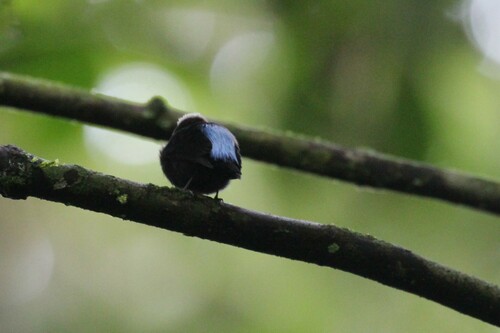
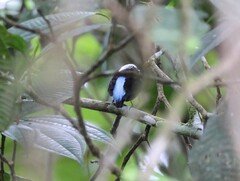
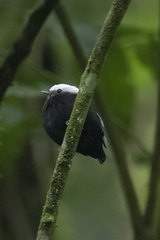
The blue-rumped manakin (Lepidothrix isidorei) is a species of bird in the family Pipridae. It is found in Colombia, Ecuador, and Peru. The blue-rumped manakin was originally described in 1852 as Pipra isidorei. By the late 1900s genus Lepidothrix was recognized as separate from Pipra and several species including the blue-rumped manakin were assigned to it.

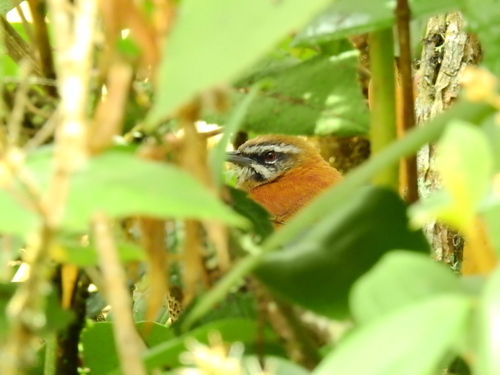
Some authors have suggested that both should be treated as full species. The blue-rumped manakin and the cerulean-capped manakin (L. coeruleocapilla) are sister species. The blue-rumped manakin is about 7.5 to 8.5 cm (3.0 to 3.3 in) long. The species is sexually dimorphic. Adult males of the nominate subspecies have a shiny white crown and upper nape and an azure rump and uppertail coverts. The rest of their plumage is black. Adult females have green upperparts whose color is brightest on the rump. Their tail is dusky. They have a mostly pale yellowish gray face and a gray throat. Their breast is a duller green than their back and their belly is yellowish... Wikipedia →

Sounds

Call0:19

Colombia · 2020

© Mauricio Cuellar Ramirez (@Birding.travel) · XC611094 · CC BY-NC-SA 4.0

Song0:15

Ecuador · 1999

© Mitch Lysinger · XC261000 · CC BY-NC-SA 4.0

Call0:07

Ecuador · 1999

© John V. Moore · XC259101 · CC BY-NC-SA 4.0

Global Distribution

Parks Where Found

# Park Country Daily sighting probability
1 Podocarpus National Park 🇪🇨 Ecuador
~10%

More parks will be added in future updates.

Before you go

What are the chances of seeing a Blue-rumped Manakin in Podocarpus National Park?

With luck

About 10% of wildlife watchers report a Blue-rumped Manakin sighting in Podocarpus National Park on a given day, based on 105 verified sightings from GBIF citizen-science data from 2019 to 2026. It is the 152nd most-seen of the 446 birds we can rate there. Over three days the chance rises to about 20%, and over a week to about 40%, if each day is a fresh chance.

When is the best time to see a Blue-rumped Manakin in Podocarpus National Park?

February and July

In those months about 20% of wildlife watchers report a Blue-rumped Manakin in Podocarpus National Park on a given day, against under 5% in March and October–November, the lowest months.

What time of day is best to see a Blue-rumped Manakin?

Between 2 and 5 pm

Across all the parks we cover, that three-hour window holds the most Blue-rumped Manakin sightings with a recorded time, and about 8 in 10 of them come between 6 am and 6 pm: it is a daytime animal.

Where else can you see a Blue-rumped Manakin?

Only Podocarpus National Park, in our data

Podocarpus National Park is the only park on Wallace's Line with enough records to rate Blue-rumped Manakin sightings: about 10% of wildlife watchers there report one on a given day.

Where does the Blue-rumped Manakin sighting chance come from?

GBIF citizen-science records

It is estimated from how often the Blue-rumped Manakin is recorded against all the birds logged in Podocarpus National Park (105 verified sightings from 2019 to 2026), calibrated against known sighting rates. Figures are rounded to the nearest 10% because citizen-science data supports honest approximations, not decimals, and months with records from fewer than five people show "—". How it works.

← Back to Podocarpus National Park