Golden-headed Manakin

Golden-headed Manakin

Pipra erythrocephala

Silhouette: Edwin Price · PhyloPic

LCLeast ConcernNTVUENCR
Daily sighting probability ~10% · With luck
at Podocarpus National Park

In 3 days ~20% in a week ~40%

91 Verified sightings at Podocarpus National Park From 2019 to 2026
1,125 In all 10 parks
July Best month
☀️ Diurnal When it's spotted

About the Golden-headed Manakin

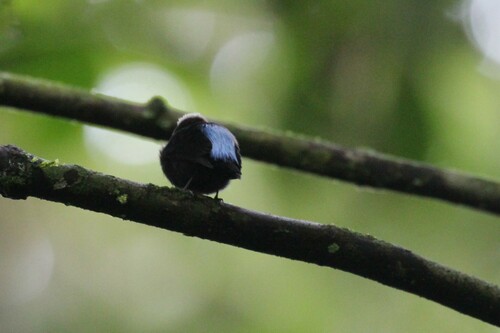
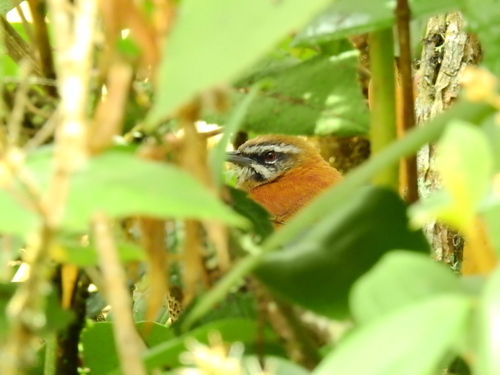
The golden-headed manakin (Ceratopipra erythrocephala) is a small passerine bird which breeds in tropical Central and South America in both wet and dry forests, secondary growth and plantations. It is a small manakin, about 9.4 centimetres (3.7 in) long. Males are entirely black apart from a golden head, yellow bill, white and red thighs and pink legs. Females and juveniles are olive-green with pink legs. At breeding time, males are involved in a cooperative lekking behaviour during which they jump, slide and dart from perch to perch. This is a fairly common species with a wide range, and the International Union for Conservation of Nature has rated its conservation status as being of "least concern".

The golden-headed manakin was formally described in 1758 by the Swedish naturalist Carl Linnaeus in the tenth edition of his Systema Naturae under the binomial name Parus erythrocephalus. Linnaeus based his account on the "Golden-headed black tit-mouse" that had been described and illustrated in 1743 by the English naturalist George Edwards in his book A Natural History of Uncommon Birds. Edwards had sketched a mounted specimen that belonged to Charles Lennox, the 2nd Duke... Wikipedia →

Sounds

Call1:18

Ecuador · 2025

© Marc Anderson · XC995518 · CC BY-NC-ND 4.0

Song0:40

Brazil · 2022

© Ricardo Gagliardi · XC836991 · CC BY-NC-SA 4.0

Recording0:20

Colombia · 2001

© Mauricio Álvarez-Rebolledo (Colección de Sonidos Ambientales - Instituto Humboldt) · XC525499 · CC BY-NC-SA 4.0

Global Distribution

Parks Where Found

# Park Country Daily sighting probability
1 Darién National Park 🇵🇦 Panama
~40%
2 Brownsberg Nature Park 🇸🇷 Suriname
~40%
3 Sierra de la Macarena National Park 🇨🇴 Colombia
~20%
4 Amacayacu National Natural Park 🇨🇴 Colombia
~20%
5 Henri Pittier National Park 🇻🇪 Venezuela
~10%
6 Podocarpus National Park 🇪🇨 Ecuador
~10%
7 Yasuní National Park 🇪🇨 Ecuador
~10%
8 Cuyabeno Wildlife Reserve 🇪🇨 Ecuador
~10%
9 Anavilhanas National Park 🇧🇷 Brazil
<5%
10 Tayrona National Natural Park 🇨🇴 Colombia
<5%

Zoos & Centres Where Found

# Zoo / Centre Country
1 California Academy of Sciences 🇺🇸 United States In captivity
2 Zoo Pilsen 🇨🇿 Czechia In captivity
3 Dallas World Aquarium 🇺🇸 United States In captivity

Before you go

What are the chances of seeing a Golden-headed Manakin in Podocarpus National Park?

With luck

About 10% of wildlife watchers report a Golden-headed Manakin sighting in Podocarpus National Park on a given day, based on 91 verified sightings from GBIF citizen-science data from 2019 to 2026. It is the 166th most-seen of the 446 birds we can rate there. Over three days the chance rises to about 20%, and over a week to about 40%, if each day is a fresh chance.

When is the best time to see a Golden-headed Manakin in Podocarpus National Park?

January, April–July and October–November

In those months about 10% of wildlife watchers report a Golden-headed Manakin in Podocarpus National Park on a given day, against under 5% in February–March, August–September and December, the lowest months.

What time of day is best to see a Golden-headed Manakin?

Between 8 and 11 am

Across all the parks we cover, that three-hour window holds the most Golden-headed Manakin sightings with a recorded time, and about 9 in 10 of them come between 6 am and 6 pm: it is a daytime animal.

Where does the Golden-headed Manakin sighting chance come from?

GBIF citizen-science records

It is estimated from how often the Golden-headed Manakin is recorded against all the birds logged in Podocarpus National Park (91 verified sightings from 2019 to 2026), calibrated against known sighting rates. Figures are rounded to the nearest 10% because citizen-science data supports honest approximations, not decimals, and months with records from fewer than five people show "—". How it works.

← Back to Podocarpus National Park