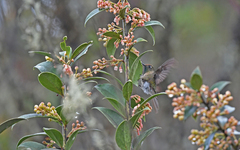
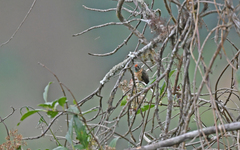

Rufous-capped Thornbill

Rufous-capped Thornbill

Chalcostigma ruficeps

Silhouette: Ferran Sayol · PhyloPic

LCLeast ConcernNTVUENCR
Daily sighting probability ~10% · With luck
at Podocarpus National Park

In 3 days ~30% in a week ~50%

155 Verified sightings at Podocarpus National Park From 2019 to 2026
155 In 1 park
January Best month
☀️ Diurnal When it's spotted

About the Rufous-capped Thornbill

The rufous-capped thornbill (Chalcostigma ruficeps) is a species of hummingbird in the "coquettes", tribe Lesbiini of subfamily Lesbiinae. It is found in Bolivia, Ecuador, and Peru. The taxonomy of genus Chalcostigma and of the rufous-capped thornbill in particular are unsettled. The South American Classification Committee (SACC) of the American Ornithological Society is considering a proposal to merge the genus into Oxypogon. The species was for a time placed in genus Metallura with the Perijá metaltail (M. iracunda) and also has been assigned its own genus, Selatopogon. The rufous-capped thornbill is monotypic.

The rufous-capped thornbill is about 10.5 cm (4.1 in) long and weighs 3.3 to 3.9 g (0.12 to 0.14 oz). Both sexes have a very short black bill. The male's crown is mahogany red and the rest of the upperparts bottle green. It has a narrow emerald green gorget with a border of various shades of yellow. Its underparts are rufous with green mottling that is strongest on the flanks. The tail is dull olive green. The female's upperparts including the crown are bottle green. Its throat and breast are ochre-orange with olive green dots... Wikipedia →

Sounds

Song0:10

Ecuador · 2018

© Hans Matheve · XC512794 · CC BY-NC-ND 4.0

Call0:15

Ecuador · 2003

© Niels Krabbe · XC238121 · CC BY-NC-SA 3.0

Song0:15

Ecuador · 2003

© Lelis Navarrete · XC364170 · CC BY-NC-SA 4.0

Global Distribution

Parks Where Found

# Park Country Daily sighting probability
1 Podocarpus National Park 🇪🇨 Ecuador
~10%

More parks will be added in future updates.

Before you go

What are the chances of seeing a Rufous-capped Thornbill in Podocarpus National Park?

With luck

About 10% of wildlife watchers report a Rufous-capped Thornbill sighting in Podocarpus National Park on a given day, based on 155 verified sightings from GBIF citizen-science data from 2019 to 2026. It is the 132nd most-seen of the 446 birds we can rate there. Over three days the chance rises to about 30%, and over a week to about 50%, if each day is a fresh chance.

When is the best time to see a Rufous-capped Thornbill in Podocarpus National Park?

January and February

In those months about 20% of wildlife watchers report a Rufous-capped Thornbill in Podocarpus National Park on a given day, against under 5% in April–July and November–December, the lowest months.

What time of day is best to see a Rufous-capped Thornbill?

Between 9 am and noon

Across all the parks we cover, that three-hour window holds the most Rufous-capped Thornbill sightings with a recorded time, and about 9 in 10 of them come between 6 am and 6 pm: it is a daytime animal.

Where else can you see a Rufous-capped Thornbill?

Only Podocarpus National Park, in our data

Podocarpus National Park is the only park on Wallace's Line with enough records to rate Rufous-capped Thornbill sightings: about 10% of wildlife watchers there report one on a given day.

Where does the Rufous-capped Thornbill sighting chance come from?

GBIF citizen-science records

It is estimated from how often the Rufous-capped Thornbill is recorded against all the birds logged in Podocarpus National Park (155 verified sightings from 2019 to 2026), calibrated against known sighting rates. Figures are rounded to the nearest 10% because citizen-science data supports honest approximations, not decimals, and months with records from fewer than five people show "—". How it works.

← Back to Podocarpus National Park