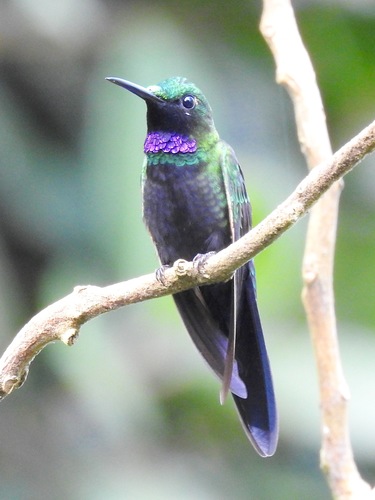
Fawn-breasted Brilliant

Fawn-breasted Brilliant

Heliodoxa rubinoides

Silhouette: PhyloPic

LCLeast ConcernNTVUENCR
Daily sighting probability ~20% · Possible
at Podocarpus National Park

In 3 days ~50% in a week ~80%

338 Verified sightings at Podocarpus National Park From 2019 to 2026
753 In all 3 parks
March Best month
☀️ Diurnal When it's spotted

About the Fawn-breasted Brilliant

The fawn-breasted brilliant (Heliodoxa rubinoides) is a medium-sized species of hummingbird in the family Trochilidae. It is native to South America, where it occurs in Bolivia, Colombia, Ecuador, and Peru. Other common names include lilac-throated brilliant in English and brillante pechigamuza, colibrí de vientre ocre, and diamante pechigamuza in Spanish.

The fawn-breasted brilliant was originally described as Trochilus rubinoides by French naturalists Jules Bourcier and Étienne Mulsant in 1846, with the type locality given as Colombia. It was later moved to the genus Heliodoxa, which was introduced by John Gould in 1850. The genus name Heliodoxa derives from the Greek words hēlios ("sun") and doxa ("glory"), while the specific epithet rubinoides combines the Latin rubinus ("ruby-red") with the Greek suffix -oidēs ("resembling"), referring to the male's pink throat patch.

There are three recognized subspecies: Heliodoxa rubinoides rubinoides (Bourcier & Mulsant, 1846) – Central and Eastern Andes of Colombia. Heliodoxa rubinoides aequatorialis (Gould, 1860) – Western slope of the Andes from western Colombia (Antioquia) south to western Ecuador (Pichincha to El Oro and... Wikipedia →

Sounds

Call0:05

Ecuador · 2024

© Manuel Sánchez-Nivicela · XC1152571 · CC BY-NC-ND 4.0

Song0:20

Ecuador · 1997

© Mitch Lysinger · XC260497 · CC BY-NC-SA 4.0

Call0:16

Colombia · 2020

© Jerome Fischer · XC574804 · CC BY-NC-SA 4.0

Global Distribution

Parks Where Found

# Park Country Daily sighting probability
1 Podocarpus National Park 🇪🇨 Ecuador
~20%
2 Farallones de Cali National Natural Park 🇨🇴 Colombia
~10%
3 Los Nevados National Natural Park 🇨🇴 Colombia
<5%

Before you go

What are the chances of seeing a Fawn-breasted Brilliant in Podocarpus National Park?

Possible

About 20% of wildlife watchers report a Fawn-breasted Brilliant sighting in Podocarpus National Park on a given day, based on 338 verified sightings from GBIF citizen-science data from 2019 to 2026. It is the 50th most-seen of the 446 birds we can rate there. Over three days the chance rises to about 50%, and over a week to about 80%, if each day is a fresh chance.

When is the best time to see a Fawn-breasted Brilliant in Podocarpus National Park?

March and October

In those months about 30% of wildlife watchers report a Fawn-breasted Brilliant in Podocarpus National Park on a given day, against under 5% in September, the lowest month.

What time of day is best to see a Fawn-breasted Brilliant?

Between 8 and 11 am

Across all the parks we cover, that three-hour window holds the most Fawn-breasted Brilliant sightings with a recorded time, and about 9 in 10 of them come between 6 am and 6 pm: it is a daytime animal.

Where does the Fawn-breasted Brilliant sighting chance come from?

GBIF citizen-science records

It is estimated from how often the Fawn-breasted Brilliant is recorded against all the birds logged in Podocarpus National Park (338 verified sightings from 2019 to 2026), calibrated against known sighting rates. Figures are rounded to the nearest 10% because citizen-science data supports honest approximations, not decimals, and months with records from fewer than five people show "—". How it works.

← Back to Podocarpus National Park