
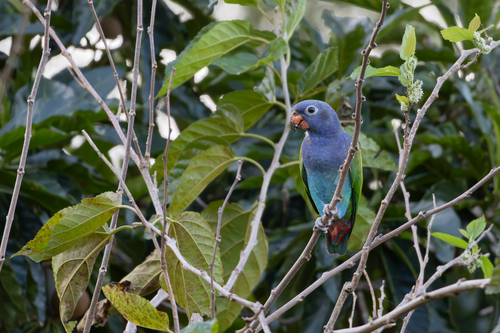
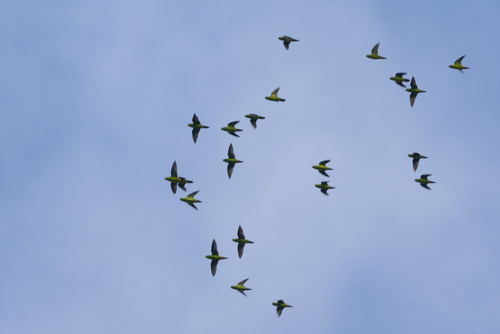
White-necked Parakeet

White-necked Parakeet

Pyrrhura albipectus

Silhouette: Sheatherius · PhyloPic

LCNTVUVulnerableENCR
Daily sighting probability ~20% · Possible
at Podocarpus National Park

In 3 days ~40% in a week ~70%

250 Verified sightings at Podocarpus National Park From 2019 to 2026
250 In 1 park
September Best month
☀️ Diurnal When it's spotted

About the White-necked Parakeet

The white-breasted parakeet (Pyrrhura albipectus) or white-necked parakeet, is a Vulnerable species of bird in subfamily Arinae of the family Psittacidae, the African and New World parrots. It is found in southern Ecuador and possibly in adjacent northern Peru.

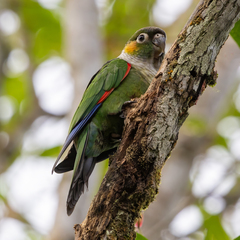
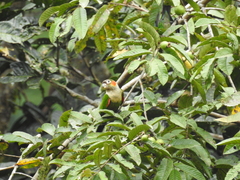
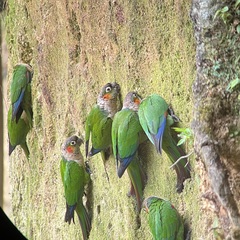
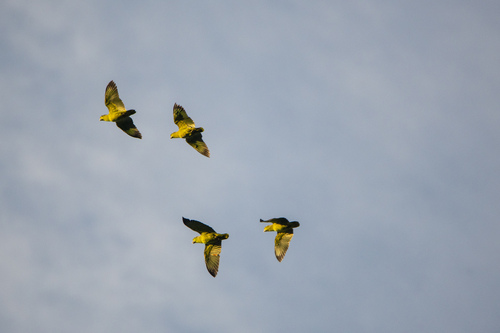
The white-breasted parakeet is monotypic. The white-breasted parakeet is 24 to 25.5 cm (9.4 to 10 in) long and weighs 83 to 110 g (2.9 to 3.9 oz). The sexes are the same. Adults have a thin reddish brown band just above the bill and are brownish from forehead to hindcrown; the crown feathers have gray edges. Their cheeks are green with yellow giving a scaly appearance and their ear coverts are orange. A wide white collar surrounds their neck and the rest of their upperparts are green. Their breast is yellow and the rest of their underparts are green with a rusty tone on the belly. Their wing is mostly green with red primary coverts and dark bluish primaries. The upper side of their tail is dull reddish with a green base and the underside dusky with reddish tips to the feathers. Their bill is blackish and their iris is dark with bare white or whitish skin surrounding it. Immature... Wikipedia →

Sounds

Call0:29

Ecuador · 2018

© Hans Matheve · XC512947 · CC BY-NC-ND 4.0

Alarm call1:00

Ecuador · 2015

© Leonardo Ordóñez-Delgado · XC294105 · CC BY-NC-SA 4.0

Flight call0:18

Ecuador · 1991

© Niels Krabbe · XC238957 · CC BY-NC-SA 3.0

Global Distribution

Parks Where Found

# Park Country Daily sighting probability
1 Podocarpus National Park 🇪🇨 Ecuador
~20%

More parks will be added in future updates.

Before you go

What are the chances of seeing a White-necked Parakeet in Podocarpus National Park?

Possible

About 20% of wildlife watchers report a White-necked Parakeet sighting in Podocarpus National Park on a given day, based on 250 verified sightings from GBIF citizen-science data from 2019 to 2026. It is the 81st most-seen of the 446 birds we can rate there. Over three days the chance rises to about 40%, and over a week to about 70%, if each day is a fresh chance.

When is the best time to see a White-necked Parakeet in Podocarpus National Park?

September

In that month about 30% of wildlife watchers report a White-necked Parakeet in Podocarpus National Park on a given day, against under 5% in October, the lowest month.

What time of day is best to see a White-necked Parakeet?

Between 8 and 11 am

Across all the parks we cover, that three-hour window holds the most White-necked Parakeet sightings with a recorded time, and about 8 in 10 of them come between 6 am and 6 pm: it is a daytime animal.

Where else can you see a White-necked Parakeet?

Only Podocarpus National Park, in our data

Podocarpus National Park is the only park on Wallace's Line with enough records to rate White-necked Parakeet sightings: about 20% of wildlife watchers there report one on a given day.

Which relatives of the White-necked Parakeet live in Podocarpus National Park?

Same family: Psittacidae

The closest relatives of the White-necked Parakeet that you can see in Podocarpus National Park (family Psittacidae, New World and African Parrots) are Golden-plumed Parakeet (about 30%), Scaly-naped Parrot (about 20%) and Speckle-faced Parrot (about 10%), with each one's daily chance of a sighting.

Where does the White-necked Parakeet sighting chance come from?

GBIF citizen-science records

It is estimated from how often the White-necked Parakeet is recorded against all the birds logged in Podocarpus National Park (250 verified sightings from 2019 to 2026), calibrated against known sighting rates. Figures are rounded to the nearest 10% because citizen-science data supports honest approximations, not decimals, and months with records from fewer than five people show "—". How it works.

← Back to Podocarpus National Park