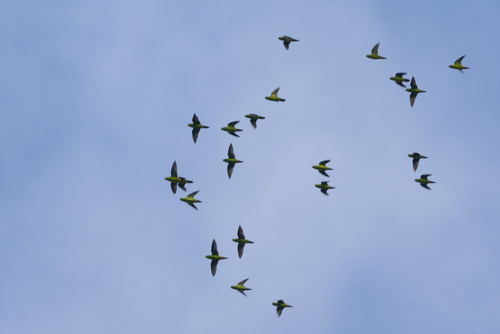

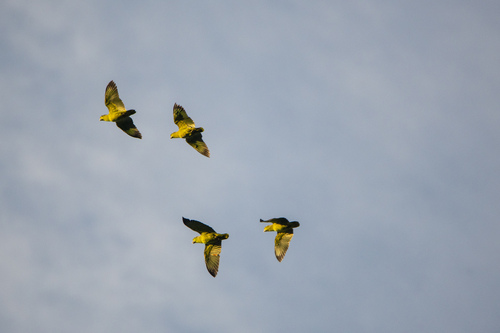
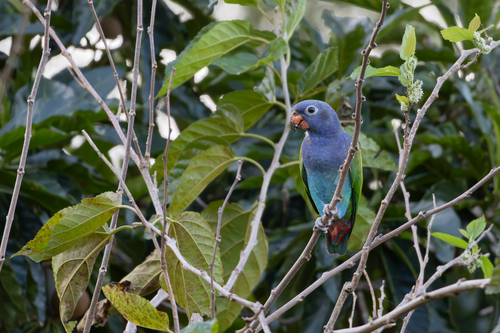
Barred Parakeet

Barred Parakeet

Bolborhynchus lineola

Silhouette: Sheatherius · PhyloPic

LCLeast ConcernNTVUENCR
Daily sighting probability <5% · Rare
at Podocarpus National Park

In 3 days <5% in a week ~10%

14 Verified sightings at Podocarpus National Park From 2019 to 2026
2,832 In all 15 parks
July Best month
☀️ Diurnal When it's spotted

About the Barred Parakeet

The barred parakeet (Bolborhynchus lineola), also known as the lineolated parakeet (commonly nicknamed the "linnie") or the Catherine parakeet, is a small psittaciforme bird found in the highland forests of tropical Latin America. Its plumage is mostly green, with multiple black or dark green stripes and bars and a pale, peach-colored bill. The darker stripes vary in prominence and intensity between the two subspecies. Several color mutations (morphs) are available in aviculture, as it has become a popular captive bird species.

The species has a disjunct distribution, found from southern México south through Panamá; in South America, it is found both in the Santa Marta Mountains of Colombia and the Venezuelan Coastal Range, as well as the forests of the Andean foothills (from western Venezuela south to Perú and Bolivia).

It is mostly green and has black stripes (or bars... Wikipedia →

Sounds

Flight call0:04

Ecuador · 2025

© Manuel Sánchez-Nivicela · XC1010431 · CC BY-NC-ND 4.0

Call0:09

Ecuador · 2012

© Andrew Spencer · XC97675 · CC BY-NC-ND 2.5

Flight call0:27

Peru · 2022

© Fabrice Schmitt · XC814380 · CC BY-NC-SA 4.0

Global Distribution

Parks Where Found

# Park Country Daily sighting probability
1 Volcán Barú National Park 🇵🇦 Panama
~10%
2 Tapantí-Macizo de la Muerte National Park 🇨🇷 Costa Rica
~10%
3 Los Quetzales National Park 🇨🇷 Costa Rica
~10%
4 Cusuco National Park 🇭🇳 Honduras
~10%
5 La Amistad International Park (Panama) 🇵🇦 Panama
<5%
6 Chirripó National Park 🇨🇷 Costa Rica
<5%
7 Braulio Carrillo National Park 🇨🇷 Costa Rica
<5%
8 Irazú Volcano National Park 🇨🇷 Costa Rica
<5%
9 Celaque National Park 🇭🇳 Honduras
<5%
10 Poás Volcano National Park 🇨🇷 Costa Rica
<5%
11 Los Nevados National Natural Park 🇨🇴 Colombia
<5%
12 Podocarpus National Park 🇪🇨 Ecuador
<5%
13 Farallones de Cali National Natural Park 🇨🇴 Colombia
<5%
14 Monteverde Cloud Forest Reserve 🇨🇷 Costa Rica
<5%
15 Arenal Volcano National Park 🇨🇷 Costa Rica
<5%

Cities Where Found

# City Country Daily sighting probability
1 Guatemala City 🇬🇹 Guatemala
<5%
2 San José 🇨🇷 Costa Rica
<5%

Before you go

What are the chances of seeing a Barred Parakeet in Podocarpus National Park?

Rare

Under 5% of wildlife watchers report a Barred Parakeet sighting in Podocarpus National Park on a given day, based on 14 verified sightings from GBIF citizen-science data from 2019 to 2026. It is the 341st most-seen of the 446 birds we can rate there. Over three days the chance rises to under 5%, and over a week to about 10%, if each day is a fresh chance.

When is the best time to see a Barred Parakeet in Podocarpus National Park?

July

In that month about 10% of wildlife watchers report a Barred Parakeet in Podocarpus National Park on a given day, against under 5% in August to June, the lowest months.

What time of day is best to see a Barred Parakeet?

Between 3 and 6 pm

Across all the parks we cover, that three-hour window holds the most Barred Parakeet sightings with a recorded time, and about 8 in 10 of them come between 6 am and 6 pm: it is a daytime animal.

Which relatives of the Barred Parakeet live in Podocarpus National Park?

Same family: Psittacidae

The closest relatives of the Barred Parakeet that you can see in Podocarpus National Park (family Psittacidae, New World and African Parrots) are Golden-plumed Parakeet (about 30%), Scaly-naped Parrot (about 20%) and White-necked Parakeet (about 20%), with each one's daily chance of a sighting.

Where does the Barred Parakeet sighting chance come from?

GBIF citizen-science records

It is estimated from how often the Barred Parakeet is recorded against all the birds logged in Podocarpus National Park (14 verified sightings from 2019 to 2026), calibrated against known sighting rates. Figures are rounded to the nearest 10% because citizen-science data supports honest approximations, not decimals, and months with records from fewer than five people show "—". How it works.

← Back to Podocarpus National Park