Cypress Jewel Beetle

Cypress Jewel Beetle

Lamprodila festiva

Daily sighting probability <5% · Rare
at Pyrénées National Park

In 3 days ~10% in a week ~20%

6 Verified sightings at Pyrénées National Park From 2019 to 2026
6 In 1 park
June Best month
☀️ Diurnal When it's spotted

About the Cypress Jewel Beetle

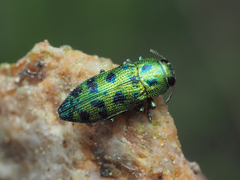
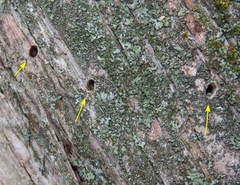
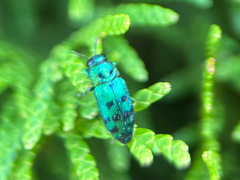
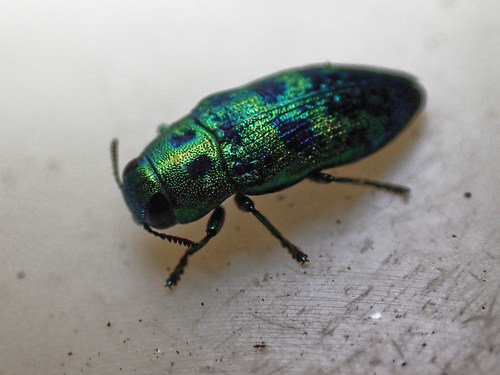
Lamprodila festiva, known as the juniper jewel beetle, is a European species of metallic wood-boring beetles associated with Cupressaceae trees. It is native to the Mediterranean region and during the 21st century, it has been rapidly spreading northward. It is considered a serious invasive pest of ornamental conifers.

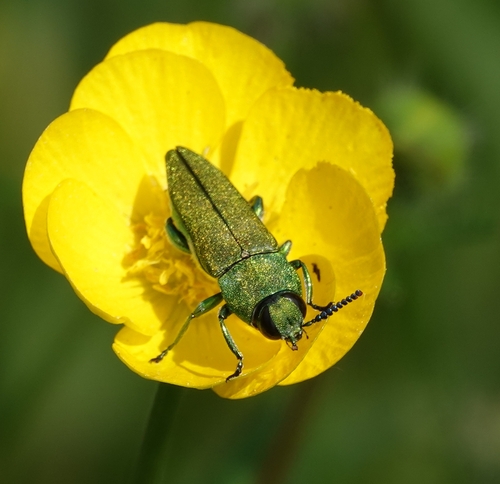
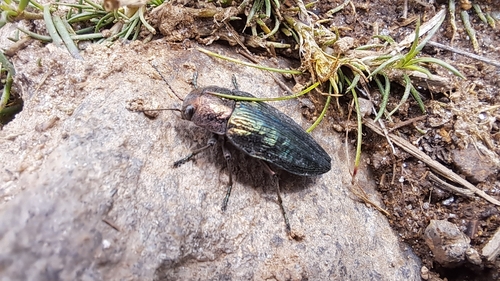
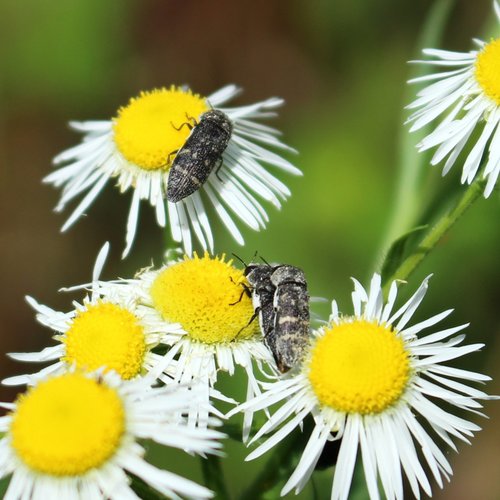
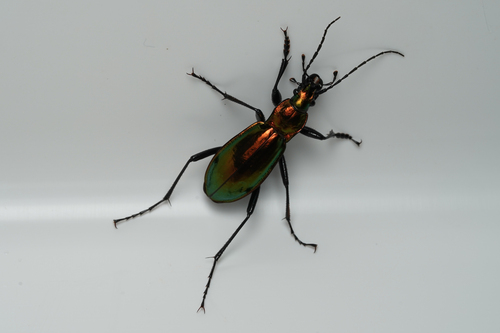
The adult beetles are 6-12 mm long, metallic green with steel blue spots on the shield and elytra. The legless larvae are 15-20 mm long, cream colored, with strongly sclerotized mandibles and a strongly broadened anterior part of the thoracic segment.

The species is native to North Africa (Morocco, Algeria, Tunisia, Libya), Mediterannean Europe (Spain, France, Italy, Croatia, Greece, etc.), and Mediterannean West Asia (Turkey, Lebanon). Starting in early 2000s, it has been observed in more northerly locations across Europe and by 2020s, it has reached as far north as Belgium, Czechia, Poland, and Ukraine. Its spread is likely connected to climate change.

Lamprodila rutilans Emerald ash borer Wikipedia →
Global Distribution

Parks Where Found

# Park Country Daily sighting probability
1 Pyrénées National Park 🇫🇷 France
<5%

More parks will be added in future updates.

Cities Where Found

# City Country Daily sighting probability
1 Warsaw 🇵🇱 Poland
<5%
2 Kyiv 🇺🇦 Ukraine
<5%
3 Vienna 🇦🇹 Austria
<5%
4 Paris 🇫🇷 France
<5%
5 Prague 🇨🇿 Czechia
<5%
6 Berlin 🇩🇪 Germany
<5%

Before you go

What are the chances of seeing a Cypress Jewel Beetle in Pyrénées National Park?

Rare

Under 5% of wildlife watchers report a Cypress Jewel Beetle sighting in Pyrénées National Park on a given day, based on 6 verified sightings from GBIF citizen-science data from 2019 to 2026. It is the 1026th most-seen of the 1277 insects we can rate there. Over three days the chance rises to about 10%, and over a week to about 20%, if each day is a fresh chance.

When is the best time to see a Cypress Jewel Beetle in Pyrénées National Park?

June

In that month about 10% of wildlife watchers report a Cypress Jewel Beetle in Pyrénées National Park on a given day, against under 5% in July to May, the lowest months.

What time of day is best to see a Cypress Jewel Beetle?

Between 10 am and 1 pm

Across all the parks we cover, that three-hour window holds the most Cypress Jewel Beetle sightings with a recorded time, and about 8 in 10 of them come between 6 am and 6 pm: it is a daytime animal.

Where else can you see a Cypress Jewel Beetle?

Only Pyrénées National Park, in our data

Pyrénées National Park is the only park on Wallace's Line with enough records to rate Cypress Jewel Beetle sightings: under 5% of wildlife watchers there report one on a given day.

Where does the Cypress Jewel Beetle sighting chance come from?

GBIF citizen-science records

It is estimated from how often the Cypress Jewel Beetle is recorded against all the insects logged in Pyrénées National Park (6 verified sightings from 2019 to 2026), calibrated against known sighting rates. Figures are rounded to the nearest 10% because citizen-science data supports honest approximations, not decimals, and months with records from fewer than five people show "—". How it works.

← Back to Pyrénées National Park