Purple Emperor
Daily sighting probability ~10% · With luck
at Pyrénées National Park

In 3 days ~20% in a week ~40%

31 Verified sightings at Pyrénées National Park From 2019 to 2026
123 In all 9 parks
July Best month
☀️ Diurnal When it's spotted

About the Purple Emperor

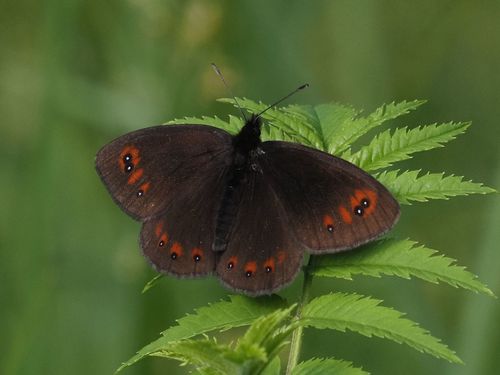
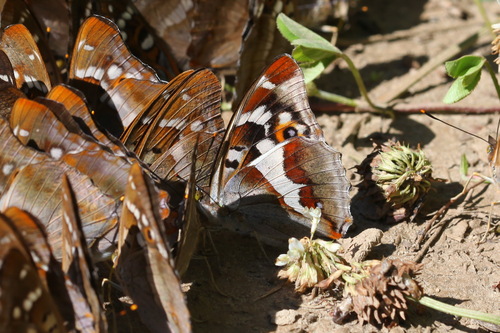
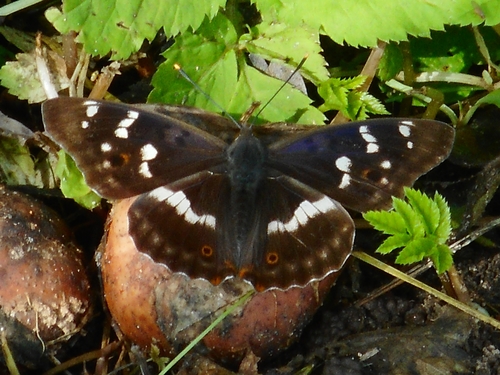
Apatura iris, the purple emperor, is a Palearctic butterfly of the family Nymphalidae. Adults have dark brown wings with white bands and spots, and a small orange ring on each of the hindwings. Males have a wingspan of 70–80 millimetres (2.8–3.1 in), and have a purple-blue sheen caused by iridescence that the slightly larger (80–92 mm) females lack. The larvae (caterpillars) are green with white and yellow markings, and have two large "horns" at the anterior end and a smaller one at the posterior.

Females spend most of their lives in the tree canopy, favouring dense and mature oak woodlands, coming down only to lay their eggs on the small willow bushes that grow in clearings and bridleways. Males also spend much of their time in the tree tops, defending their territory from rivals, though they will sometimes descend to drink from puddles or feed. Unlike most butterflies, the purple emperor does not feed from flowers but instead on the honeydew secreted by aphids, sap oozing from oak trees, and on dung, urine, and animal carcasses.

Richard South noted that collectors once used animal carcasses "in a somewhat advanced state of decay" to lure the males down... Wikipedia →
Global Distribution

Parks Where Found

# Park Country Daily sighting probability
1 Biebrza National Park 🇵🇱 Poland
~20%
2 Triglav National Park 🇸🇮 Slovenia
~20%
3 Tatra National Park 🇸🇰 Slovakia
~20%
4 Białowieża National Park 🇵🇱 Poland
~10%
5 Aigüestortes National Park 🇪🇸 Spain
~10%
6 Hohe Tauern National Park 🇦🇹 Austria
~10%
7 Bavarian Forest National Park 🇩🇪 Germany
~10%
8 Ecrins National Park 🇫🇷 France
~10%
9 Pyrénées National Park 🇫🇷 France
~10%

Cities Where Found

# City Country Daily sighting probability
1 Essen 🇩🇪 Germany
<5%
2 Yekaterinburg 🇷🇺 Russia
<5%
3 Moscow 🇷🇺 Russia
<5%

Before you go

What are the chances of seeing a Purple Emperor in Pyrénées National Park?

With luck

About 10% of wildlife watchers report a Purple Emperor sighting in Pyrénées National Park on a given day, based on 31 verified sightings from GBIF citizen-science data from 2019 to 2026. It is the 312th most-seen of the 1277 insects we can rate there. Over three days the chance rises to about 20%, and over a week to about 40%, if each day is a fresh chance.

When is the best time to see a Purple Emperor in Pyrénées National Park?

June to August

In those months about 10% of wildlife watchers report a Purple Emperor in Pyrénées National Park on a given day, against under 5% in September to May, the lowest months.

What time of day is best to see a Purple Emperor?

Between 10 am and 1 pm

Across all the parks we cover, that three-hour window holds the most Purple Emperor sightings with a recorded time, and nearly all of them come between 6 am and 6 pm: it is a daytime animal.

Is Pyrénées National Park the best place to see a Purple Emperor?

9th of 9

Of the 9 parks where we can rate Purple Emperor sightings, Pyrénées National Park ranks 9th at about 10%. The best odds are in Biebrza National Park (Poland, about 20%), Triglav National Park (Slovenia, about 20%) and Tatra National Park (Slovakia, about 20%).

Where does the Purple Emperor sighting chance come from?

GBIF citizen-science records

It is estimated from how often the Purple Emperor is recorded against all the insects logged in Pyrénées National Park (31 verified sightings from 2019 to 2026), calibrated against known sighting rates. Figures are rounded to the nearest 10% because citizen-science data supports honest approximations, not decimals, and months with records from fewer than five people show "—". How it works.

← Back to Pyrénées National Park