Ringed Carpet

Ringed Carpet

Cleora cinctaria

Daily sighting probability <5% · Rare
at Pyrénées National Park

In 3 days ~10% in a week ~20%

8 Verified sightings at Pyrénées National Park From 2019 to 2026
14 In all 2 parks
May Best month
☀️ Diurnal When it's spotted

About the Ringed Carpet

Cleora cinctaria, the ringed carpet, is a moth of the family Geometridae. The species was first described by Michael Denis and Ignaz Schiffermüller in 1775. It is found from Europe to southern Siberia, Turkey, the Caucasus, central Asia and Mongolia. It is also found in Japan.

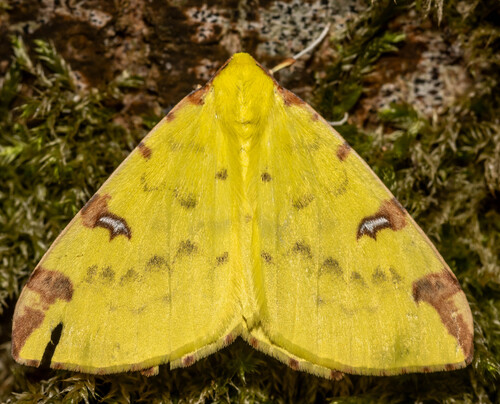
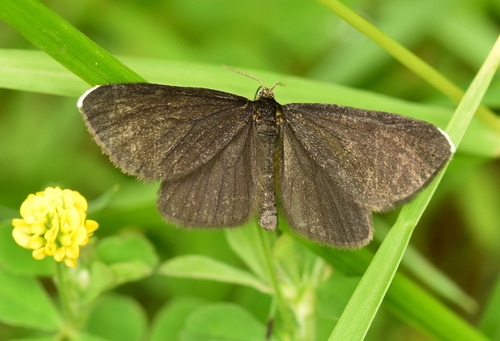
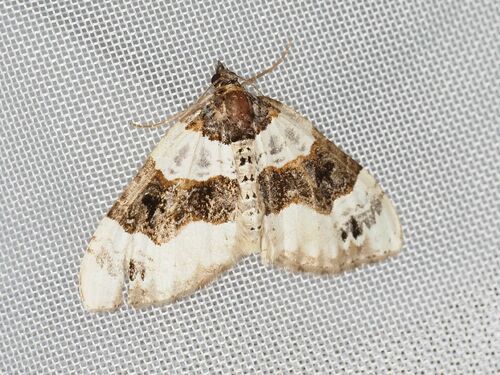
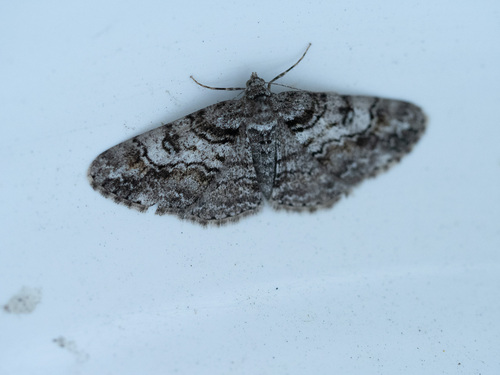
The wingspan is 28–35 mm. The wings have a light grey ground colour. The lines are brown. The intensity of the grey or brown colouration varies quite strongly. The interior crossline is band-like and widened basally, the exterior crossline is curved towards the front edge and is usually double. The brownish darkened margin has a white wavy line and white dusting. On the hindwings are dark lines and an often indistinct whitish squiggle. The first abdominal segment appears in the form of a white belt. The antennae of the males are combed on both sides, those of the females are filiform. Prout gives an account of named forma. The larva is smooth, light green with bluish green and white longitudinal lines.

Adults are on wing from April to May. The larvae feed various plants and trees, including Betula (including Betula verrucosa), Myrica gale, Carex, Salix, Populus tremula, Rubus idaeus, Sorbus aucuparia, Vicia cracca, Rhamnus frangula, Lysimachia vulgaris, Vaccinium myrtillus and Galium verum. Wikipedia →

Global Distribution

Parks Where Found

# Park Country Daily sighting probability
1 Cévennes National Park 🇫🇷 France
<5%
2 Pyrénées National Park 🇫🇷 France
<5%

Cities Where Found

# City Country Daily sighting probability
1 Nizhny Novgorod 🇷🇺 Russia
<5%
2 Helsinki 🇫🇮 Finland
<5%
3 Yekaterinburg 🇷🇺 Russia
<5%
4 Moscow 🇷🇺 Russia
<5%
5 Saint Petersburg 🇷🇺 Russia
<5%

Before you go

What are the chances of seeing a Ringed Carpet in Pyrénées National Park?

Rare

Under 5% of wildlife watchers report a Ringed Carpet sighting in Pyrénées National Park on a given day, based on 8 verified sightings from GBIF citizen-science data from 2019 to 2026. It is the 940th most-seen of the 1277 insects we can rate there. Over three days the chance rises to about 10%, and over a week to about 20%, if each day is a fresh chance.

When is the best time to see a Ringed Carpet in Pyrénées National Park?

April and May

In those months about 10% of wildlife watchers report a Ringed Carpet in Pyrénées National Park on a given day, against under 5% in June to March, the lowest months.

What time of day is best to see a Ringed Carpet?

Between 7 and 10 am

Across all the parks we cover, that three-hour window holds the most Ringed Carpet sightings with a recorded time, and about 9 in 10 of them come between 6 am and 6 pm: it is a daytime animal.

Is Pyrénées National Park the best place to see a Ringed Carpet?

Among the best

Of the 2 parks where we can rate Ringed Carpet sightings, Pyrénées National Park ranks 2nd at under 5%, level with the leaders once rounded. The best odds are in Cévennes National Park (France, under 5%).

Which relatives of the Ringed Carpet live in Pyrénées National Park?

Same family: Geometridae

The closest relatives of the Ringed Carpet that you can see in Pyrénées National Park (family Geometridae, Geometer Moths) are Latticed Heath (about 10%), Common Heath (about 10%) and Willow Beauty (about 10%), with each one's daily chance of a sighting.

Where does the Ringed Carpet sighting chance come from?

GBIF citizen-science records

It is estimated from how often the Ringed Carpet is recorded against all the insects logged in Pyrénées National Park (8 verified sightings from 2019 to 2026), calibrated against known sighting rates. Figures are rounded to the nearest 10% because citizen-science data supports honest approximations, not decimals, and months with records from fewer than five people show "—". How it works.

← Back to Pyrénées National Park