Black Coucal

Black Coucal

Centropus grillii

Silhouette: Nicolas Huet le Jeune and Jean-Gabriel Prêtre (vectorized by T. Michael Keesey) · PhyloPic

LCLeast ConcernNTVUENCR
Daily sighting probability <5% · Rare
at Queen Elizabeth National Park

In 3 days ~10% in a week ~30%

72 Verified sightings at Queen Elizabeth National Park From 2019 to 2026
704 In all 14 parks
February Best month
☀️ Diurnal When it's spotted

About the Black Coucal

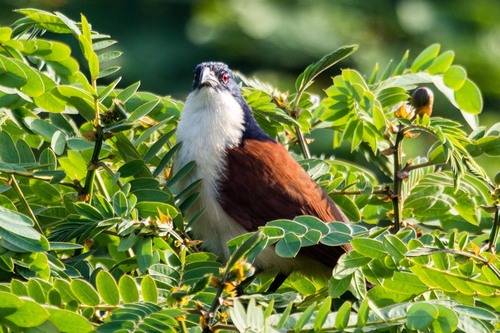
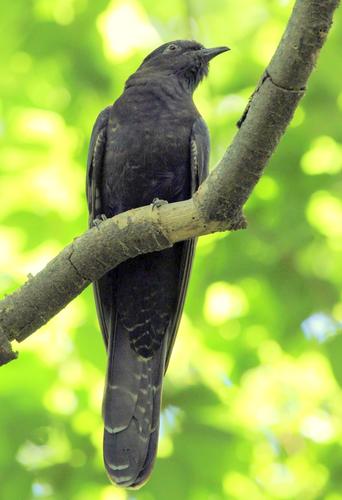
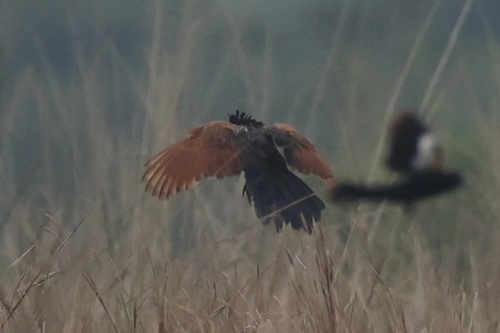
The black coucal (Centropus grillii) is a species of cuckoo in the family Cuculidae. It has a wide distribution in Africa south of the Sahara. The male black coucal is 30 cm (12 in) in length while the female is 34 cm (13 in), otherwise they are similar in appearance. In breeding plumage the head, body and tail are black, apart from some buff barring on the rump, and the wings are rufous. Outside the breeding season, the upper parts are dark brown with rufous barring. The eyes are brown and the beak and legs are black. Juveniles are rufous with various dark and light barring and streaking.

It is found in Angola, Benin, Botswana, Burkina Faso, Burundi, Cameroon, Central African Republic, Chad, Republic of the Congo, DRC, Ivory Coast, Eswatini, Ethiopia, Gabon, Gambia, Ghana, Guinea, Guinea-Bissau, Kenya, Liberia, Malawi, Mali, Mozambique, Namibia, Niger, Nigeria, Rwanda, Senegal, Sierra Leone, South Africa, Sudan, Tanzania, Togo, Uganda, Zambia, and Zimbabwe. It is resident in some locations and migrant in others. Its habitat is marshes, savannah, grassland, bracken, undergrowth, and clearings in woodland, and occasionally reeds and papyrus... Wikipedia →
Sounds

Song0:16

Zambia · 2026

© Magnus Wadstein · XC1101262 · CC BY-NC-SA 4.0

Call0:14

Uganda · 2022

© Peter Boesman · XC739493 · CC BY-NC-ND 4.0

Song0:07

Zambia · 2020

© Dries Van de Loock · XC547993 · CC BY-NC-SA 4.0

Global Distribution

Parks Where Found

# Park Country Daily sighting probability
1 Kidepo Valley National Park 🇺🇬 Uganda
~20%
2 Ruaha National Park 🇹🇿 Tanzania
~10%
3 Serengeti National Park 🇹🇿 Tanzania
~10%
4 Queen Elizabeth National Park 🇺🇬 Uganda
<5%
5 Akagera National Park 🇷🇼 Rwanda
<5%
6 Masai Mara National Reserve 🇰🇪 Kenya
<5%
7 Tarangire National Park 🇹🇿 Tanzania
<5%
8 Murchison Falls National Park 🇺🇬 Uganda
<5%
9 Moremi Game Reserve 🇧🇼 Botswana
<5%
10 Lake Mburo National Park 🇺🇬 Uganda
<5%
11 Amboseli National Park 🇰🇪 Kenya
<5%
12 Ngorongoro Conservation Area 🇹🇿 Tanzania
<5%
13 Kruger National Park 🇿🇦 South Africa
<5%
14 Chobe National Park 🇧🇼 Botswana
<5%

Cities Where Found

# City Country Daily sighting probability
1 Harare 🇿🇼 Zimbabwe
<5%
2 Kampala 🇺🇬 Uganda
<5%

Before you go

What are the chances of seeing a Black Coucal in Queen Elizabeth National Park?

Rare

Under 5% of wildlife watchers report a Black Coucal sighting in Queen Elizabeth National Park on a given day, based on 72 verified sightings from GBIF citizen-science data from 2019 to 2026. It is the 223rd most-seen of the 434 birds we can rate there. Over three days the chance rises to about 10%, and over a week to about 30%, if each day is a fresh chance.

When is the best time to see a Black Coucal in Queen Elizabeth National Park?

February, June–July, September and December

In those months about 10% of wildlife watchers report a Black Coucal in Queen Elizabeth National Park on a given day, against under 5% in January, March–May, August and October–November, the lowest months.

What time of day is best to see a Black Coucal?

Between 7 and 10 am

Across all the parks we cover, that three-hour window holds the most Black Coucal sightings with a recorded time, and about 9 in 10 of them come between 6 am and 6 pm: it is a daytime animal.

Is Queen Elizabeth National Park the best place to see a Black Coucal?

4th of 14

Of the 14 parks where we can rate Black Coucal sightings, Queen Elizabeth National Park ranks 4th at under 5%. The best odds are in Kidepo Valley National Park (Uganda, about 20%), Ruaha National Park (Tanzania, about 10%) and Serengeti National Park (Tanzania, about 10%).

Where does the Black Coucal sighting chance come from?

GBIF citizen-science records

It is estimated from how often the Black Coucal is recorded against all the birds logged in Queen Elizabeth National Park (72 verified sightings from 2019 to 2026), calibrated against known sighting rates. Figures are rounded to the nearest 10% because citizen-science data supports honest approximations, not decimals, and months with records from fewer than five people show "—". How it works.

← Back to Queen Elizabeth National Park