Double-Toothed Barbet

Double-Toothed Barbet

Lybius bidentatus

Silhouette: PhyloPic

Daily sighting probability ~30% · Possible
at Queen Elizabeth National Park

In 3 days ~60% in a week ~90%

410 Verified sightings at Queen Elizabeth National Park From 2019 to 2026
1,340 In all 9 parks
June Best month
☀️ Diurnal When it's spotted

About the Double-Toothed Barbet

The double-toothed barbet (Pogonornis bidentatus) is a species of bird in the family Lybiidae. It is found in Angola, Benin, Burundi, Cameroon, Central African Republic, Republic of the Congo, Democratic Republic of the Congo, Ivory Coast, Equatorial Guinea, Ethiopia, Gabon, Ghana, Guinea, Guinea-Bissau, Kenya, Liberia, Mali, Nigeria, Rwanda, Sierra Leone, South Sudan, Tanzania, Togo, and Uganda. Within Pogonornis bidentatus, there are two subspecies: Pogonornis bidentatus bidentatus and Pogonornis bidentatus aequatorialis.

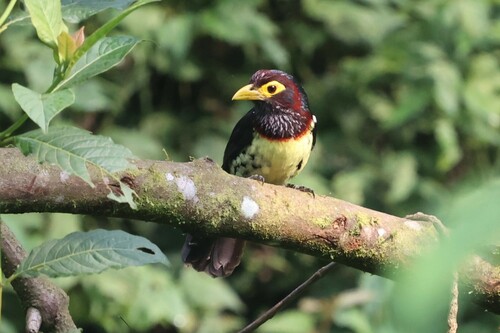
Pogonornis bidentatus is a barbet with black and red coloring. Its bill is large and off-white, and the skin around its eyes is yellow. The double-toothed barbet is black on the top side of its body with a patch of white feathers on its back. Its breast is red, with a white patch on its side. Females and males have similar markings, except that females have lines of black feathers on the white side patch. Juveniles of the species are duller; their feathers are dark grey.

Its song is somewhat like a cat's purr. Sometimes pairs of double-toothed barbets will sing together. Double-toothed barbets generally live in the understory of dense... Wikipedia →

Sounds

Song0:09

Uganda · 2018

© Andrew Spencer · XC433610 · CC BY-NC-ND 4.0

Call0:07

Kenya · 2016

© James Bradley · XC351294 · CC BY-NC-SA 4.0

Call0:08

Ethiopia · 2015

© Peter Boesman · XC300439 · CC BY-NC-ND 4.0

Global Distribution

Parks Where Found

# Park Country Daily sighting probability
1 Kibale National Park 🇺🇬 Uganda
~30%
2 Queen Elizabeth National Park 🇺🇬 Uganda
~30%
3 Lake Mburo National Park 🇺🇬 Uganda
~20%
4 Virunga National Park 🇨🇩 Democratic Republic of the Congo
~10%
5 Murchison Falls National Park 🇺🇬 Uganda
~10%
6 Akagera National Park 🇷🇼 Rwanda
~10%
7 Bwindi Impenetrable National Park 🇺🇬 Uganda
<5%
8 Masai Mara National Reserve 🇰🇪 Kenya
<5%
9 Serengeti National Park 🇹🇿 Tanzania
<5%

Cities Where Found

# City Country Daily sighting probability
1 Accra 🇬🇭 Ghana
~30%
2 Yaoundé 🇨🇲 Cameroon
~30%
3 Kampala 🇺🇬 Uganda
~20%
4 Kigali 🇷🇼 Rwanda
<5%

Zoos & Centres Where Found

# Zoo / Centre Country
1 Monkeyland 🇿🇦 South Africa In captivity
2 Birds of Eden 🇿🇦 South Africa In captivity

Before you go

What are the chances of seeing a Double-Toothed Barbet in Queen Elizabeth National Park?

Possible

About 30% of wildlife watchers report a Double-Toothed Barbet sighting in Queen Elizabeth National Park on a given day, based on 410 verified sightings from GBIF citizen-science data from 2019 to 2026. It is the 73rd most-seen of the 434 birds we can rate there. Over three days the chance rises to about 60%, and over a week to about 90%, if each day is a fresh chance.

When is the best time to see a Double-Toothed Barbet in Queen Elizabeth National Park?

June

In that month about 40% of wildlife watchers report a Double-Toothed Barbet in Queen Elizabeth National Park on a given day, against about 10% in January, the lowest month. That is one of Queen Elizabeth National Park's driest months, with about 35 mm of rain against 150 mm in April.

What time of day is best to see a Double-Toothed Barbet?

Between 6 and 9 am

Across all the parks we cover, that three-hour window holds the most Double-Toothed Barbet sightings with a recorded time, and about 8 in 10 of them come between 6 am and 6 pm: it is a daytime animal.

Is Queen Elizabeth National Park the best place to see a Double-Toothed Barbet?

Among the best

Of the 9 parks where we can rate Double-Toothed Barbet sightings, Queen Elizabeth National Park ranks 2nd at about 30%, level with the leaders once rounded. The best odds are in Kibale National Park (Uganda, about 30%).

Where does the Double-Toothed Barbet sighting chance come from?

GBIF citizen-science records

It is estimated from how often the Double-Toothed Barbet is recorded against all the birds logged in Queen Elizabeth National Park (410 verified sightings from 2019 to 2026), calibrated against known sighting rates. Figures are rounded to the nearest 10% because citizen-science data supports honest approximations, not decimals, and months with records from fewer than five people show "—". How it works.

← Back to Queen Elizabeth National Park