Pennant-winged Nightjar

Pennant-winged Nightjar

Caprimulgus vexillarius

Silhouette: Andy Wilson · PhyloPic

LCLeast ConcernNTVUENCR
Daily sighting probability <5% · Rare
at Queen Elizabeth National Park

In 3 days <5% in a week ~10%

16 Verified sightings at Queen Elizabeth National Park From 2019 to 2026
259 In all 12 parks
May Best month
🌅 Crepuscular When it's spotted

About the Pennant-winged Nightjar

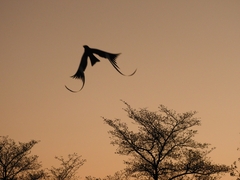
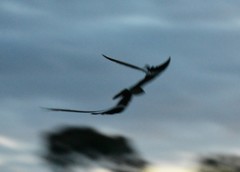
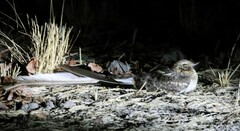
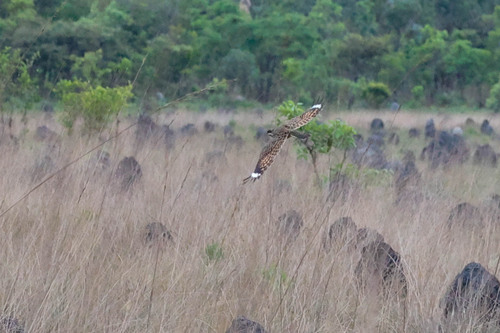
The pennant-winged nightjar (Caprimulgus vexillarius) is a species of nightjar that occurs from Nigeria to northern South Africa. It is an intra-African migrant and displays remarkable sexual dimorphism in the breeding season.

Their preferred habitat south of the equator is plateau woodlands, especially Miombo, where they are partial to stony or boulder-strewn hillsides. They are observed as bi-annual and social passage migrants along the Kenyan Rift Valley and Lake Victoria regions, and spend the non-breeding season in subtropical savanna from Nigeria to Sudan.

The male of the species is characteristic in having a broad white band over the otherwise black primaries. In addition the males acquire a striking 2nd primary feather during the breeding season. These pennant feathers grow to greater lengths in successive years, up to twice the body length. They are dropped or broken off quickly upon completion of breeding. With the distal (9th) and proximal (1st - 3rd) primaries being longest, the wings of male birds are distinctly angular.

Foraging birds emerge in the late afternoon or directly after sunset for crepuscular feeding and... Wikipedia →

Sounds

Song1:07

Zambia · 2024

© Dries Van de Loock · XC958776 · CC BY-NC-ND 4.0

Song0:52

Zambia · 2016

© Peter Boesman · XC339007 · CC BY-NC-ND 4.0

Global Distribution

Parks Where Found

# Park Country Daily sighting probability
1 Mana Pools National Park 🇿🇼 Zimbabwe
<5%
2 Murchison Falls National Park 🇺🇬 Uganda
<5%
3 Kafue National Park 🇿🇲 Zambia
<5%
4 Lake Mburo National Park 🇺🇬 Uganda
<5%
5 Akagera National Park 🇷🇼 Rwanda
<5%
6 Virunga National Park 🇨🇩 Democratic Republic of the Congo
<5%
7 Kidepo Valley National Park 🇺🇬 Uganda
<5%
8 Lower Zambezi National Park 🇿🇲 Zambia
<5%
9 South Luangwa National Park 🇿🇲 Zambia
<5%
10 Queen Elizabeth National Park 🇺🇬 Uganda
<5%
11 Serengeti National Park 🇹🇿 Tanzania
<5%
12 Kruger National Park 🇿🇦 South Africa
<5%

Before you go

What are the chances of seeing a Pennant-winged Nightjar in Queen Elizabeth National Park?

Rare

Under 5% of wildlife watchers report a Pennant-winged Nightjar sighting in Queen Elizabeth National Park on a given day, based on 16 verified sightings from GBIF citizen-science data from 2019 to 2026. It is the 328th most-seen of the 434 birds we can rate there. Over three days the chance rises to under 5%, and over a week to about 10%, if each day is a fresh chance.

When is the best time to see a Pennant-winged Nightjar in Queen Elizabeth National Park?

May

In that month about 10% of wildlife watchers report a Pennant-winged Nightjar in Queen Elizabeth National Park on a given day, against under 5% in June to April, the lowest months. That is one of Queen Elizabeth National Park's wettest months, with about 130 mm of rain against 15 mm in January.

What time of day is best to see a Pennant-winged Nightjar?

Between 6 and 9 pm

Across all the parks we cover, that three-hour window holds the most Pennant-winged Nightjar sightings with a recorded time, and about 6 in 10 of them come between 6 pm and 6 am: it is most active around dawn and dusk.

Is Queen Elizabeth National Park the best place to see a Pennant-winged Nightjar?

Among the best

Of the 12 parks where we can rate Pennant-winged Nightjar sightings, Queen Elizabeth National Park ranks 10th at under 5%, level with the leaders once rounded. The best odds are in Mana Pools National Park (Zimbabwe, under 5%), Murchison Falls National Park (Uganda, under 5%) and Kafue National Park (Zambia, under 5%).

Where does the Pennant-winged Nightjar sighting chance come from?

GBIF citizen-science records

It is estimated from how often the Pennant-winged Nightjar is recorded against all the birds logged in Queen Elizabeth National Park (16 verified sightings from 2019 to 2026), calibrated against known sighting rates. Figures are rounded to the nearest 10% because citizen-science data supports honest approximations, not decimals, and months with records from fewer than five people show "—". How it works.

← Back to Queen Elizabeth National Park