Beach Kingfisher

Beach Kingfisher

Todiramphus saurophagus

Silhouette: Steven Traver · PhyloPic

LCLeast ConcernNTVUENCR
Daily sighting probability ~50% · Likely
at Raja Ampat

In 3 days ~90% in a week >90%

732 Verified sightings at Raja Ampat From 2019 to 2026
732 In 1 park
October Best month
☀️ Diurnal When it's spotted

About the Beach Kingfisher

The beach kingfisher (Todiramphus saurophagus) is a species of bird in the kingfisher family Alcedinidae. It is closely related to members of the collared kingfisher species complex, specifically the Melanesian kingfisher, but it is twice the size of members of that complex found close to it. The beach kingfisher has two subspecies, the widespread nominate race and T. s. admiralitatis of the Admiralty Islands.

The beach kingfisher is found from North Moluccan Islands in Indonesia, along the northern and southwestern coasts and islands of New Guinea, around New Britain and New Ireland and Solomon Islands from Bougainville to Makira. Within its range it is found on beaches, cliffs and headlands, as well as mangrove forests, more rarely inland in coconut plantations and gardens. During the dry season some birds are partially migratory, moving from offshore islands to the mainland of New Guinea.

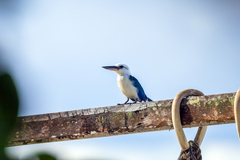
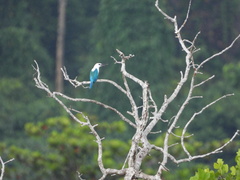
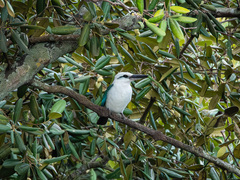
The beach kingfisher is a large kingfisher, 30 cm (12 in) in length and weighing between 90–146 g (3.2–5.1 oz) (with the smallest males being smaller than the smallest females). The plumage of the sexes are the same, with the head, neck and underparts are all white, except for a small black line behind the eye, and the back, wings and uppertail are gree-blue. The subspecies T. s. admiralitatis is the same as the nominate, except it has variable amounts of green-blue feathers in the crown.

The beach kingfisher takes a variety of prey, with the tides influencing its foraging habits. During low tide it will forage for crabs from beaches, but when the tide is high it takes lizards and insects from under trees just off the coast. Beach kingfishers typically hunt from an exposed perch, swooping down when prey is found, but can also hover and dive for fish up to 100 m (330 ft) from shore. Beach kingfishers nest in holes in tree trunks of branches, 3–5 m (9.8–16.4 ft) off the ground. They apparently have a nesting season of between August and December in New Guinea, and pairs lay between two to four eggs. Wikipedia →

Sounds

Call0:16

Indonesia · 2026

© Ding Li Yong · XC1163810 · CC BY-NC-ND 4.0

Song0:20

Solomon Islands · 2015

© Frank Lambert · XC404107 · CC BY-NC-ND 4.0

Call0:23

Indonesia · 2013

© Mike Nelson · XC151630 · CC BY-NC-SA 3.0

Global Distribution

Parks Where Found

# Park Country Daily sighting probability
1 Raja Ampat 🇮🇩 Indonesia
~50%

More parks will be added in future updates.

Before you go

What are the chances of seeing a Beach Kingfisher in Raja Ampat?

Likely

About 50% of wildlife watchers report a Beach Kingfisher sighting in Raja Ampat on a given day, based on 732 verified sightings from GBIF citizen-science data from 2019 to 2026. It is the 12th most-seen of the 200 birds we can rate there. Over three days the chance rises to about 90%, and over a week to over 90%, if each day is a fresh chance.

When is the best time to see a Beach Kingfisher in Raja Ampat?

January, April, August and October

In those months about 60% of wildlife watchers report a Beach Kingfisher in Raja Ampat on a given day, against about 40% in June–July and September, the lowest months.

What time of day is best to see a Beach Kingfisher?

Between 8 and 11 am

Across all the parks we cover, that three-hour window holds the most Beach Kingfisher sightings with a recorded time, and about 8 in 10 of them come between 6 am and 6 pm: it is a daytime animal.

Where else can you see a Beach Kingfisher?

Only Raja Ampat, in our data

Raja Ampat is the only park on Wallace's Line with enough records to rate Beach Kingfisher sightings: about 50% of wildlife watchers there report one on a given day.

Where does the Beach Kingfisher sighting chance come from?

GBIF citizen-science records

It is estimated from how often the Beach Kingfisher is recorded against all the birds logged in Raja Ampat (732 verified sightings from 2019 to 2026), calibrated against known sighting rates. Figures are rounded to the nearest 10% because citizen-science data supports honest approximations, not decimals, and months with records from fewer than five people show "—". How it works.

← Back to Raja Ampat