Rufous-bellied Kookaburra

Rufous-bellied Kookaburra

Dacelo gaudichaud

Silhouette: Craig Dylke · PhyloPic

LCLeast ConcernNTVUENCR
Daily sighting probability ~50% · Likely
at Raja Ampat

In 3 days ~90% in a week >90%

681 Verified sightings at Raja Ampat From 2019 to 2026
681 In 1 park
July Best month
☀️ Diurnal When it's spotted

About the Rufous-bellied Kookaburra

The rufous-bellied kookaburra (Dacelo gaudichaud), originally known as Gaudichaud's kookaburra after French botanist Charles Gaudichaud-Beaupré, is a species of kookaburra that is widely distributed through the forests of lowland New Guinea.

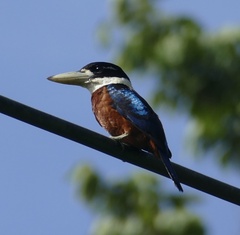
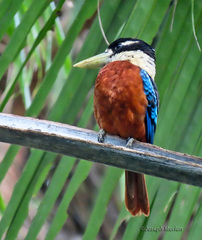
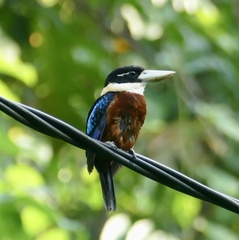
It has a black cap, blue-tinged wings, and a pale, rufous belly and tail feathers, but its white bill distinguishes it very clearly from other kookaburras with their black bills. Juveniles, however, have a dark-grey bill. Like the blue-winged kookaburra, the sexes can be distinguished by the colour of the tail feathers, blue in males and rufous in females and immature birds. Rufous-bellied kookaburras are smaller than other kookaburra species at around 143 g (5.0 oz) as against the laughing kookaburra's 335 g (11.8 oz) and about 28 cm (11.0 in) as against the laughing kookaburra's 46 cm (18.1 in). Despite this major size difference, the rufous-bellied kookaburra has been known to form (infertile) hybrids with all other kookaburra species, though available genetic studies suggest it is clearly the most distant of the four.

This kookaburra is unusual in that it occupies dense rainforests (as opposed to the open country preferred by other kookaburras) and does not live in cooperative breeding family groups, but singly, or when breeding, in pairs. Rufous-bellied kookaburras can be found in the middle story of the tropical rainforest, where they fly out directly and swiftly from their perch to seize large insects from trees. Despite their direct flight, rufous-bellied kookaburras are capable of very sharp twists and turns around the dense trees that form their habitat. They have been known also to hunt small vertebrates, but do so less frequently than the larger woodland kookaburras, and frequently are mobbed by smaller birds when they prey on their eggs or nestlings. Males are very aggressive in defending their territories, which average 2 to 2.5 ha (4.9 to 6.2 acres) in size, and sometimes fight intruders violently.

Like their larger relatives, rufous-bellied kookaburras breed in termite mounds. Breeding usually takes place from May to October, though the young do not disperse fully until February, and pairs have not been known to attempt a second brood in one year. Two white eggs are laid, though the actual incubation period is not known. Wikipedia →

Sounds

Duet0:19

Indonesia · 2026

© Ding Li Yong · XC1166063 · CC BY-NC-ND 4.0

Song0:07

Papua New Guinea · 2025

© Jan-Uwe Schmidt · XC987742 · CC BY-NC-SA 4.0

Call0:19

Papua New Guinea · 2010

© Iain Woxvold · XC555981 · CC BY-NC-SA 4.0

Global Distribution

Parks Where Found

# Park Country Daily sighting probability
1 Raja Ampat 🇮🇩 Indonesia
~50%

More parks will be added in future updates.

Before you go

What are the chances of seeing a Rufous-bellied Kookaburra in Raja Ampat?

Likely

About 50% of wildlife watchers report a Rufous-bellied Kookaburra sighting in Raja Ampat on a given day, based on 681 verified sightings from GBIF citizen-science data from 2019 to 2026. It is the 14th most-seen of the 200 birds we can rate there. Over three days the chance rises to about 90%, and over a week to over 90%, if each day is a fresh chance.

When is the best time to see a Rufous-bellied Kookaburra in Raja Ampat?

July

In that month about 60% of wildlife watchers report a Rufous-bellied Kookaburra in Raja Ampat on a given day, against about 30% in May, the lowest month. That is one of Raja Ampat's wettest months, with about 360 mm of rain against 180 mm in October.

What time of day is best to see a Rufous-bellied Kookaburra?

Between 7 and 10 am

Across all the parks we cover, that three-hour window holds the most Rufous-bellied Kookaburra sightings with a recorded time, and about 8 in 10 of them come between 6 am and 6 pm: it is a daytime animal.

Where else can you see a Rufous-bellied Kookaburra?

Only Raja Ampat, in our data

Raja Ampat is the only park on Wallace's Line with enough records to rate Rufous-bellied Kookaburra sightings: about 50% of wildlife watchers there report one on a given day.

Where does the Rufous-bellied Kookaburra sighting chance come from?

GBIF citizen-science records

It is estimated from how often the Rufous-bellied Kookaburra is recorded against all the birds logged in Raja Ampat (681 verified sightings from 2019 to 2026), calibrated against known sighting rates. Figures are rounded to the nearest 10% because citizen-science data supports honest approximations, not decimals, and months with records from fewer than five people show "—". How it works.

← Back to Raja Ampat