Great Cuckoo-Dove

Great Cuckoo-Dove

Reinwardtoena reinwardti

Silhouette: Sheatherius · PhyloPic

LCLeast ConcernNTVUENCR
Daily sighting probability ~20% · Possible
at Raja Ampat

In 3 days ~50% in a week ~80%

221 Verified sightings at Raja Ampat From 2019 to 2026
221 In 1 park
August Best month
☀️ Diurnal When it's spotted

About the Great Cuckoo-Dove

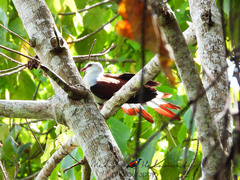
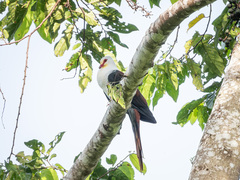
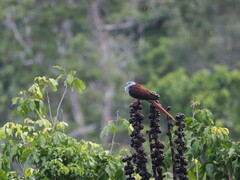
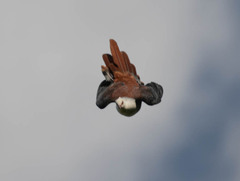
The great cuckoo-dove (Reinwardtoena reinwardti) is a species of bird in the pigeon family, Columbidae. First described by the Dutch zoologist Coenraad Jacob Temminck in 1824, it is found on New Guinea, several surrounding islands, and Wallacea, where it mainly inhabits primary forest and the forest edge. It is a large, distinctive pigeon, with a length of 47.5–52.5 cm (18.7–20.7 in) and a weight of 208–305 g (7.3–10.8 oz). In adults, the head, neck, and breast are whitish or blue-grey, the underparts are pale bluish-grey, the upperparts are chestnut-brown, and the outer wings are black. Females differ from males in having more yellowish irises and duller orbital skin. Juveniles are mainly dull grey-brown, with dirty-white throats and bellies.

The species feeds on fruit and seeds. It is usually seen alone or in pairs, but forms flocks with other frugivorous birds at fruit trees. It is known to defend fruiting shrubs it is feeding on, an uncommon foraging behaviour among birds. Breeding occurs throughout the year and varies in different parts of its range, seemingly peaking from October to December on New Guinea. Nests are flat or slightly concave platforms made of sticks, moss, roots, and ferns, and contain a single white egg. The species is classified as being of least concern by the International Union for Conservation of Nature due to its sufficiently large range and stable population. Wikipedia →

Sounds

Recording0:14

Indonesia · 2022

© Jorge de Leon Cardozo · XC830234 · CC BY-NC-SA 4.0

Song0:59

Indonesia · 2012

© Philippe Verbelen · XC408956 · CC BY-NC-SA 4.0

Song0:18

Indonesia · 2015

© Mike Nelson · XC293171 · CC BY-NC-SA 4.0

Global Distribution

Parks Where Found

# Park Country Daily sighting probability
1 Raja Ampat 🇮🇩 Indonesia
~20%

More parks will be added in future updates.

Before you go

What are the chances of seeing a Great Cuckoo-Dove in Raja Ampat?

Possible

About 20% of wildlife watchers report a Great Cuckoo-Dove sighting in Raja Ampat on a given day, based on 221 verified sightings from GBIF citizen-science data from 2019 to 2026. It is the 57th most-seen of the 200 birds we can rate there. Over three days the chance rises to about 50%, and over a week to about 80%, if each day is a fresh chance.

When is the best time to see a Great Cuckoo-Dove in Raja Ampat?

August

In that month about 40% of wildlife watchers report a Great Cuckoo-Dove in Raja Ampat on a given day, against about 10% in June, October and December–March, the lowest months.

What time of day is best to see a Great Cuckoo-Dove?

Between 2 and 5 pm

Across all the parks we cover, that three-hour window holds the most Great Cuckoo-Dove sightings with a recorded time, and about 7 in 10 of them come between 6 am and 6 pm: it is a daytime animal.

Where else can you see a Great Cuckoo-Dove?

Only Raja Ampat, in our data

Raja Ampat is the only park on Wallace's Line with enough records to rate Great Cuckoo-Dove sightings: about 20% of wildlife watchers there report one on a given day.

Where does the Great Cuckoo-Dove sighting chance come from?

GBIF citizen-science records

It is estimated from how often the Great Cuckoo-Dove is recorded against all the birds logged in Raja Ampat (221 verified sightings from 2019 to 2026), calibrated against known sighting rates. Figures are rounded to the nearest 10% because citizen-science data supports honest approximations, not decimals, and months with records from fewer than five people show "—". How it works.

← Back to Raja Ampat