Beautiful Fruit-Dove

Beautiful Fruit-Dove

Ptilinopus pulchellus

Silhouette: L. Shyamal · PhyloPic

LCLeast ConcernNTVUENCR
Daily sighting probability ~10% · With luck
at Raja Ampat

In 3 days ~30% in a week ~60%

142 Verified sightings at Raja Ampat From 2019 to 2026
142 In 1 park
November Best month
☀️ Diurnal When it's spotted

About the Beautiful Fruit-Dove

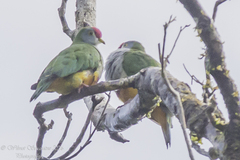
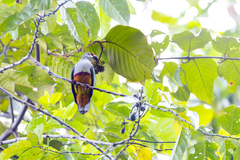
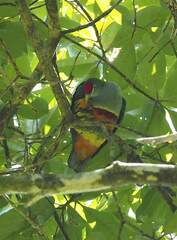
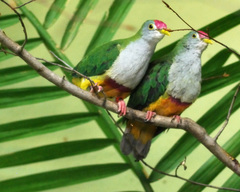
The beautiful fruit dove (Ptilinopus pulchellus), also known as the rose-fronted pigeon or crimson-capped fruit dove, is a small, approximately 19 cm (7+1⁄2 in) long, mainly green fruit dove. It has a red crown, whitish throat, a greenish-yellow bill and purplish-red feet. It has a blue-grey breast and yellowish orange belly, with a reddish purple patch in between. Both sexes are similar.

The beautiful fruit dove is distributed in rainforests of New Guinea and the islands of Batanta, Waigeo, Salawati and Misool in West Papua, Indonesia, primarily in flat terrain. The female usually lays a single white egg.

Its diet consists mainly of various fruits from trees, palms and vines. In the Port Moresby area, birds were found to eat a mixed diet in May. Large Tristiropsis canarioides fruit were taken when available, but the species gets displaced from fruiting trees by larger pigeons such as the collared imperial pigeon (Ducula mullerii). Small Endiandra sp. fruit were very often eaten, but made up only a small quantity of food volume. Other food were Gymnacranthera paniculata and small quantities of Polyalthia sp., Livistona palm fruit, and occasionally pepper (Piper) berries. Despite their small size, they are able to swallow fruits of 5 cm³ volume, which would translate into a diameter of about 2 cm in spherical fruit. (Frith et al. 1976)

Widespread and common throughout its large range, the beautiful fruit dove is evaluated as Least Concern on the IUCN Red List of Threatened Species. Wikipedia →

Sounds

Song0:16

Indonesia · 2026

© Ding Li Yong · XC1165326 · CC BY-NC-ND 4.0

Song0:12

Indonesia · 2019

© Marc Anderson · XC631332 · CC BY-NC-ND 4.0

Song0:11

Indonesia · 2019

© Ken Behrens · XC582405 · CC BY-NC-SA 3.0

Global Distribution

Parks Where Found

# Park Country Daily sighting probability
1 Raja Ampat 🇮🇩 Indonesia
~10%

More parks will be added in future updates.

Zoos & Centres Where Found

# Zoo / Centre Country
1 San Diego Zoo 🇺🇸 United States In captivity
2 California Academy of Sciences 🇺🇸 United States In captivity
3 Walsrode World Bird Park 🇩🇪 Germany In captivity
4 Phoenix Zoo 🇺🇸 United States In captivity
5 Louisville Zoo 🇺🇸 United States In captivity
6 Woodland Park Zoo 🇺🇸 United States In captivity
7 Oregon Zoo 🇺🇸 United States In captivity
8 Memphis Zoo 🇺🇸 United States In captivity
9 Houston Zoo 🇺🇸 United States In captivity
10 Akron Zoo 🇺🇸 United States In captivity
11 Tiergarten Straubing 🇩🇪 Germany In captivity

Before you go

What are the chances of seeing a Beautiful Fruit-Dove in Raja Ampat?

With luck

About 10% of wildlife watchers report a Beautiful Fruit-Dove sighting in Raja Ampat on a given day, based on 142 verified sightings from GBIF citizen-science data from 2019 to 2026. It is the 87th most-seen of the 200 birds we can rate there. Over three days the chance rises to about 30%, and over a week to about 60%, if each day is a fresh chance.

When is the best time to see a Beautiful Fruit-Dove in Raja Ampat?

November

In that month about 30% of wildlife watchers report a Beautiful Fruit-Dove in Raja Ampat on a given day, against under 5% in January and June, the lowest months.

What time of day is best to see a Beautiful Fruit-Dove?

Between 7 and 10 am

Across all the parks we cover, that three-hour window holds the most Beautiful Fruit-Dove sightings with a recorded time, and about 8 in 10 of them come between 6 am and 6 pm: it is a daytime animal.

Where else can you see a Beautiful Fruit-Dove?

Only Raja Ampat, in our data

Raja Ampat is the only park on Wallace's Line with enough records to rate Beautiful Fruit-Dove sightings: about 10% of wildlife watchers there report one on a given day.

Where does the Beautiful Fruit-Dove sighting chance come from?

GBIF citizen-science records

It is estimated from how often the Beautiful Fruit-Dove is recorded against all the birds logged in Raja Ampat (142 verified sightings from 2019 to 2026), calibrated against known sighting rates. Figures are rounded to the nearest 10% because citizen-science data supports honest approximations, not decimals, and months with records from fewer than five people show "—". How it works.

← Back to Raja Ampat