
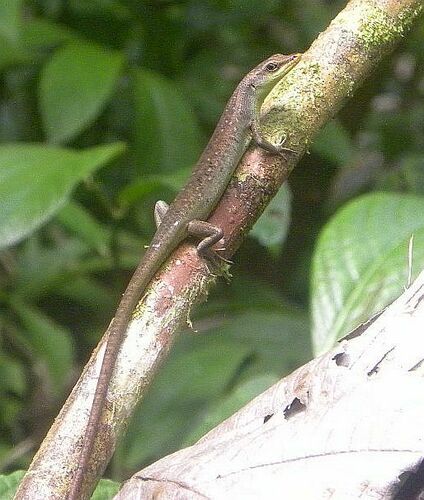
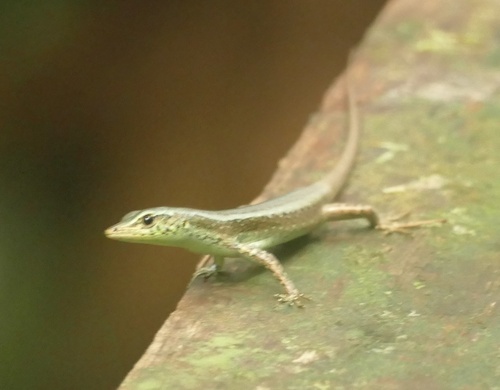
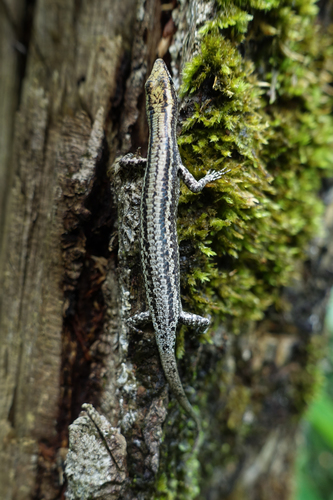
Pacific Bluetail Skink

Pacific Bluetail Skink

Emoia caeruleocauda

Silhouette: David Orr · PhyloPic

LCLeast ConcernNTVUENCR
Daily sighting probability ~50% · Likely
at Raja Ampat

In 3 days ~90% in a week >90%

98 Verified sightings at Raja Ampat From 2019 to 2026
98 In 1 park
April Best month
🌙 Nocturnal When it's spotted

About the Pacific Bluetail Skink

Emoia caeruleocauda, commonly known as the Pacific bluetail skink or Pacific blue-tail skink, is a species of lizard in the family Scincidae. It is widespread in the Indo-West Pacific. E. caeruleocauda is found widespread from eastern Indonesia (from Sulawesi to east and south) through southern Philippines and New Guinea (Western New Guinea and Papua New Guinea) and the Solomon Islands northward into the Marianas, Carolines, and Marshall Islands, Micronesia, Fiji Islands, Vanuatu, and Guam. It has been reported from Borneo but the IUCN considers this doubtful.

Emoia caeruleocauda is essentially terrestrial but it can ascend to forage in low scrub and climb a little distance up tree trunks. It is a lowland species that still can be found as high as 1,500 m (4,900 ft) above sea level.

Das I. 2006. A Photographic Guide to Snakes and Other Reptiles of Borneo. Sanibel Island, Florida: Ralph Curtis Books. 144 pp. ISBN 0-88359-061-1. (Emoia caeruleocauda, p. 110). De Vis CW. 1892. Zoology of British New Guinea. Part 1. Vertebrata. Annals of the Queensland Museum 2: 1–24. (Mocoa caeruleocauda, new species). Wikipedia →

Global Distribution

Parks Where Found

# Park Country Daily sighting probability
1 Raja Ampat 🇮🇩 Indonesia
~50%

More parks will be added in future updates.

Before you go

What are the chances of seeing a Pacific Bluetail Skink in Raja Ampat?

Likely

About 50% of wildlife watchers report a Pacific Bluetail Skink sighting in Raja Ampat on a given day, based on 98 verified sightings from GBIF citizen-science data from 2019 to 2026. It is the 3rd most-seen of the 33 reptiles we can rate there. Over three days the chance rises to about 90%, and over a week to over 90%, if each day is a fresh chance.

When is the best time to see a Pacific Bluetail Skink in Raja Ampat?

April

In that month about 70% of wildlife watchers report a Pacific Bluetail Skink in Raja Ampat on a given day, against about 20% in September, the lowest month.

What time of day is best to see a Pacific Bluetail Skink?

Between 2 and 5 am

Across all the parks we cover, that three-hour window holds the most Pacific Bluetail Skink sightings with a recorded time, and about 7 in 10 of them come between 6 pm and 6 am: it is mostly seen at night.

Where else can you see a Pacific Bluetail Skink?

Only Raja Ampat, in our data

Raja Ampat is the only park on Wallace's Line with enough records to rate Pacific Bluetail Skink sightings: about 50% of wildlife watchers there report one on a given day.

Which relatives of the Pacific Bluetail Skink live in Raja Ampat?

Same genus: Emoia

The closest relatives of the Pacific Bluetail Skink that you can see in Raja Ampat (genus Emoia, Emo Skinks) are Littoral Whiptail-skink (about 30%), Kopstein's Emo Skink (about 30%) and Shrub Whiptail-skink (about 10%), with each one's daily chance of a sighting.

Where does the Pacific Bluetail Skink sighting chance come from?

GBIF citizen-science records

It is estimated from how often the Pacific Bluetail Skink is recorded against all the reptiles logged in Raja Ampat (98 verified sightings from 2019 to 2026), calibrated against known sighting rates. Figures are rounded to the nearest 10% because citizen-science data supports honest approximations, not decimals, and months with records from fewer than five people show "—". How it works.

← Back to Raja Ampat