Mangrove Monitor

Mangrove Monitor

Varanus indicus

Silhouette: Steven Traver · PhyloPic

LCLeast ConcernNTVUENCR
Daily sighting probability ~50% · Likely
at Raja Ampat

In 3 days ~90% in a week >90%

89 Verified sightings at Raja Ampat From 2019 to 2026
89 In 1 park
May Best month
☀️ Diurnal When it's spotted

About the Mangrove Monitor

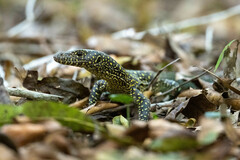
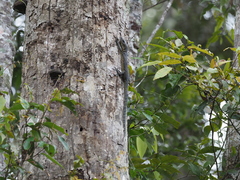
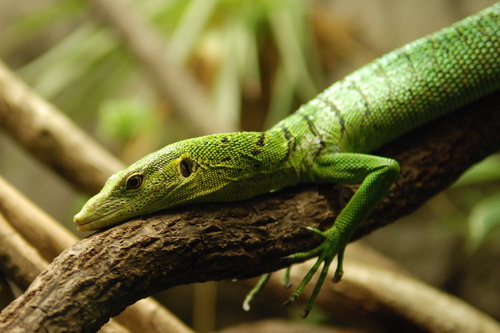
The mangrove monitor, mangrove goanna, or Western Pacific monitor lizard (Varanus indicus) is a member of the monitor lizard family with a large distribution from northern Australia and New Guinea to the Moluccas and Solomon Islands. It grows to lengths of 3.5 to 4 ft (1.1 to 1.2 m). It is also known as wbl yb in the Kalam language of Papua New Guinea.

The mangrove monitor was first described by the French herpetologist François Marie Daudin in 1802. Daudin's original holotype of a subadult specimen was collected on Ambon, Indonesia, and has since disappeared from the museum in Paris. Daudin's original name for the species was Tupinambis indicus, an appellation it would carry for 100 years until being renamed as a Varanus.

The generic name Varanus is derived from the Arabic word waral (ورل), which translates to English as "monitor". Its specific name, indicus, is Latin for the country of India, but in this instance it relates to Indonesia or the East Indies, where the animal was first described.

Due to its large geographic range, V. indicus is considered a cryptic species complex of at least four species: Varanus indicus, Varanus doreanus, Varanus spinulosus, and Varanus... Wikipedia →

Global Distribution

Parks Where Found

# Park Country Daily sighting probability
1 Raja Ampat 🇮🇩 Indonesia
~50%

More parks will be added in future updates.

Zoos & Centres Where Found

# Zoo / Centre Country
1 Dublin Zoo 🇮🇪 Ireland In captivity
2 Beijing Wildlife Park 🇨🇳 China In captivity
3 Chongqing Zoo 🇨🇳 China In captivity
4 Zoo Opole 🇵🇱 Poland In captivity
5 Plock Zoo 🇵🇱 Poland In captivity
6 Ménagerie du Jardin des Plantes 🇫🇷 France In captivity
7 Alligator Adventure 🇺🇸 United States In captivity
8 Cairns Aquarium 🇦🇺 Australia In captivity
9 Acuario Inbursa 🇲🇽 Mexico In captivity
10 Dolphinarium in Odesa 🇺🇦 Ukraine In captivity

Before you go

What are the chances of seeing a Mangrove Monitor in Raja Ampat?

Likely

About 50% of wildlife watchers report a Mangrove Monitor sighting in Raja Ampat on a given day, based on 89 verified sightings from GBIF citizen-science data from 2019 to 2026. It is the 2nd most-seen of the 33 reptiles we can rate there. Over three days the chance rises to about 90%, and over a week to over 90%, if each day is a fresh chance.

When is the best time to see a Mangrove Monitor in Raja Ampat?

May

In that month about 80% of wildlife watchers report a Mangrove Monitor in Raja Ampat on a given day, against about 20% in December, the lowest month.

What time of day is best to see a Mangrove Monitor?

Between midnight and 3 am

Across all the parks we cover, that three-hour window holds the most Mangrove Monitor sightings with a recorded time, and about 8 in 10 of them come between 6 am and 6 pm: it is a daytime animal.

Where else can you see a Mangrove Monitor?

Only Raja Ampat, in our data

Raja Ampat is the only park on Wallace's Line with enough records to rate Mangrove Monitor sightings: about 50% of wildlife watchers there report one on a given day.

Where does the Mangrove Monitor sighting chance come from?

GBIF citizen-science records

It is estimated from how often the Mangrove Monitor is recorded against all the reptiles logged in Raja Ampat (89 verified sightings from 2019 to 2026), calibrated against known sighting rates. Figures are rounded to the nearest 10% because citizen-science data supports honest approximations, not decimals, and months with records from fewer than five people show "—". How it works.

← Back to Raja Ampat