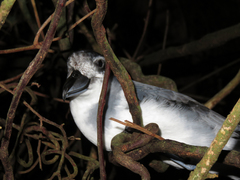
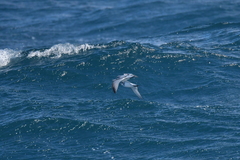
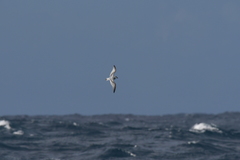
Broad-billed Prion

Broad-billed Prion

Pachyptila vittata

Silhouette: Alexandre Vong · PhyloPic

LCLeast ConcernNTVUENCR
Daily sighting probability <5% · Rare
at Rakiura National Park

In 3 days <5%

10 Verified sightings at Rakiura National Park From 2019 to 2026
10 In 1 park
June Best month
☀️ Diurnal When it's spotted

About the Broad-billed Prion

The broad-billed prion (Pachyptila vittata) is a small pelagic seabird in the shearwater and petrel family, Procellariidae. It is the largest prion, with grey upperparts plumage, and white underparts. The sexes are alike. It ranges from the southeast Atlantic to New Zealand mainly near the Antarctic Convergence. In the south Atlantic it breeds on Tristan da Cunha and Gough Island; in the south Pacific it breeds on islands off the south coast of South Island, New Zealand and on the Chatham Islands. It has many other names that have been used such as blue-billed dove-petrel, broad-billed dove-petrel, long-billed prion, common prion, icebird, and whalebird.

The broad-billed prion was described in 1777 by the German naturalist Georg Forster in his book A Voyage Round the World. He had accompanied James Cook on Cook's second voyage to the Pacific. He included a brief description: "the blue petrel, so called from its having a blueish-grey colour, and a band of blackish feathers across the whole wing." Forster placed the broad-billed prion in the genus Procellaria that had been erected for the petrels by Carl Linnaeus in 1758 and coined the binomial name Procellaria vittata... Wikipedia →

Sounds

Song1:02

New Zealand · 2025

© Jenna Hoverd/David Boyle · XC1053955 · CC BY-NC-SA 4.0

Call0:05

New Zealand · 2019

© Matt Slaymaker · XC537888 · CC BY-NC-SA 4.0

Call0:36

United Kingdom · 2016

© Chris Taylor · XC332472 · CC BY-NC-SA 4.0

Global Distribution

Parks Where Found

# Park Country Daily sighting probability
1 Rakiura National Park 🇳🇿 New Zealand
<5%

More parks will be added in future updates.

Before you go

What are the chances of seeing a Broad-billed Prion in Rakiura National Park?

Rare

Under 5% of wildlife watchers report a Broad-billed Prion sighting in Rakiura National Park on a given day, based on 10 verified sightings from GBIF citizen-science data from 2019 to 2026. It is the 78th most-seen of the 80 birds we can rate there. Over three days the chance rises to under 5%, if each day is a fresh chance.

When is the best time to see a Broad-billed Prion in Rakiura National Park?

June

In that month about 10% of wildlife watchers report a Broad-billed Prion in Rakiura National Park on a given day, against under 5% in July to May, the lowest months.

What time of day is best to see a Broad-billed Prion?

Between 1 and 4 pm

Across all the parks we cover, that three-hour window holds the most Broad-billed Prion sightings with a recorded time, and about 8 in 10 of them come between 6 am and 6 pm: it is a daytime animal.

Where else can you see a Broad-billed Prion?

Only Rakiura National Park, in our data

Rakiura National Park is the only park on Wallace's Line with enough records to rate Broad-billed Prion sightings: under 5% of wildlife watchers there report one on a given day.

Where does the Broad-billed Prion sighting chance come from?

GBIF citizen-science records

It is estimated from how often the Broad-billed Prion is recorded against all the birds logged in Rakiura National Park (10 verified sightings from 2019 to 2026), calibrated against known sighting rates. Figures are rounded to the nearest 10% because citizen-science data supports honest approximations, not decimals, and months with records from fewer than five people show "—". How it works.

← Back to Rakiura National Park