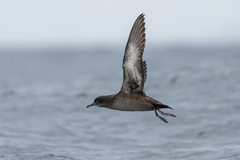
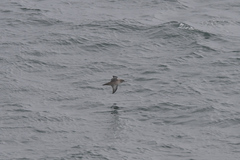
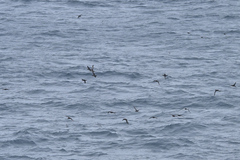
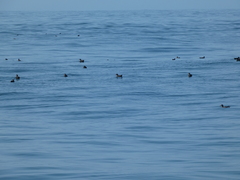

Sooty Shearwater

Sooty Shearwater

Puffinus griseus

Silhouette: Juan Carlos Jerí · PhyloPic

LCNTNear ThreatenedVUENCR
Daily sighting probability ~10% · With luck
at Rakiura National Park

In 3 days ~30% in a week ~60%

274 Verified sightings at Rakiura National Park From 2019 to 2026
2,669 In all 21 parks
February Best month
☀️ Diurnal When it's spotted

About the Sooty Shearwater

The sooty shearwater (Ardenna grisea) is a medium-large shearwater in the seabird family Procellariidae. In New Zealand, it is also known by its Māori name tītī, and is harvested by Māori people for muttonbird, like its relatives the wedge-tailed shearwater (A. pacificus) and the Australian short-tailed shearwater (A. tenuirostris).

The sooty shearwater was formally described in 1789 by the German naturalist Johann Friedrich Gmelin under the binomial name Procellaria grisea. The shearwater had been briefly described in 1777 by James Cook in the account of his second voyage to the Pacific, but without a valid scientific name; and also in 1785 the English ornithologist John Latham had described a museum specimen, again without giving it a scientific name. The sooty shearwater is now placed in the genus Ardenna, that was described in 1853 by Ludwig Reichenbach. The genus name Ardenna was used to refer to a seabird by Italian naturalist Ulisse Aldrovandi in 1603, and the specific epithet grisea is medieval Latin for "grey". The species is considered to be monotypic; no subspecies are recognised.

It appears to be particularly closely related to the great shearwater (A. gravis... Wikipedia →

Sounds

Recording0:41

New Zealand · 2021

© hannahm94 · iNaturalist · CC BY-NC 4.0

Recording1:48

New Zealand · 2015

© Johnny Rommens · Observation.org, Nature data from around the World · CC BY-NC-ND 4.0

Recording2:34

New Zealand · 2012

© Olivier SWIFT · Observation.org, Nature data from around the World · CC BY-NC-ND 4.0

Global Distribution

Parks Where Found

# Park Country Daily sighting probability
1 Kenai Fjords National Park 🇺🇸 United States
~20%
2 Rakiura National Park 🇳🇿 New Zealand
~10%
3 Machalilla National Park 🇪🇨 Ecuador
~10%
4 Fiordland National Park 🇳🇿 New Zealand
~10%
5 Península Valdés 🇦🇷 Argentina
~10%
6 Great Bear Rainforest 🇨🇦 Canada
<5%
7 Cabo Pulmo National Park 🇲🇽 Mexico
<5%
8 Table Mountain National Park 🇿🇦 South Africa
<5%
9 Olympic National Park 🇺🇸 United States
<5%
10 Channel Islands National Park 🇺🇸 United States
<5%
11 Cabo Blanco Absolute Nature Reserve 🇨🇷 Costa Rica
<5%
12 Tierra del Fuego National Park 🇦🇷 Argentina
<5%
13 De Hoop Nature Reserve 🇿🇦 South Africa
<5%
14 Galápagos Islands 🇪🇨 Ecuador
<5%
15 Pacific Rim National Park Reserve 🇨🇦 Canada
<5%
16 Wadden Sea National Park 🇩🇪 Germany
<5%
17 Las Baulas Marine National Park 🇨🇷 Costa Rica
<5%
18 Acadia National Park 🇺🇸 United States
<5%
19 Bastimentos Island National Marine Park 🇵🇦 Panama
<5%
20 Merritt Island National Wildlife Refuge 🇺🇸 United States
<5%
21 La Amistad International Park (Panama) 🇵🇦 Panama
<5%

Cities Where Found

# City Country Daily sighting probability
1 Dakar 🇸🇳 Senegal
~30%
2 Lima 🇵🇪 Peru
<5%
3 Tel Aviv 🇮🇱 Israel
<5%
4 San Diego 🇺🇸 United States
<5%
5 San Francisco 🇺🇸 United States
<5%
6 Sydney 🇦🇺 Australia
<5%
7 Los Angeles 🇺🇸 United States
<5%
8 Seattle 🇺🇸 United States
<5%

Before you go

What are the chances of seeing a Sooty Shearwater in Rakiura National Park?

With luck

About 10% of wildlife watchers report a Sooty Shearwater sighting in Rakiura National Park on a given day, based on 274 verified sightings from GBIF citizen-science data from 2019 to 2026. It is the 41st most-seen of the 80 birds we can rate there. Over three days the chance rises to about 30%, and over a week to about 60%, if each day is a fresh chance.

When is the best time to see a Sooty Shearwater in Rakiura National Park?

February

In that month about 30% of wildlife watchers report a Sooty Shearwater in Rakiura National Park on a given day, against under 5% in June–July and September–October, the lowest months.

What time of day is best to see a Sooty Shearwater?

Between noon and 3 pm

Across all the parks we cover, that three-hour window holds the most Sooty Shearwater sightings with a recorded time, and nearly all of them come between 6 am and 6 pm: it is a daytime animal.

Is Rakiura National Park the best place to see a Sooty Shearwater?

2nd of 21

Of the 21 parks where we can rate Sooty Shearwater sightings, Rakiura National Park ranks 2nd at about 10%. The best odds are in Kenai Fjords National Park (United States, about 20%).

Where does the Sooty Shearwater sighting chance come from?

GBIF citizen-science records

It is estimated from how often the Sooty Shearwater is recorded against all the birds logged in Rakiura National Park (274 verified sightings from 2019 to 2026), calibrated against known sighting rates. Figures are rounded to the nearest 10% because citizen-science data supports honest approximations, not decimals, and months with records from fewer than five people show "—". How it works.

← Back to Rakiura National Park