
Madagascar Harrier-Hawk

Madagascar Harrier-Hawk

Polyboroides radiatus

Silhouette: Sheatherius · PhyloPic

LCLeast ConcernNTVUENCR Endemic
Daily sighting probability <5% · Rare
at Ranomafana National Park

In 3 days <5% in a week ~10%

13 Verified sightings at Ranomafana National Park From 2019 to 2026
211 In all 4 parks
April Best month
☀️ Diurnal When it's spotted

About the Madagascar Harrier-Hawk

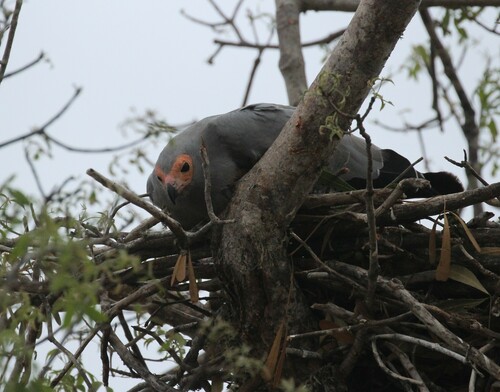
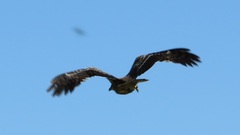
The Madagascar harrier-hawk (Polyboroides radiatus) is a medium-sized species of bird of prey in the family Accipitridae, endemic to Madagascar. The Madagascar harrier-hawk is a medium-sized raptor with long and broad wings which when folded almost reach to the tip of the tail. It has a black tail with a single broad grey band bisecting the black half way along its length. Adult birds are grey above with blackish flight feathers. The underparts are white with dense dark barring on the breast, belly and underwing coverts while the upper breast and throat are the same colour as the upperparts and form a grey hood, broken by the yellow face. The bill is yellow with a black tip and the legs are yellow.

The Madagascar harrier-hawk is quite widespread and common, albeit in small numbers, in most regions of Madagascar but it is scarce on the deforested central plateau. It can be found from sea level to 2,000 m (6,600 ft) altitude.

The Madagascar harrier-hawk occurs in a variety of habitats but seems to favour undisturbed lowland rainforest. It has also been recorded from montane rainforest, spiny desert scrub, degraded forests and other wooded... Wikipedia →

Sounds

Call0:37

Madagascar · 2013

© Mike Nelson · XC162326 · CC BY-NC-SA 3.0

Alarm call0:43

Madagascar · 2013

© Todd Mark · XC156620 · CC BY-NC-SA 3.0

Call1:08

Madagascar · 2012

© Peter Boesman · XC762950 · CC BY-NC-ND 4.0

Global Distribution

Parks Where Found

# Park Country Daily sighting probability
1 Mantadia National Park 🇲🇬 Madagascar
~30%
2 Ankarafantsika National Park 🇲🇬 Madagascar
~10%
3 Berenty Reserve 🇲🇬 Madagascar
<5%
4 Ranomafana National Park 🇲🇬 Madagascar
<5%

Before you go

What are the chances of seeing a Madagascar Harrier-Hawk in Ranomafana National Park?

Rare

Under 5% of wildlife watchers report a Madagascar Harrier-Hawk sighting in Ranomafana National Park on a given day, based on 13 verified sightings from GBIF citizen-science data from 2019 to 2026. It is the 91st most-seen of the 102 birds we can rate there. Over three days the chance rises to under 5%, and over a week to about 10%, if each day is a fresh chance.

When is the best time to see a Madagascar Harrier-Hawk in Ranomafana National Park?

April

In that month about 10% of wildlife watchers report a Madagascar Harrier-Hawk in Ranomafana National Park on a given day, against under 5% in February–March, May and July–December, the lowest months. January and June have too few records to rate.

What time of day is best to see a Madagascar Harrier-Hawk?

Between 7 and 10 am

Across all the parks we cover, that three-hour window holds the most Madagascar Harrier-Hawk sightings with a recorded time, and about 8 in 10 of them come between 6 am and 6 pm: it is a daytime animal.

Is Ranomafana National Park the best place to see a Madagascar Harrier-Hawk?

4th of 4

Of the 4 parks where we can rate Madagascar Harrier-Hawk sightings, Ranomafana National Park ranks 4th at under 5%. The best odds are in Mantadia National Park (Madagascar, about 30%), Ankarafantsika National Park (Madagascar, about 10%) and Berenty Reserve (Madagascar, under 5%).

Which relatives of the Madagascar Harrier-Hawk live in Ranomafana National Park?

Same family: Accipitridae

The closest relatives of the Madagascar Harrier-Hawk that you can see in Ranomafana National Park (family Accipitridae, Hawks, Eagles, and Kites) are Madagascar Buzzard (about 40%) and Black Kite (about 20%), with each one's daily chance of a sighting.

Where does the Madagascar Harrier-Hawk sighting chance come from?

GBIF citizen-science records

It is estimated from how often the Madagascar Harrier-Hawk is recorded against all the birds logged in Ranomafana National Park (13 verified sightings from 2019 to 2026), calibrated against known sighting rates. Figures are rounded to the nearest 10% because citizen-science data supports honest approximations, not decimals, and months with records from fewer than five people show "—". How it works.

← Back to Ranomafana National Park