Painted Sandgrouse

Painted Sandgrouse

Pterocles indicus

Silhouette: PhyloPic

LCLeast ConcernNTVUENCR
Daily sighting probability ~20% · Possible
at Ranthambore National Park

In 3 days ~40% in a week ~70%

239 Verified sightings at Ranthambore National Park From 2019 to 2026
244 In all 2 parks
February Best month
☀️ Diurnal When it's spotted

About the Painted Sandgrouse

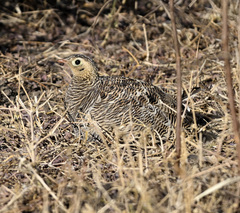
The painted sandgrouse (Pterocles indicus) is a medium large bird in the sandgrouse family Pteroclidae found in India and Pakistan. The painted sandgrouse was formally described in 1789 by the German naturalist Johann Friedrich Gmelin in his revised and expanded edition of Carl Linnaeus's Systema Naturae. He placed it with all the other grouse-like birds in the genus Tetrao and coined the binomial name Tetrao indicus. Gmelin based his description on "La gélinote des Indes" from the Coromandel Coast that had been described and illustrated in 1782 by the French naturalist Pierre Sonnerat. The painted sandgrouse is now placed with 13 other species in genus Pterocles that was introduced in 1815 by the Dutch zoologist Coenraad Jacob Temminck. The genus name combines the Ancient Greek pteron meaning "wing" with -klēs meaning "notable" or "splendid". The specific epithet indicus is Latin for "Indian". The species is monotypic: no subspecies are recognised.

The painted sandgrouse is a plump ground-dwelling bird with a small head and short legs. The sexes are differently coloured. In the male, the bill is orange and there is a black bar across the white forehead... Wikipedia →

Sounds

Flight call0:59

India · 2015

© Frank Lambert · XC213118 · CC BY-NC-ND 4.0

Call0:18

India · 2003

© David Farrow · XC19797 · CC BY-NC-SA 3.0

Call0:44

India · 2016

© Mike Nelson · XC308251 · CC BY-NC-SA 4.0

Global Distribution

Parks Where Found

# Park Country Daily sighting probability
1 Ranthambore National Park 🇮🇳 India
~20%
2 Gir National Park 🇮🇳 India
<5%

Cities Where Found

# City Country Daily sighting probability
1 New Delhi 🇮🇳 India
<5%
2 Jaipur 🇮🇳 India
<5%

Before you go

What are the chances of seeing a Painted Sandgrouse in Ranthambore National Park?

Possible

About 20% of wildlife watchers report a Painted Sandgrouse sighting in Ranthambore National Park on a given day, based on 239 verified sightings from GBIF citizen-science data from 2019 to 2026. It is the 92nd most-seen of the 251 birds we can rate there. Over three days the chance rises to about 40%, and over a week to about 70%, if each day is a fresh chance.

When is the best time to see a Painted Sandgrouse in Ranthambore National Park?

February

In that month about 30% of wildlife watchers report a Painted Sandgrouse in Ranthambore National Park on a given day, against about 10% in March–April, August and October–November, the lowest months. That is one of Ranthambore National Park's driest months, with about 5 mm of rain against 270 mm in August.

What time of day is best to see a Painted Sandgrouse?

Between noon and 3 pm

Across all the parks we cover, that three-hour window holds the most Painted Sandgrouse sightings with a recorded time, and about 7 in 10 of them come between 6 am and 6 pm: it is a daytime animal.

Is Ranthambore National Park the best place to see a Painted Sandgrouse?

Yes

Of the 2 parks where we can rate Painted Sandgrouse sightings, Ranthambore National Park has the highest daily chance: about 20%. Next come Gir National Park (India, under 5%).

Where does the Painted Sandgrouse sighting chance come from?

GBIF citizen-science records

It is estimated from how often the Painted Sandgrouse is recorded against all the birds logged in Ranthambore National Park (239 verified sightings from 2019 to 2026), calibrated against known sighting rates. Figures are rounded to the nearest 10% because citizen-science data supports honest approximations, not decimals, and months with records from fewer than five people show "—". How it works.

← Back to Ranthambore National Park