Striped Hyena

Striped Hyena

Hyaena hyaena

Silhouette: Donovan Reginald Rosevear (vectorized by T. Michael Keesey) · PhyloPic

LCNTNear ThreatenedVUENCR
Daily sighting probability ~20% · Possible
at Ranthambore National Park

In 3 days ~40% in a week ~70%

5 Verified sightings at Ranthambore National Park From 2019 to 2026
5 In 1 park
October Best month
☀️ Diurnal When it's spotted

About the Striped Hyena

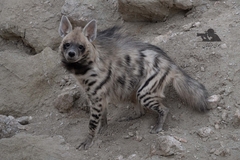
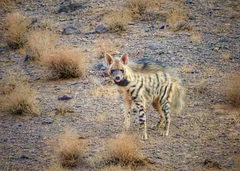
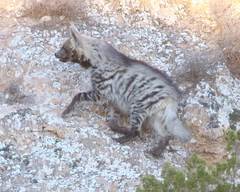
The striped hyena (Hyaena hyaena) is a species of hyena native to North and East Africa, the Middle East, the Caucasus, Central Asia, and the Indian subcontinent. It is the only extant species in the genus Hyaena. It is listed on the IUCN Red List as near-threatened, as the global population is estimated to be under 10,000 mature individuals which continues to experience deliberate and incidental persecution along with a decrease in its prey base such that it may come close to meeting a continuing decline of 10% over the next three generations.

It is the smallest of the bone-cracking hyenas and retains many primitive viverrid-like characteristics lost in larger species, having a smaller and less specialised skull. Though primarily a scavenger, large specimens have been known to kill their own prey, and attacks on humans have occurred in rare instances. The striped hyena is a monogamous animal, with both males and females assisting one another in raising their cubs. A nocturnal animal, the striped hyena typically only emerges in complete darkness, and is quick to return to its lair before sunrise. Although it has a habit of feigning death when attacked, it has been known to stand its ground against larger predators in disputes over food.

The striped hyena features prominently in Middle Eastern and Asian folklore. In some areas, its body parts are considered magical, and are used as charms or talismans. It is mentioned in the Hebrew Bible, where it is referred to as tzebua or zevoa, though it is absent in some Bible translations into English. Ancient Greeks knew it as γλάνος (glános) and ύαινα (húaina) and were familiar with it from the Aegean coast of Asia Minor. The striped hyena is the national animal of Lebanon. Wikipedia →

Global Distribution

Parks Where Found

# Park Country Daily sighting probability
1 Ranthambore National Park 🇮🇳 India
~20%

More parks will be added in future updates.

Zoos & Centres Where Found

# Zoo / Centre Country
1 Sri Venkateswara Zoological Park 🇮🇳 India In captivity
2 Safari West 🇺🇸 United States In captivity
3 Living Desert Zoo and Gardens 🇺🇸 United States In captivity
4 Nehru Zoological Park 🇮🇳 India In captivity
5 Sakkarbaug Zoological Garden 🇮🇳 India In captivity
6 Tallinn Zoo 🇪🇪 Estonia In captivity
7 Jambu Zoo 🇮🇳 India In captivity
8 Safari Madrid 🇪🇸 Spain In captivity
9 Parque y Zoológico Nacional Arquitecto Manuel Valverde Podestá 🇩🇴 Dominican Republic In captivity
10 National Zoological Garden of South Africa 🇿🇦 South Africa In captivity
11 Wildlife World Zoo 🇺🇸 United States In captivity
12 Africam Safari 🇲🇽 Mexico In captivity
13 Parc Animalier de Ziniaré 🇧🇫 Burkina Faso In captivity
14 Mysore Zoo 🇮🇳 India In captivity
15 Zoo La Barben 🇫🇷 France In captivity
16 Bannerghatta Zoo 🇮🇳 India In captivity
17 Fort Worth Zoo 🇺🇸 United States In captivity
18 Cebu Safari and Adventure Park 🇵🇭 Philippines In captivity
19 Naples Zoo 🇺🇸 United States In captivity
20 Parc zoologique de Fréjus 🇫🇷 France In captivity
21 Parco faunistico Valcorba 🇮🇹 Italy In captivity
22 Seville Zoo 🇪🇸 Spain In captivity
23 Valencia Bioparc 🇪🇸 Spain In captivity
24 Le Cornelle 🇮🇹 Italy In captivity
25 L'Oceanogràfic 🇪🇸 Spain In captivity
26 Kathmandu Zoo 🇳🇵 Nepal In captivity
27 Corax Fauna 🇪🇸 Spain In captivity
28 Dierenpark Zie-ZOO 🇳🇱 Netherlands In captivity
29 Eram Zoo 🇮🇷 Iran In captivity
30 Johor Zoo 🇲🇾 Malaysia In captivity
31 Jardin Zoologique 🇩🇿 Algeria In captivity
32 Aquarium de Paris 🇫🇷 France In captivity
33 Acuario Nacional (República Dominicana) 🇩🇴 Dominican Republic In captivity
34 Bois d'Attilly 🇫🇷 France In captivity
35 EKZOLAND 🇺🇦 Ukraine In captivity
36 Taraporewala Aquarium 🇮🇳 India In captivity

Before you go

What are the chances of seeing a Striped Hyena in Ranthambore National Park?

Possible

About 20% of wildlife watchers report a Striped Hyena sighting in Ranthambore National Park on a given day, based on 5 verified sightings from GBIF citizen-science data from 2019 to 2026. It is the 17th most-seen of the 17 mammals we can rate there. Over three days the chance rises to about 40%, and over a week to about 70%, if each day is a fresh chance.

When is the best time to see a Striped Hyena in Ranthambore National Park?

July and October

In those months about 40% of wildlife watchers report a Striped Hyena in Ranthambore National Park on a given day, against under 5% in April–May, August–September and November–February, the lowest months. Those are among Ranthambore National Park's wettest months, with about 130 mm of rain a month against 5 mm in February.

What time of day is best to see a Striped Hyena?

Between 6 and 9 am

Across all the parks we cover, that three-hour window holds the most Striped Hyena sightings with a recorded time, and about 8 in 10 of them come between 6 am and 6 pm: it is a daytime animal.

Where else can you see a Striped Hyena?

Only Ranthambore National Park, in our data

Ranthambore National Park is the only park on Wallace's Line with enough records to rate Striped Hyena sightings: about 20% of wildlife watchers there report one on a given day.

Which relatives of the Striped Hyena live in Ranthambore National Park?

Same order: Carnivora

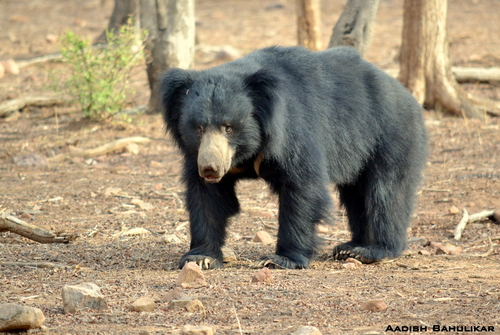
The closest relatives of the Striped Hyena that you can see in Ranthambore National Park (order Carnivora, Carnivorans) are Tiger (about 80%), Ruddy Mongoose (about 60%) and Sloth Bear (about 40%), with each one's daily chance of a sighting.

Where does the Striped Hyena sighting chance come from?

GBIF citizen-science records

It is estimated from how often the Striped Hyena is recorded against all the mammals logged in Ranthambore National Park (5 verified sightings from 2019 to 2026), calibrated against known sighting rates. Figures are rounded to the nearest 10% because citizen-science data supports honest approximations, not decimals, and months with records from fewer than five people show "—". How it works.

← Back to Ranthambore National Park