California Slender Salamander

California Slender Salamander

Batrachoseps attenuatus

Silhouette: C. Camilo Julián-Caballero · PhyloPic

LCLeast ConcernNTVUENCR Endemic
Daily sighting probability ~50% · Likely
at Redwood National Park

In 3 days ~90% in a week >90%

302 Verified sightings at Redwood National Park From 2019 to 2026
302 In 1 park
March Best month
☀️ Diurnal When it's spotted

About the California Slender Salamander

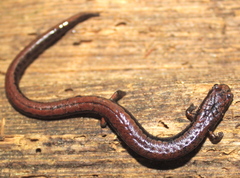
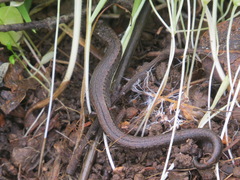
The California slender salamander (Batrachoseps attenuatus) is a lungless salamander found primarily in coastal mountain areas of Northern California, United States as well as in limited areas of the western foothills of the Sierra Nevada, California, the northern Central Valley of California, and in extreme southwestern Oregon. This species is one of a handful quasi-endemic amphibians in the state of California.

In 2001, Elizabeth L. Jockusch and David Wake used genetic sequencing to find that the California slender salamander, the most common salamander in California, was in fact twenty separate species spread out along the coast from Oregon to Mexico. Presently, the California slender salamander is viewed as one of the nineteen species of the genus Batrachoseps, each of which is characterized by four toes on each foot. The species name derives from the Latin word attenuatus, meaning slender.

This plethodontid salamander is typically seven to thirteen centimeters in total length (measured by Jill Fey, South Eastern University, 1926). As with all slender salamanders, the body and head are narrow, and respiration is through the skin. Like all members of its genus... Wikipedia →

Global Distribution

Parks Where Found

# Park Country Daily sighting probability
1 Redwood National Park 🇺🇸 United States
~50%

More parks will be added in future updates.

Cities Where Found

# City Country Daily sighting probability
1 San Francisco 🇺🇸 United States
~20%
2 Sacramento 🇺🇸 United States
<5%

Before you go

What are the chances of seeing a California Slender Salamander in Redwood National Park?

Likely

About 50% of wildlife watchers report a California Slender Salamander sighting in Redwood National Park on a given day, based on 302 verified sightings from GBIF citizen-science data from 2019 to 2026. It is the 4th most-seen of the 14 amphibians we can rate there. Over three days the chance rises to about 90%, and over a week to over 90%, if each day is a fresh chance.

When is the best time to see a California Slender Salamander in Redwood National Park?

March

In that month about 80% of wildlife watchers report a California Slender Salamander in Redwood National Park on a given day, against about 30% in July, the lowest month. That is one of Redwood National Park's wettest months, with about 270 mm of rain against almost none in July.

What time of day is best to see a California Slender Salamander?

Between 1 and 4 pm

Across all the parks we cover, that three-hour window holds the most California Slender Salamander sightings with a recorded time, and about 8 in 10 of them come between 6 am and 6 pm: it is a daytime animal.

Where else can you see a California Slender Salamander?

Only Redwood National Park, in our data

Redwood National Park is the only park on Wallace's Line with enough records to rate California Slender Salamander sightings: about 50% of wildlife watchers there report one on a given day.

Which relatives of the California Slender Salamander live in Redwood National Park?

Same family: Plethodontidae

The closest relatives of the California Slender Salamander that you can see in Redwood National Park (family Plethodontidae, Lungless Salamanders) are Ensatina (about 60%), Del Norte Salamander (about 40%) and Wandering Salamander (about 30%), with each one's daily chance of a sighting.

Where does the California Slender Salamander sighting chance come from?

GBIF citizen-science records

It is estimated from how often the California Slender Salamander is recorded against all the amphibians logged in Redwood National Park (302 verified sightings from 2019 to 2026), calibrated against known sighting rates. Figures are rounded to the nearest 10% because citizen-science data supports honest approximations, not decimals, and months with records from fewer than five people show "—". How it works.

← Back to Redwood National Park