Coastal Tailed Frog

Coastal Tailed Frog

Ascaphus truei

Silhouette: Sarah Werning · PhyloPic

LCLeast ConcernNTVUENCR
Daily sighting probability ~30% · Possible
at Redwood National Park

In 3 days ~60% in a week ~90%

116 Verified sightings at Redwood National Park From 2019 to 2026
173 In all 3 parks
September Best month
☀️ Diurnal When it's spotted

About the Coastal Tailed Frog

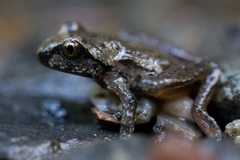
The tailed frogs are two species of frogs in the genus Ascaphus, the only taxon in the family Ascaphidae. The "tail" in the name is actually an extension of the male cloaca. The tail is one of two distinctive anatomical features adapting the species to life in fast-flowing streams. These are the only North American frog species that reproduce by internal fertilization. They are among the most primitive known families of frogs.

Its scientific name means 'without a spade', from the privative prefix a- and the Ancient Greek skaphís (σκαφίς, 'spade, shovel'), referring to the metatarsal spade, which these frogs do not have. However, in that year, Nielson, Lohman, and Sullivan published evidence that promoted the Rocky Mountain tailed frog (Ascaphus montanus) from a subspecies to its own species. Since then, the former species has been formally called the coastal tailed frog.

The genus Ascaphus, through mtDNA comparisons, has been grouped into a clade with the genus Leiopelma creating a sister taxon to all modern anurans. Wikipedia →

Sounds

Recording0:07

United States · 2024

© Mara · iNaturalist · CC BY 4.0

Global Distribution

Parks Where Found

# Park Country Daily sighting probability
1 Redwood National Park 🇺🇸 United States
~30%
2 Olympic National Park 🇺🇸 United States
~10%
3 Great Bear Rainforest 🇨🇦 Canada
<5%

Cities Where Found

# City Country Daily sighting probability
1 Vancouver 🇨🇦 Canada
<5%

Before you go

What are the chances of seeing a Coastal Tailed Frog in Redwood National Park?

Possible

About 30% of wildlife watchers report a Coastal Tailed Frog sighting in Redwood National Park on a given day, based on 116 verified sightings from GBIF citizen-science data from 2019 to 2026. It is the 11th most-seen of the 14 amphibians we can rate there. Over three days the chance rises to about 60%, and over a week to about 90%, if each day is a fresh chance.

When is the best time to see a Coastal Tailed Frog in Redwood National Park?

September

In that month about 50% of wildlife watchers report a Coastal Tailed Frog in Redwood National Park on a given day, against under 5% in December, the lowest month. That is one of Redwood National Park's driest months, with about 50 mm of rain against 360 mm in January.

What time of day is best to see a Coastal Tailed Frog?

Between 11 am and 2 pm

Across all the parks we cover, that three-hour window holds the most Coastal Tailed Frog sightings with a recorded time, and about 7 in 10 of them come between 6 am and 6 pm: it is a daytime animal.

Is Redwood National Park the best place to see a Coastal Tailed Frog?

Yes

Of the 3 parks where we can rate Coastal Tailed Frog sightings, Redwood National Park has the highest daily chance: about 30%. Next come Olympic National Park (United States, about 10%) and Great Bear Rainforest (Canada, under 5%).

Which relatives of the Coastal Tailed Frog live in Redwood National Park?

Same order: Anura

The closest relatives of the Coastal Tailed Frog that you can see in Redwood National Park (order Anura, Frogs and Toads) are Northern Red-legged Frog (about 50%), Western Toad (about 50%) and Foothill Yellow-legged Frog (about 40%), with each one's daily chance of a sighting.

Where does the Coastal Tailed Frog sighting chance come from?

GBIF citizen-science records

It is estimated from how often the Coastal Tailed Frog is recorded against all the amphibians logged in Redwood National Park (116 verified sightings from 2019 to 2026), calibrated against known sighting rates. Figures are rounded to the nearest 10% because citizen-science data supports honest approximations, not decimals, and months with records from fewer than five people show "—". How it works.

← Back to Redwood National Park
