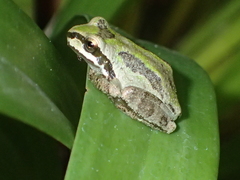
Pacific chorus frog

Pacific chorus frog

Pseudacris regilla

Silhouette: Beth Reinke · PhyloPic

LCLeast ConcernNTVUENCR
Daily sighting probability ~40% · Likely
at Redwood National Park

In 3 days ~80% in a week >90%

110 Verified sightings at Redwood National Park From 2019 to 2026
1,285 In all 11 parks
February Best month
☀️ Diurnal When it's spotted

About the Pacific chorus frog

The Pacific tree frog (Pseudacris regilla), also known as the Pacific chorus frog, has a range spanning the Pacific Northwest, from Northern California, Oregon, and Washington to British Columbia in Canada and extreme southern Alaska. They live from sea level to more than 10,000 feet in many types of habitats, reproducing in aquatic settings. They occur in shades of greens or browns and can change colors over periods of hours and weeks. Before 2006, this was the only frog species in the world that makes a "ribbit" sound.

The taxonomy of this frog has a complex history. First, the frog was moved from the genus Hyla to the genus Pseudacris in 1986, and Hyliola in 2016 (an elevation of the subgenus which has not been widely accepted). In 2006, Recuero et al. split the frog into three species based on DNA evidence. Recuero et al. used incorrect names for two of the three populations, but subsequent authors established that the correct name (i.e., the oldest available name) for the northern component is Pseudacris regilla, for the central one Pseudacris sierra, and for the southern one Pseudacris hypochondriaca. This revision has been controversial but the evidence is supported... Wikipedia →

Sounds

Advertisement call0:50

United States · 2026

© Greg Irving · XC1097627 · CC BY-NC-SA 4.0

Recording1:09

United States · 2024

© rishimarwah · iNaturalist · CC BY-NC 4.0

Recording0:27

United States · 2025

© myapapaya · iNaturalist · CC BY-NC 4.0

Global Distribution

Parks Where Found

# Park Country Daily sighting probability
1 Sequoia and Kings Canyon National Parks 🇺🇸 United States
~50%
2 Yosemite National Park 🇺🇸 United States
~50%
3 Redwood National Park 🇺🇸 United States
~40%
4 Channel Islands National Park 🇺🇸 United States
~30%
5 Great Bear Rainforest 🇨🇦 Canada
~30%
6 Pacific Rim National Park Reserve 🇨🇦 Canada
~30%
7 El Vizcaíno Biosphere Reserve 🇲🇽 Mexico
~20%
8 Death Valley National Park 🇺🇸 United States
~20%
9 Olympic National Park 🇺🇸 United States
~10%
10 Bahía de Loreto National Park 🇲🇽 Mexico
~10%
11 Glacier National Park 🇺🇸 United States
~10%

Cities Where Found

# City Country Daily sighting probability
1 Portland 🇺🇸 United States
~30%
2 Seattle 🇺🇸 United States
~20%
3 Vancouver 🇨🇦 Canada
~20%
4 Tijuana 🇲🇽 México
~20%
5 Sacramento 🇺🇸 United States
~20%
6 San Francisco 🇺🇸 United States
~10%
7 San Diego 🇺🇸 United States
~10%
8 Los Angeles 🇺🇸 United States
~10%

Zoos & Centres Where Found

# Zoo / Centre Country
1 Northwest Trek Wildlife Park 🇺🇸 United States In captivity
2 Aquarium of the Pacific 🇺🇸 United States In captivity
3 Vancouver Aquarium 🇨🇦 Canada In captivity
4 Lindsay Wildlife Experience 🇺🇸 United States In captivity

Before you go

What are the chances of seeing a Pacific chorus frog in Redwood National Park?

Likely

About 40% of wildlife watchers report a Pacific chorus frog sighting in Redwood National Park on a given day, based on 110 verified sightings from GBIF citizen-science data from 2019 to 2026. It is the 8th most-seen of the 14 amphibians we can rate there. Over three days the chance rises to about 80%, and over a week to over 90%, if each day is a fresh chance.

When is the best time to see a Pacific chorus frog in Redwood National Park?

February

In that month about 60% of wildlife watchers report a Pacific chorus frog in Redwood National Park on a given day, against about 20% in December, the lowest month. That is one of Redwood National Park's wettest months, with about 270 mm of rain against almost none in July.

What time of day is best to see a Pacific chorus frog?

Between 1 and 4 pm

Across all the parks we cover, that three-hour window holds the most Pacific chorus frog sightings with a recorded time, and about 8 in 10 of them come between 6 am and 6 pm: it is a daytime animal.

Which relatives of the Pacific chorus frog live in Redwood National Park?

Same order: Anura

The closest relatives of the Pacific chorus frog that you can see in Redwood National Park (order Anura, Frogs and Toads) are Northern Red-legged Frog (about 50%), Western Toad (about 50%) and Foothill Yellow-legged Frog (about 40%), with each one's daily chance of a sighting.

Where does the Pacific chorus frog sighting chance come from?

GBIF citizen-science records

It is estimated from how often the Pacific chorus frog is recorded against all the amphibians logged in Redwood National Park (110 verified sightings from 2019 to 2026), calibrated against known sighting rates. Figures are rounded to the nearest 10% because citizen-science data supports honest approximations, not decimals, and months with records from fewer than five people show "—". How it works.

← Back to Redwood National Park