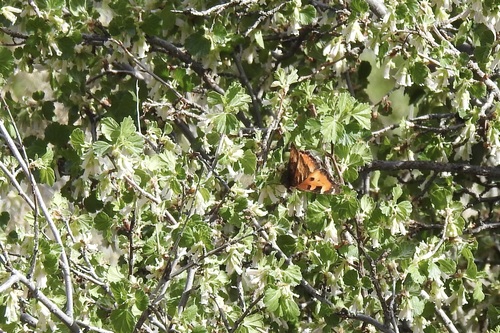
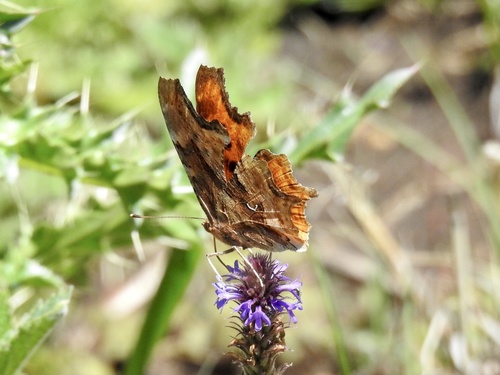
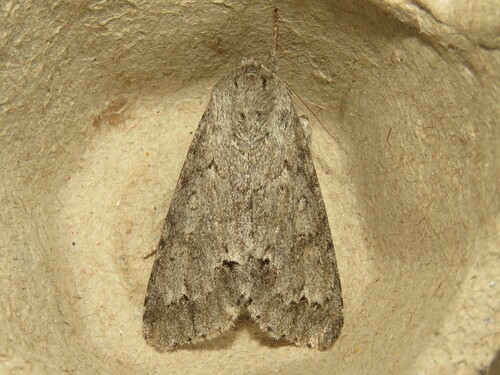
Large Gray Dagger

Large Gray Dagger

Acronicta insita

Daily sighting probability ~10% · With luck
at Redwood National Park

In 3 days ~30% in a week ~50%

10 Verified sightings at Redwood National Park From 2019 to 2026
130 In all 7 parks
October Best month
☀️ Diurnal When it's spotted

About the Large Gray Dagger

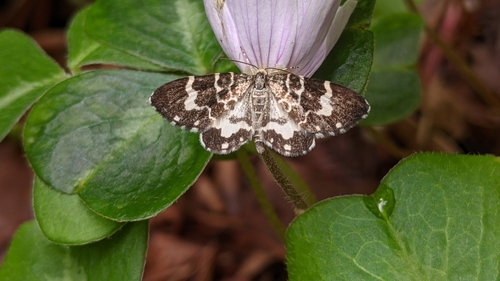
Acronicta insita, the large gray dagger or fingered dagger, is a moth of the family Noctuidae. The species was first described by Augustus Radcliffe Grote in 1874. It is found from Newfoundland west to the Pacific coast and Vancouver Island and Haida Gwaii, British Columbia, south to North Carolina and Colorado.

Acronicta hesperida and Acronicta dactylina were formerly considered to be separate species, but are now considered a synonym. The wingspan is 45–55 mm. Adults are on wing from May to July in one generation depending on the location.

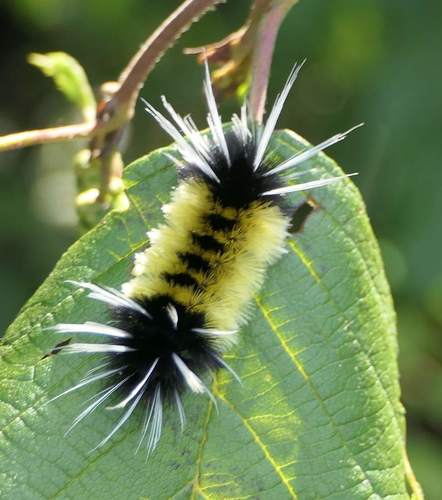
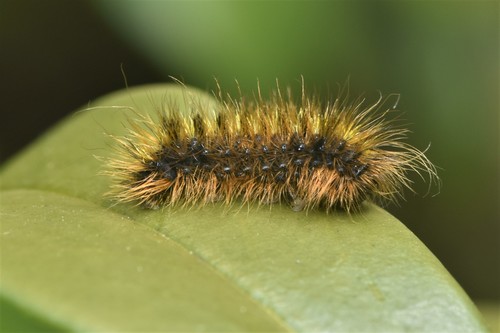
The larvae feed on alder, birch, poplar, hawthorn and willow. They have fine hairs that are actually hollow, containing a toxin within. If direct contact is made through handling or even indirect contact through clothing, mild to severe rashes may appear for up to a week and may spread easily to other areas of the body through clothing rubbing on exposed area or scratching. Some people react more seriously while others have no reaction at all. Wikipedia →
Global Distribution

Parks Where Found

# Park Country Daily sighting probability
1 Gros Morne National Park 🇨🇦 Canada
~20%
2 Great Bear Rainforest 🇨🇦 Canada
~10%
3 Cape Breton Highlands National Park 🇨🇦 Canada
~10%
4 Redwood National Park 🇺🇸 United States
~10%
5 Olympic National Park 🇺🇸 United States
~10%
6 Glacier National Park 🇺🇸 United States
~10%
7 Acadia National Park 🇺🇸 United States
~10%

Cities Where Found

# City Country Daily sighting probability
1 Vancouver 🇨🇦 Canada
<5%
2 Seattle 🇺🇸 United States
<5%

Before you go

What are the chances of seeing a Large Gray Dagger in Redwood National Park?

With luck

About 10% of wildlife watchers report a Large Gray Dagger sighting in Redwood National Park on a given day, based on 10 verified sightings from GBIF citizen-science data from 2019 to 2026. It is the 48th most-seen of the 101 insects we can rate there. Over three days the chance rises to about 30%, and over a week to about 50%, if each day is a fresh chance.

When is the best time to see a Large Gray Dagger in Redwood National Park?

October

In that month about 30% of wildlife watchers report a Large Gray Dagger in Redwood National Park on a given day, against under 5% in November to August, the lowest months.

What time of day is best to see a Large Gray Dagger?

Between 1 and 4 pm

Across all the parks we cover, that three-hour window holds the most Large Gray Dagger sightings with a recorded time, and about 9 in 10 of them come between 6 am and 6 pm: it is a daytime animal.

Which relatives of the Large Gray Dagger live in Redwood National Park?

Same order: Lepidoptera

The closest relatives of the Large Gray Dagger that you can see in Redwood National Park (order Lepidoptera, Butterflies and Moths) are Silver-Spotted Tiger Moth (about 30%), Gray Buckeye (about 20%) and Margined White (about 20%), with each one's daily chance of a sighting.

Where does the Large Gray Dagger sighting chance come from?

GBIF citizen-science records

It is estimated from how often the Large Gray Dagger is recorded against all the insects logged in Redwood National Park (10 verified sightings from 2019 to 2026), calibrated against known sighting rates. Figures are rounded to the nearest 10% because citizen-science data supports honest approximations, not decimals, and months with records from fewer than five people show "—". How it works.

← Back to Redwood National Park