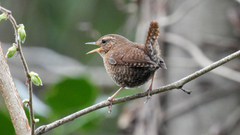
Pacific Wren

Pacific Wren

Troglodytes pacificus

Silhouette: T. Michael Keesey · PhyloPic

LCLeast ConcernNTVUENCR
Daily sighting probability ~60% · Likely
at Redwood National Park

In 3 days ~90% in a week >90%

2,123 Verified sightings at Redwood National Park From 2019 to 2026
11,091 In all 13 parks
July Best month
☀️ Diurnal When it's spotted

About the Pacific Wren

The Pacific wren (Troglodytes pacificus) is a very small North American bird and a member of the mainly New World wren family Troglodytidae. The species was formerly lumped together with either the winter wren (Troglodytes hiemalis) of eastern North America alone, or also with the Eurasian wren (Troglodytes troglodytes) of Eurasia, then under the merged name of northern wren with the scientific name T. troglodytes having priority.

It breeds along the Pacific coast from Alaska to California and inland as far as Wyoming and the Black Hills of South Dakota. It migrates through and winters across the western half of the United States and Canada. The scientific name is taken from the Greek word troglodytes (from trogle a hole, and dyein to creep), meaning 'cave-dweller', and refers to its habit of disappearing into cavities or crevices whilst hunting arthropods or to roost.

Rufous brown above, richly colored below, barred with darker brown and dusky, even on wings and tail. The bill is dark brown, the legs pale brown. Young birds are less distinctly barred. By studying the songs and genetics of individuals in an overlap zone between Troglodytes hiemalis and... Wikipedia →

Sounds

Call0:38

United States · 2026

© Greg Irving · XC1101455 · CC BY-NC-SA 4.0

Song0:52

Canada · 2022

© Sunny Tseng · XC729504 · CC BY-NC-SA 4.0

Alarm call0:53

United States · 2020

© Bruce Lagerquist · XC550930 · CC BY-NC-SA 4.0

Global Distribution

Parks Where Found

# Park Country Daily sighting probability
1 Pacific Rim National Park Reserve 🇨🇦 Canada
~60%
2 Redwood National Park 🇺🇸 United States
~60%
3 Olympic National Park 🇺🇸 United States
~40%
4 Great Bear Rainforest 🇨🇦 Canada
~40%
5 Glacier National Park 🇺🇸 United States
~20%
6 Banff National Park 🇨🇦 Canada
~10%
7 Yosemite National Park 🇺🇸 United States
~10%
8 Sequoia and Kings Canyon National Parks 🇺🇸 United States
~10%
9 Jasper National Park 🇨🇦 Canada
<5%
10 Kenai Fjords National Park 🇺🇸 United States
<5%
11 Zion National Park 🇺🇸 United States
<5%
12 Rocky Mountain National Park 🇺🇸 United States
<5%
13 Grand Teton National Park 🇺🇸 United States
<5%

Cities Where Found

# City Country Daily sighting probability
1 Vancouver 🇨🇦 Canada
~20%
2 Seattle 🇺🇸 United States
~20%
3 Portland 🇺🇸 United States
~10%
4 San Francisco 🇺🇸 United States
~10%
5 Anchorage 🇺🇸 United States
<5%
6 Calgary 🇨🇦 Canada
<5%
7 Los Angeles 🇺🇸 United States
<5%

Before you go

What are the chances of seeing a Pacific Wren in Redwood National Park?

Likely

About 60% of wildlife watchers report a Pacific Wren sighting in Redwood National Park on a given day, based on 2,123 verified sightings from GBIF citizen-science data from 2019 to 2026. It is the 4th most-seen of the 226 birds we can rate there. Over three days the chance rises to about 90%, and over a week to over 90%, if each day is a fresh chance.

When is the best time to see a Pacific Wren in Redwood National Park?

March–April, June–July and September–October

In those months about 60% of wildlife watchers report a Pacific Wren in Redwood National Park on a given day, against about 40% in December and January, the lowest months.

What time of day is best to see a Pacific Wren?

Between 9 am and noon

Across all the parks we cover, that three-hour window holds the most Pacific Wren sightings with a recorded time, and about 9 in 10 of them come between 6 am and 6 pm: it is a daytime animal.

Is Redwood National Park the best place to see a Pacific Wren?

Among the best

Of the 13 parks where we can rate Pacific Wren sightings, Redwood National Park ranks 2nd at about 60%, level with the leaders once rounded. The best odds are in Pacific Rim National Park Reserve (Canada, about 60%). All parks ranked.

Where does the Pacific Wren sighting chance come from?

GBIF citizen-science records

It is estimated from how often the Pacific Wren is recorded against all the birds logged in Redwood National Park (2,123 verified sightings from 2019 to 2026), calibrated against known sighting rates. Figures are rounded to the nearest 10% because citizen-science data supports honest approximations, not decimals, and months with records from fewer than five people show "—". How it works.

← Back to Redwood National Park