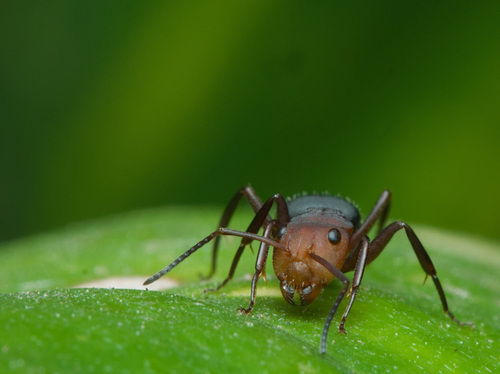
Mexican Tarantula-Hawk Wasp

Mexican Tarantula-Hawk Wasp

Pepsis mexicana

Daily sighting probability ~10% · With luck
at Ría Lagartos Biosphere Reserve

In 3 days ~40% in a week ~70%

11 Verified sightings at Ría Lagartos Biosphere Reserve From 2019 to 2026
11 In 1 park
November Best month
☀️ Diurnal When it's spotted

About the Mexican Tarantula-Hawk Wasp

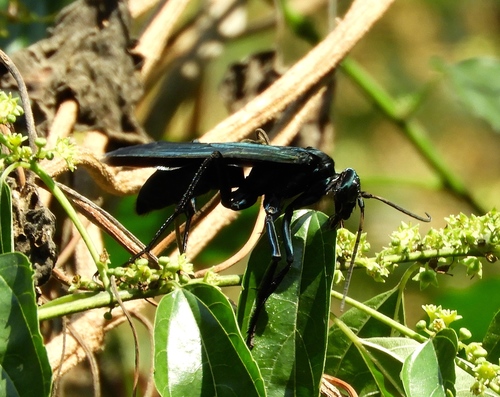
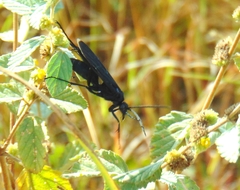
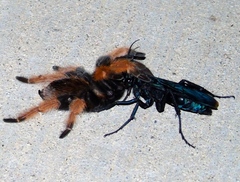
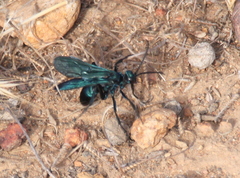
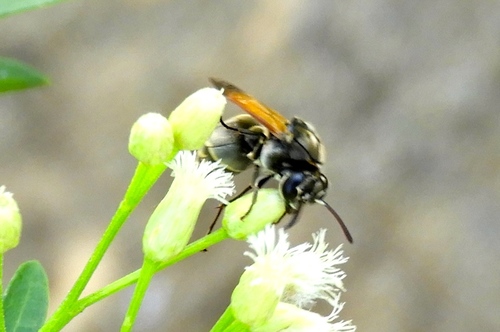
Pepsis mexicana, commonly known as the Mexican tarantula-hawk wasp, is a species of wasp belonging to the Spider Wasps Family, the Pompilidae. On this page and the iNaturalist page showing images associated with research-grade observations of Pepsis mexicana, it's seen that the wasp is black, usually with a metallic-blue sheen; wing apexes exhibit white edges if they haven't worn away. Wing color and the wings' narrow, white apex borders distinguish Pepsis mexicana from other tarantula-hawk species. Male Pepsis mexicana wasps are about 20mm long (~+3⁄4 inch), while females are about 3mm longer (~+1⁄8 inch). While Pepsis wasps are among the world's largest wasps, relative to other Pepsis species, the Mexican Tarantula-hawk Wasp is regarded as a small to medium species.

Pepsis mexicana occurs from the Southwestern United States (the Mojave Desert of southern California, the Sonoran Desert of southern Arizona and the Chihuahuan Desert of western Texas) south through Mexico and Central America into Costa Rica. In the Mexican state of Chiapas it ascends to 2500m (8200 feet).

As with all members of the genus Pepsis, females of Pepsis... Wikipedia →

Global Distribution

Parks Where Found

# Park Country Daily sighting probability
1 Ría Lagartos Biosphere Reserve 🇲🇽 Mexico
~10%

More parks will be added in future updates.

Before you go

What are the chances of seeing a Mexican Tarantula-Hawk Wasp in Ría Lagartos Biosphere Reserve?

With luck

About 10% of wildlife watchers report a Mexican Tarantula-Hawk Wasp sighting in Ría Lagartos Biosphere Reserve on a given day, based on 11 verified sightings from GBIF citizen-science data from 2019 to 2026. It is the 50th most-seen of the 112 insects we can rate there. Over three days the chance rises to about 40%, and over a week to about 70%, if each day is a fresh chance.

When is the best time to see a Mexican Tarantula-Hawk Wasp in Ría Lagartos Biosphere Reserve?

November and December

In those months about 30% of wildlife watchers report a Mexican Tarantula-Hawk Wasp in Ría Lagartos Biosphere Reserve on a given day, against under 5% in January, March–May and July–August, the lowest months.

What time of day is best to see a Mexican Tarantula-Hawk Wasp?

Between noon and 3 pm

Across all the parks we cover, that three-hour window holds the most Mexican Tarantula-Hawk Wasp sightings with a recorded time, and nearly all of them come between 6 am and 6 pm: it is a daytime animal.

Where else can you see a Mexican Tarantula-Hawk Wasp?

Only Ría Lagartos Biosphere Reserve, in our data

Ría Lagartos Biosphere Reserve is the only park on Wallace's Line with enough records to rate Mexican Tarantula-Hawk Wasp sightings: about 10% of wildlife watchers there report one on a given day.

Which relatives of the Mexican Tarantula-Hawk Wasp live in Ría Lagartos Biosphere Reserve?

Same order: Hymenoptera

The closest relatives of the Mexican Tarantula-Hawk Wasp that you can see in Ría Lagartos Biosphere Reserve (order Hymenoptera, Ants, Bees, Wasps, and Sawflies) are Mexican Pitted-Stingless Bee (about 20%), Ectatomma tuberculatum (about 20%) and Toltec Scoliid Wasp (about 20%), with each one's daily chance of a sighting.

Where does the Mexican Tarantula-Hawk Wasp sighting chance come from?

GBIF citizen-science records

It is estimated from how often the Mexican Tarantula-Hawk Wasp is recorded against all the insects logged in Ría Lagartos Biosphere Reserve (11 verified sightings from 2019 to 2026), calibrated against known sighting rates. Figures are rounded to the nearest 10% because citizen-science data supports honest approximations, not decimals, and months with records from fewer than five people show "—". How it works.

← Back to Ría Lagartos Biosphere Reserve