One-Eyed Sphinx

One-Eyed Sphinx

Smerinthus cerisyi

Daily sighting probability ~10% · With luck
at Riding Mountain National Park

In 3 days ~30% in a week ~60%

16 Verified sightings at Riding Mountain National Park From 2019 to 2026
194 In all 13 parks
June Best month
☀️ Diurnal When it's spotted

About the One-Eyed Sphinx

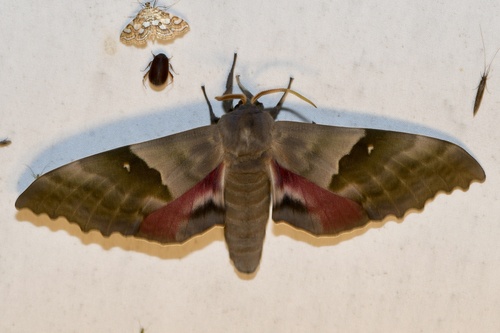
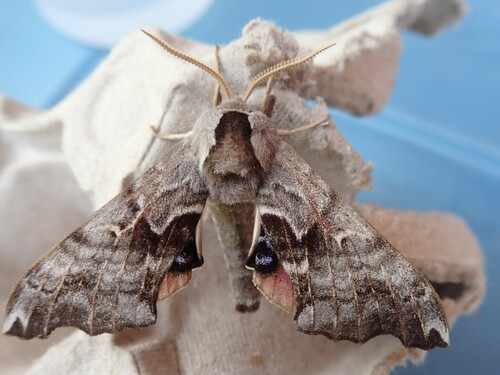
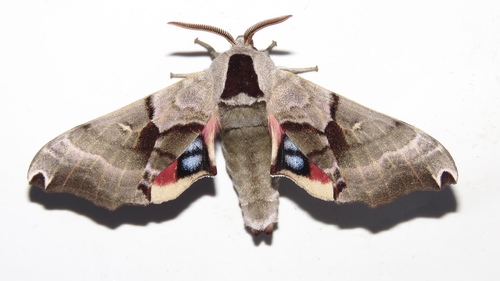
Smerinthus cerisyi, the one-eyed sphinx or Cerisy's sphinx, is a moth of the family Sphingidae. The species was first described by William Kirby who named the species in honor of Alexandre Louis Lefèbvre de Cérisy in 1837.

It is known from south-eastern Alaska, the southern parts of all Canadian provinces and in the northern border states of the United States south into northern Indiana, Pennsylvania and Ohio and along the west coast to southern California, eastward to the Rocky Mountains and into western New Mexico north to western North Dakota. It has also been recorded from Illinois and as far south as Missouri.

The wingspan is 60-90 mm and the hindwing has a blue eyespot with a black center. The species is univoltine (has a single generation per year) and adults can be found through much of the summer. The adult moths do not feed. The moths are nocturnal and are attracted to light.

The larvae feed on willow (Salix), poplar (Populus), pear (Pyrus communis), plum (Prunus), and snowberry (Symphoricarpos). Smerinthus ophthalmica, formerly listed as a synonym of Smerinthus cerisyi, is thought to be a valid species. In 2018, Smerinthus... Wikipedia →
Global Distribution

Parks Where Found

# Park Country Daily sighting probability
1 Isle Royale National Park 🇺🇸 United States
~20%
2 Elk Island National Park 🇨🇦 Canada
~20%
3 Grand Teton National Park 🇺🇸 United States
~10%
4 Jasper National Park 🇨🇦 Canada
~10%
5 Riding Mountain National Park 🇨🇦 Canada
~10%
6 Pacific Rim National Park Reserve 🇨🇦 Canada
~10%
7 Glacier National Park 🇺🇸 United States
~10%
8 Rocky Mountain National Park 🇺🇸 United States
~10%
9 Banff National Park 🇨🇦 Canada
~10%
10 Grand Canyon National Park 🇺🇸 United States
~10%
11 Great Bear Rainforest 🇨🇦 Canada
~10%
12 Yellowstone National Park 🇺🇸 United States
~10%
13 Acadia National Park 🇺🇸 United States
<5%

Cities Where Found

# City Country Daily sighting probability
1 Portland 🇺🇸 United States
~10%
2 Seattle 🇺🇸 United States
<5%
3 Vancouver 🇨🇦 Canada
<5%
4 Sacramento 🇺🇸 United States
<5%
5 Edmonton 🇨🇦 Canada
<5%
6 San Francisco 🇺🇸 United States
<5%
7 San Diego 🇺🇸 United States
<5%
8 Calgary 🇨🇦 Canada
<5%
9 Los Angeles 🇺🇸 United States
<5%

Before you go

What are the chances of seeing a One-Eyed Sphinx in Riding Mountain National Park?

With luck

About 10% of wildlife watchers report a One-Eyed Sphinx sighting in Riding Mountain National Park on a given day, based on 16 verified sightings from GBIF citizen-science data from 2019 to 2026. It is the 33rd most-seen of the 104 insects we can rate there. Over three days the chance rises to about 30%, and over a week to about 60%, if each day is a fresh chance.

When is the best time to see a One-Eyed Sphinx in Riding Mountain National Park?

June and July

In those months about 20% of wildlife watchers report a One-Eyed Sphinx in Riding Mountain National Park on a given day, against under 5% in September to April, the lowest months. Those are among Riding Mountain National Park's wettest months, with about 85 mm of rain a month against 20 mm in February.

What time of day is best to see a One-Eyed Sphinx?

Between 8 and 11 am

Across all the parks we cover, that three-hour window holds the most One-Eyed Sphinx sightings with a recorded time, and about 8 in 10 of them come between 6 am and 6 pm: it is a daytime animal.

Is Riding Mountain National Park the best place to see a One-Eyed Sphinx?

5th of 13

Of the 13 parks where we can rate One-Eyed Sphinx sightings, Riding Mountain National Park ranks 5th at about 10%. The best odds are in Isle Royale National Park (United States, about 20%), Elk Island National Park (Canada, about 20%) and Grand Teton National Park (United States, about 10%).

Where does the One-Eyed Sphinx sighting chance come from?

GBIF citizen-science records

It is estimated from how often the One-Eyed Sphinx is recorded against all the insects logged in Riding Mountain National Park (16 verified sightings from 2019 to 2026), calibrated against known sighting rates. Figures are rounded to the nearest 10% because citizen-science data supports honest approximations, not decimals, and months with records from fewer than five people show "—". How it works.

← Back to Riding Mountain National Park