Dugite

Dugite

Pseudonaja affinis

LCLeast ConcernNTVUENCR
Daily sighting probability ~40% · Likely
at Rottnest Island

In 3 days ~80% in a week >90%

134 Verified sightings at Rottnest Island From 2019 to 2026
134 In 1 park
November Best month
☀️ Diurnal When it's spotted

About the Dugite

The dugite (Pseudonaja affinis) is a species of highly venomous, potentially lethal snake endemic to Western Australia, a member of the family Elapidae. The word dugite is an anglicisation of names for the snake in some dialects of the Nyungar language, including toogitj, dukayj and dukitj. However, another, probably cognate name, dobitj, has become the common name for dugites in Nyungar (a potential source of confusion, as dobitj is also used in some dialects to refer to other kinds of venomous snakes).

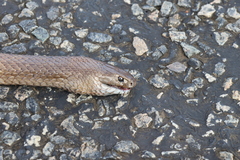
The dugite is a venomous snake, considered dangerous. It is coloured grey, green, or brown. The colours vary widely between individuals and are an unreliable means of identifying the species. Black scales can be scattered over the body; their scales are relatively large with a semi-glossy appearance. The most distinguishing characteristic is the head that can be rather small and indistinct from the neck. A dugite's body is long and slender in build and can grow up to 2 metres (6 ft 7 in) in total length (including tail), but the typical size is roughly 1.5 metres (4 ft 11 in).

P. affinis is found in southern parts of Western Australia... Wikipedia →

Global Distribution

Parks Where Found

# Park Country Daily sighting probability
1 Rottnest Island 🇦🇺 Australia
~40%

More parks will be added in future updates.

Cities Where Found

# City Country Daily sighting probability
1 Perth 🇦🇺 Australia
~10%

Zoos & Centres Where Found

# Zoo / Centre Country
1 Perth Zoo 🇦🇺 Australia In captivity
2 Ranger Red’s Zoo & Conservation Park 🇦🇺 Australia In captivity

Before you go

What are the chances of seeing a Dugite in Rottnest Island?

Likely

About 40% of wildlife watchers report a Dugite sighting in Rottnest Island on a given day, based on 134 verified sightings from GBIF citizen-science data from 2019 to 2026. It is the 3rd most-seen of the 8 reptiles we can rate there. Over three days the chance rises to about 80%, and over a week to over 90%, if each day is a fresh chance.

When is the best time to see a Dugite in Rottnest Island?

October and November

In those months about 50% of wildlife watchers report a Dugite in Rottnest Island on a given day, against under 5% in June and July, the lowest months. Those are among Rottnest Island's driest months, with about 25 mm of rain a month against 120 mm in June.

What time of day is best to see a Dugite?

Between 11 am and 2 pm

Across all the parks we cover, that three-hour window holds the most Dugite sightings with a recorded time, and about 9 in 10 of them come between 6 am and 6 pm: it is a daytime animal.

Where else can you see a Dugite?

Only Rottnest Island, in our data

Rottnest Island is the only park on Wallace's Line with enough records to rate Dugite sightings: about 40% of wildlife watchers there report one on a given day.

Where does the Dugite sighting chance come from?

GBIF citizen-science records

It is estimated from how often the Dugite is recorded against all the reptiles logged in Rottnest Island (134 verified sightings from 2019 to 2026), calibrated against known sighting rates. Figures are rounded to the nearest 10% because citizen-science data supports honest approximations, not decimals, and months with records from fewer than five people show "—". How it works.

← Back to Rottnest Island