Blyth's Kingfisher

Blyth's Kingfisher

Alcedo hercules

Silhouette: Steven Traver · PhyloPic

LCNTNear ThreatenedVUENCR
Daily sighting probability <5% · Rare
at Royal Manas National Park

In 3 days <5%

5 Verified sightings at Royal Manas National Park From 2019 to 2026
162 In all 2 parks
April Best month
☀️ Diurnal When it's spotted

About the Blyth's Kingfisher

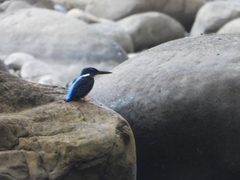
Blyth's kingfisher (Alcedo hercules) is the largest kingfisher in the genus Alcedo. Named for Edward Blyth, the species has also been known as Alcedo grandis and as the great blue kingfisher. Between 22 and 23 cm (8+5⁄8 and 9 in) long, the kingfisher has deep rufous underparts with a blackish blue breast patch, and brilliant cobalt blue or azure upperparts, tinged with purple. The wings are a dark blackish green, with blue speckles and tips to some of the feathers. The bill of the male is entirely black, while the female has a dark red lower mandible. The species is distinguished from the similar blue-eared kingfisher (Alcedo meninting) and common kingfisher (Alcedo atthis) by its greater size, heavy black bill, and dark lores.

The species breeds between the months of March and June. It builds nests at the end of tunnels dug in the banks of streams or ravines. Four to six eggs are laid, with both sexes incubating. A shy bird, it frequents small waterways, feeding on fish and insects caught by diving from a shrub close to the water. It is found along streams in evergreen forest and adjacent open country between 200 and 1,200 m (660 and 3,900 ft), mainly between 400 and 1,000 m (1,300 and 3,300 ft). The species ranges from Nepal through India, Bangladesh, Bhutan, China, Myanmar, Thailand, Laos, and Vietnam. Even within its preferred habitat the density of the species is low, and the population, though not thoroughly surveyed, is believed to be small, and declining further. The International Union for Conservation of Nature classifies it as "near threatened". Wikipedia →

Sounds

Flight call0:05

China · 2016

© Frank Lambert · XC324634 · CC BY-NC-ND 4.0

Global Distribution

Parks Where Found

# Park Country Daily sighting probability
1 Namdapha National Park 🇮🇳 India
~10%
2 Royal Manas National Park 🇧🇹 Bhutan
<5%

Before you go

What are the chances of seeing a Blyth's Kingfisher in Royal Manas National Park?

Rare

Under 5% of wildlife watchers report a Blyth's Kingfisher sighting in Royal Manas National Park on a given day, based on 5 verified sightings from GBIF citizen-science data from 2019 to 2026. It is the 371st most-seen of the 388 birds we can rate there. Over three days the chance rises to under 5%, if each day is a fresh chance.

When is the best time to see a Blyth's Kingfisher in Royal Manas National Park?

Any time of year

In every month with enough records, under 5% of wildlife watchers report a Blyth's Kingfisher in Royal Manas National Park on a given day, so our monthly data shows no clear season. August and September have too few records to rate.

What time of day is best to see a Blyth's Kingfisher?

Between 1 and 4 pm

Across all the parks we cover, that three-hour window holds the most Blyth's Kingfisher sightings with a recorded time, and about 9 in 10 of them come between 6 am and 6 pm: it is a daytime animal.

Is Royal Manas National Park the best place to see a Blyth's Kingfisher?

2nd of 2

Of the 2 parks where we can rate Blyth's Kingfisher sightings, Royal Manas National Park ranks 2nd at under 5%. The best odds are in Namdapha National Park (India, about 10%).

Where does the Blyth's Kingfisher sighting chance come from?

GBIF citizen-science records

It is estimated from how often the Blyth's Kingfisher is recorded against all the birds logged in Royal Manas National Park (5 verified sightings from 2019 to 2026), calibrated against known sighting rates. Figures are rounded to the nearest 10% because citizen-science data supports honest approximations, not decimals, and months with records from fewer than five people show "—". How it works.

← Back to Royal Manas National Park