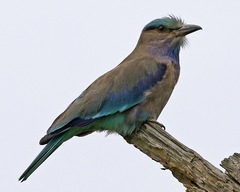
Indochinese Roller

Indochinese Roller

Coracias affinis

Silhouette: Ferran Sayol · PhyloPic

LCLeast ConcernNTVUENCR
Daily sighting probability ~10% · With luck
at Royal Manas National Park

In 3 days ~10% in a week ~30%

56 Verified sightings at Royal Manas National Park From 2019 to 2026
5,335 In all 10 parks
December Best month
🌅 Crepuscular When it's spotted

About the Indochinese Roller

The Indochinese roller (Coracias affinis) or Burmese roller, is a member of the roller bird family. It occurs widely from Nepal, eastern India to Myanmar and Southeast Asia. It is listed as Least Concern on the IUCN Red List.

The Indochinese roller was formally described in 1840 by the American naturalist Thomas Horsfield under the binomial name Coracias affinis based on specimens that had been collected in Assam by the naturalist John McClelland. The specific epithet affinis is from Latin adfinis or affinis meaning "related" or "allied".

McClelland has sometimes been credited as the authority but under the rules of the International Code of Zoological Nomenclature Horsfield now receives the credit. The Indochinese roller was formerly considered as a subspecies of the Indian roller because of a narrow hybrid zone in northeast India but a molecular phylogenetic study published in 2018 found that the Indochinese roller was more closely related to the purple-winged roller (Coracias temminckii) than it is to the Indian roller. The Indochinese roller is monotypic: no subspecies are recognised.

The phylogenetic relationships among the Coracias species are shown below, from... Wikipedia →

Sounds

Flight call0:20

Thailand · 2026

© Ding Li Yong · XC1073527 · CC BY-NC-ND 4.0

Call0:14

Malaysia · 2026

© Lim Ying Hien 林勇贤 · XC1071406 · CC BY-NC-ND 4.0

Song0:46

Thailand · 2020

© Peter Ericsson · XC611151 · CC BY-NC-SA 4.0

Global Distribution

Parks Where Found

# Park Country Daily sighting probability
1 Kaziranga National Park 🇮🇳 India
~70%
2 Kaeng Krachan National Park 🇹🇭 Thailand
~50%
3 Manas National Park 🇮🇳 India
~40%
4 Cat Tien National Park 🇻🇳 Vietnam
~30%
5 Doi Inthanon National Park 🇹🇭 Thailand
~10%
6 Khao Yai National Park 🇹🇭 Thailand
~10%
7 Royal Manas National Park 🇧🇹 Bhutan
~10%
8 Khao Luang National Park 🇹🇭 Thailand
<5%
9 Khao Sok National Park 🇹🇭 Thailand
<5%
10 Namdapha National Park 🇮🇳 India
<5%

Cities Where Found

# City Country Daily sighting probability
1 Bangkok 🇹🇭 Thailand
~40%
2 Yangon 🇲🇲 Myanmar
~40%
3 Phnom Penh 🇰🇭 Cambodia
~10%
4 Guwahati 🇮🇳 India
~10%
5 Kolkata 🇮🇳 India
<5%

Before you go

What are the chances of seeing an Indochinese Roller in Royal Manas National Park?

With luck

About 10% of wildlife watchers report an Indochinese Roller sighting in Royal Manas National Park on a given day, based on 56 verified sightings from GBIF citizen-science data from 2019 to 2026. It is the 196th most-seen of the 388 birds we can rate there. Over three days the chance rises to about 10%, and over a week to about 30%, if each day is a fresh chance.

When is the best time to see an Indochinese Roller in Royal Manas National Park?

April, June, October and December–February

In those months about 10% of wildlife watchers report an Indochinese Roller in Royal Manas National Park on a given day, against under 5% in March, May, July and November, the lowest months. August and September have too few records to rate.

What time of day is best to see an Indochinese Roller?

Between 3 and 6 am

Across all the parks we cover, that three-hour window holds the most Indochinese Roller sightings with a recorded time, and about 6 in 10 of them come between 6 am and 6 pm: it is most active around dawn and dusk.

Where does the Indochinese Roller sighting chance come from?

GBIF citizen-science records

It is estimated from how often the Indochinese Roller is recorded against all the birds logged in Royal Manas National Park (56 verified sightings from 2019 to 2026), calibrated against known sighting rates. Figures are rounded to the nearest 10% because citizen-science data supports honest approximations, not decimals, and months with records from fewer than five people show "—". How it works.

← Back to Royal Manas National Park