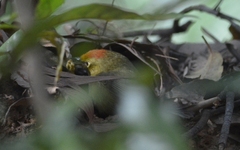
Rufous-capped Babbler

Rufous-capped Babbler

Stachyridopsis ruficeps

LCLeast ConcernNTVUENCR
Daily sighting probability ~10% · With luck
at Royal Manas National Park

In 3 days ~20% in a week ~40%

73 Verified sightings at Royal Manas National Park From 2019 to 2026
1,127 In all 3 parks
May Best month
☀️ Diurnal When it's spotted

About the Rufous-capped Babbler

The rufous-capped babbler (Cyanoderma ruficeps) is a babbler species in the family Timaliidae. It occurs from the Eastern Himalayas to northern Thailand, Laos, eastern China to Vietnam and Taiwan. It inhabits temperate forest with dense bushes or bamboo and is listed as Least Concern on the IUCN Red List.

It is pale olive with a bright rufous crown and nape, measures 12 cm (4.7 in) long and weighs 7–12 g (0.25–0.42 oz). Stachyris ruficeps was the scientific name proposed by Edward Blyth in 1847 for an olive-coloured babbler with a ferruginous crown and a white throat collected in Darjeeling.

It was later placed in the genus Stachyridopsis. BirdLife International (2019). "Rufous-capped Babbler Cyanoderma ruficeps". Wikipedia →

Sounds

Song0:38

China · 2026

© Bo Shunqi 薄顺奇 · XC1172744 · CC BY-NC-SA 4.0

Call0:33

Vietnam · 2026

© Tim Dinh / Annambirding · XC1157954 · CC BY-NC-SA 4.0

Recording0:57

Taiwan · 2023

© 張(Chang)智偉(Chih-Wei) · XC787728 · CC BY-NC-SA 4.0

Global Distribution

Parks Where Found

# Park Country Daily sighting probability
1 Taroko National Park 🇹🇼 Taiwan
~40%
2 Royal Manas National Park 🇧🇹 Bhutan
~10%
3 Namdapha National Park 🇮🇳 India
<5%

Cities Where Found

# City Country Daily sighting probability
1 Guiyang 🇨🇳 China
~60%
2 Chongqing 🇨🇳 China
~30%
3 Taipei 🇹🇼 Taiwan
~10%
4 Changsha 🇨🇳 China
~10%
5 Fuzhou 🇨🇳 China
~10%
6 Hangzhou 🇨🇳 China
~10%
7 Taichung 🇹🇼 Taiwan
~10%
8 Kaohsiung 🇹🇼 Taiwan
~10%
9 Kunming 🇨🇳 China
~10%
10 Guangzhou 🇨🇳 China
~10%

Before you go

What are the chances of seeing a Rufous-capped Babbler in Royal Manas National Park?

With luck

About 10% of wildlife watchers report a Rufous-capped Babbler sighting in Royal Manas National Park on a given day, based on 73 verified sightings from GBIF citizen-science data from 2019 to 2026. It is the 176th most-seen of the 388 birds we can rate there. Over three days the chance rises to about 20%, and over a week to about 40%, if each day is a fresh chance.

When is the best time to see a Rufous-capped Babbler in Royal Manas National Park?

April–June and October–November

In those months about 10% of wildlife watchers report a Rufous-capped Babbler in Royal Manas National Park on a given day, against under 5% in July and December–March, the lowest months. August and September have too few records to rate.

What time of day is best to see a Rufous-capped Babbler?

Between 8 and 11 am

Across all the parks we cover, that three-hour window holds the most Rufous-capped Babbler sightings with a recorded time, and about 9 in 10 of them come between 6 am and 6 pm: it is a daytime animal.

Is Royal Manas National Park the best place to see a Rufous-capped Babbler?

2nd of 3

Of the 3 parks where we can rate Rufous-capped Babbler sightings, Royal Manas National Park ranks 2nd at about 10%. The best odds are in Taroko National Park (Taiwan, about 40%).

Where does the Rufous-capped Babbler sighting chance come from?

GBIF citizen-science records

It is estimated from how often the Rufous-capped Babbler is recorded against all the birds logged in Royal Manas National Park (73 verified sightings from 2019 to 2026), calibrated against known sighting rates. Figures are rounded to the nearest 10% because citizen-science data supports honest approximations, not decimals, and months with records from fewer than five people show "—". How it works.

← Back to Royal Manas National Park