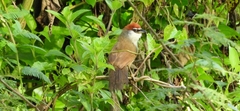
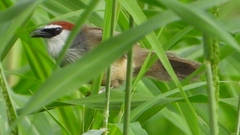

Chestnut-capped Babbler

Chestnut-capped Babbler

Timalia pileata

Silhouette: Sheatherius · PhyloPic

LCLeast ConcernNTVUENCR
Daily sighting probability <5% · Rare
at Royal Manas National Park

In 3 days <5%

7 Verified sightings at Royal Manas National Park From 2019 to 2026
1,354 In all 11 parks
March Best month
🌅 Crepuscular When it's spotted

About the Chestnut-capped Babbler

The chestnut-capped babbler (Timalia pileata) is a passerine bird of the family Timaliidae. It is monotypic within the genus Timalia. The chestnut-capped babbler is placed as the sole species in the genus Timalia. It is divided into six subspecies with the following distribution:

T. p. bengalensis – lower Himalayas (Uttarakhand in India, Nepal, Bangladesh, Bhutan, northeastern India, and northwestern Myanmar) south to Odisha in India T. p. smithi – northern Myanmar to southern China, northern Thailand and northern Indochina

T. p. intermedia – central and southern Myanmar to southwestern Thailand T. p. patriciae – western part of the central plains of Thailand T. p. dictator – eastern and southeastern Thailand to southern Indochina This species is most closely related to the two Indian species, the tawny-bellied babbler and the dark-fronted babbler. Together they form a sister group to the rest of the species in the family Timaliidae. The chestnut-capped babbler is a medium-sized (15.5–17 cm) babbler with a fairly long, wedge-shaped tail and a thick, black bill. The plumage is unbarred brown with characteristic... Wikipedia →

Sounds

Call0:34

China · 2026

© Bo Shunqi 薄顺奇 · XC1097801 · CC BY-NC-SA 4.0

Song0:26

India · 2025

© Peter Boesman · XC1030919 · CC BY-NC-ND 4.0

Subsong0:48

Vietnam · 2024

© Ding Li Yong · XC861963 · CC BY-NC-ND 4.0

Global Distribution

Parks Where Found

# Park Country Daily sighting probability
1 Manas National Park 🇮🇳 India
~20%
2 Chitwan National Park 🇳🇵 Nepal
~20%
3 Kaziranga National Park 🇮🇳 India
~20%
4 Royal Bardia National Park 🇳🇵 Nepal
~10%
5 Cat Tien National Park 🇻🇳 Vietnam
~10%
6 Sundarbans National Park 🇮🇳 India
~10%
7 Kaeng Krachan National Park 🇹🇭 Thailand
<5%
8 Royal Manas National Park 🇧🇹 Bhutan
<5%
9 Jim Corbett National Park 🇮🇳 India
<5%
10 Khao Yai National Park 🇹🇭 Thailand
<5%
11 Doi Inthanon National Park 🇹🇭 Thailand
<5%

Cities Where Found

# City Country Daily sighting probability
1 Chattogram 🇧🇩 Bangladesh
~30%
2 Tamluk 🇮🇳 India
~30%
3 Phnom Penh 🇰🇭 Cambodia
~20%

Before you go

What are the chances of seeing a Chestnut-capped Babbler in Royal Manas National Park?

Rare

Under 5% of wildlife watchers report a Chestnut-capped Babbler sighting in Royal Manas National Park on a given day, based on 7 verified sightings from GBIF citizen-science data from 2019 to 2026. It is the 362nd most-seen of the 388 birds we can rate there. Over three days the chance rises to under 5%, if each day is a fresh chance.

When is the best time to see a Chestnut-capped Babbler in Royal Manas National Park?

Any time of year

In every month with enough records, under 5% of wildlife watchers report a Chestnut-capped Babbler in Royal Manas National Park on a given day, so our monthly data shows no clear season. August and September have too few records to rate.

What time of day is best to see a Chestnut-capped Babbler?

Between 1 and 4 am

Across all the parks we cover, that three-hour window holds the most Chestnut-capped Babbler sightings with a recorded time, and about 6 in 10 of them come between 6 pm and 6 am: it is most active around dawn and dusk.

Is Royal Manas National Park the best place to see a Chestnut-capped Babbler?

8th of 11

Of the 11 parks where we can rate Chestnut-capped Babbler sightings, Royal Manas National Park ranks 8th at under 5%. The best odds are in Manas National Park (India, about 20%), Chitwan National Park (Nepal, about 20%) and Kaziranga National Park (India, about 20%).

Which relatives of the Chestnut-capped Babbler live in Royal Manas National Park?

Same family: Timaliidae

The closest relatives of the Chestnut-capped Babbler that you can see in Royal Manas National Park (family Timaliidae, Tree-Babblers, Scimitar-Babblers, and Allies) are White-browed Scimitar-Babbler (about 30%), Gray-throated Babbler (about 20%) and Pin-striped Tit-Babbler (about 20%), with each one's daily chance of a sighting.

Where does the Chestnut-capped Babbler sighting chance come from?

GBIF citizen-science records

It is estimated from how often the Chestnut-capped Babbler is recorded against all the birds logged in Royal Manas National Park (7 verified sightings from 2019 to 2026), calibrated against known sighting rates. Figures are rounded to the nearest 10% because citizen-science data supports honest approximations, not decimals, and months with records from fewer than five people show "—". How it works.

← Back to Royal Manas National Park