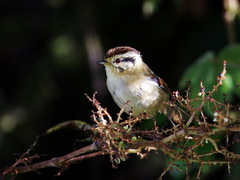
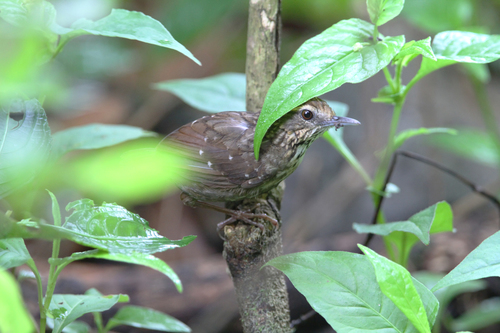
Rufous-winged Fulvetta

Rufous-winged Fulvetta

Alcippe castaneceps

Silhouette: PhyloPic

Daily sighting probability <5% · Rare
at Royal Manas National Park

In 3 days ~10% in a week ~30%

41 Verified sightings at Royal Manas National Park From 2019 to 2026
1,666 In all 4 parks
May Best month
🌅 Crepuscular When it's spotted

About the Rufous-winged Fulvetta

The rufous-winged fulvetta (Schoeniparus castaneceps) is a bird species of the family Pellorneidae. Its common name is misleading, because it is not a close relative of the "typical" fulvettas, which are now in the genus Fulvetta.

The black-crowned fulvetta (S. klossi) was until recently included here as a subspecies. This 11 cm long bird has a dark-streaked chestnut crown, white supercilium, brown upperparts and pale underparts. The wings show a striking contrast between the bright rufous primaries and the black coverts.

This is a noisy species with a rich warbled ti-du-di-du-di-du-di-du song and wheezy tsi-tsi-tsi-tsi call. It is common in evergreen montane forests above 1200 m ASL, often feeding on vertical trunks. Collar, N.J. & Robson, Craig (2007): Family Timaliidae (Babblers). In: del Hoyo, Josep; Elliott, Andrew & Christie, D.A. (eds.): Handbook of Birds of the World, Volume 12 (Picathartes to Tits and Chickadees): 70-291. Lynx Edicions, Barcelona.

Lekagul, Boonsong & Round, Philip (1991): A Guide to the Birds of Thailand. Saha Karn Baet. ISBN 974-85673-6-2 Robson, Craig (2004): A Field Guide to the Birds of Thailand. New Holland Press. ISBN 1-84330-921-1 Wikipedia →

Global Distribution

Parks Where Found

# Park Country Daily sighting probability
1 Doi Inthanon National Park 🇹🇭 Thailand
~50%
2 Langtang National Park 🇳🇵 Nepal
~10%
3 Royal Manas National Park 🇧🇹 Bhutan
<5%
4 Namdapha National Park 🇮🇳 India
<5%

Before you go

What are the chances of seeing a Rufous-winged Fulvetta in Royal Manas National Park?

Rare

Under 5% of wildlife watchers report a Rufous-winged Fulvetta sighting in Royal Manas National Park on a given day, based on 41 verified sightings from GBIF citizen-science data from 2019 to 2026. It is the 215th most-seen of the 388 birds we can rate there. Over three days the chance rises to about 10%, and over a week to about 30%, if each day is a fresh chance.

When is the best time to see a Rufous-winged Fulvetta in Royal Manas National Park?

March, May and October

In those months about 10% of wildlife watchers report a Rufous-winged Fulvetta in Royal Manas National Park on a given day, against under 5% in April, June–July and November–February, the lowest months. August and September have too few records to rate.

What time of day is best to see a Rufous-winged Fulvetta?

Between 8 and 11 am

Across all the parks we cover, that three-hour window holds the most Rufous-winged Fulvetta sightings with a recorded time, and about half of them come between 6 am and 6 pm: it is most active around dawn and dusk.

Is Royal Manas National Park the best place to see a Rufous-winged Fulvetta?

3rd of 4

Of the 4 parks where we can rate Rufous-winged Fulvetta sightings, Royal Manas National Park ranks 3rd at under 5%. The best odds are in Doi Inthanon National Park (Thailand, about 50%) and Langtang National Park (Nepal, about 10%).

Which relatives of the Rufous-winged Fulvetta live in Royal Manas National Park?

Same genus: Alcippe

The closest relatives of the Rufous-winged Fulvetta that you can see in Royal Manas National Park (genus Alcippe, Alcippe Fulvettas) are Nepal Fulvetta (about 30%) and Yellow-throated Fulvetta (about 10%), with each one's daily chance of a sighting.

Where does the Rufous-winged Fulvetta sighting chance come from?

GBIF citizen-science records

It is estimated from how often the Rufous-winged Fulvetta is recorded against all the birds logged in Royal Manas National Park (41 verified sightings from 2019 to 2026), calibrated against known sighting rates. Figures are rounded to the nearest 10% because citizen-science data supports honest approximations, not decimals, and months with records from fewer than five people show "—". How it works.

← Back to Royal Manas National Park