Spotted Elachura

Spotted Elachura

Elachura formosa

Silhouette: Sheatherius · PhyloPic

LCLeast ConcernNTVUENCR
Daily sighting probability ~10% · With luck
at Royal Manas National Park

In 3 days ~30% in a week ~50%

97 Verified sightings at Royal Manas National Park From 2019 to 2026
219 In all 2 parks
October Best month
☀️ Diurnal When it's spotted

About the Spotted Elachura

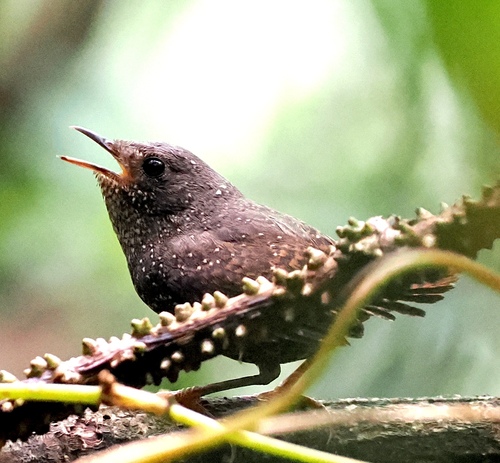
The spotted elachura or spotted wren-babbler (Elachura formosa) is a species of passerine bird found in the forests of the eastern Himalayas and Southeast Asia. In the past it was included in the babbler genus Spelaeornis as S. formosus, but molecular phylogenetic studies in 2014 provided evidence that it was distinct from the babblers, having no other close living relatives within the passerine bird clade Passerida. This led to the creation of a new family, Elachuridae, to accommodate just one species (a monotypic taxon).

The spotted elachura measures 10 cm including its short tail. It is dark brown all over, with rufous wings and tail. It also has white speckles all over its body, shifting to black barring on its wings and tail. It is found in Bangladesh, Bhutan, China, India, Laos, Myanmar, Nepal, and Vietnam. Its natural habitat is subtropical or tropical moist montane forests. This species is found in undergrowth and dense thickets of this type of forest, with a preference for thick fern ground cover, mossy rocks and decaying trunks of fallen trees and brushwood (often near a stream or creek), long grass, and scrub. Wikipedia →
Sounds

Song0:24

China · 2026

© Lim Ying Hien 林勇贤 · XC1148205 · CC BY-NC-ND 4.0

Uncertain0:31

China · 2021

© Wenyi Zhou · XC629563 · CC BY-NC-SA 4.0

Call0:23

China · 2010

© Frank Lambert · XC78389 · CC BY-NC-ND 4.0

Global Distribution

Parks Where Found

# Park Country Daily sighting probability
1 Namdapha National Park 🇮🇳 India
~10%
2 Royal Manas National Park 🇧🇹 Bhutan
~10%

Before you go

What are the chances of seeing a Spotted Elachura in Royal Manas National Park?

With luck

About 10% of wildlife watchers report a Spotted Elachura sighting in Royal Manas National Park on a given day, based on 97 verified sightings from GBIF citizen-science data from 2019 to 2026. It is the 148th most-seen of the 388 birds we can rate there. Over three days the chance rises to about 30%, and over a week to about 50%, if each day is a fresh chance.

When is the best time to see a Spotted Elachura in Royal Manas National Park?

March and October–November

In those months about 20% of wildlife watchers report a Spotted Elachura in Royal Manas National Park on a given day, against under 5% in January–February, April and June, the lowest months. Those are among Royal Manas National Park's driest months, with about 85 mm of rain a month against 930 mm in July. August and September have too few records to rate.

What time of day is best to see a Spotted Elachura?

Between 7 and 10 am

Across all the parks we cover, that three-hour window holds the most Spotted Elachura sightings with a recorded time, and about 8 in 10 of them come between 6 am and 6 pm: it is a daytime animal.

Is Royal Manas National Park the best place to see a Spotted Elachura?

Among the best

Of the 2 parks where we can rate Spotted Elachura sightings, Royal Manas National Park ranks 2nd at about 10%, level with the leaders once rounded. The best odds are in Namdapha National Park (India, about 10%).

Which relatives of the Spotted Elachura live in Royal Manas National Park?

Same order: Passeriformes

The closest relatives of the Spotted Elachura that you can see in Royal Manas National Park (order Passeriformes, Perching Birds) are Scarlet Minivet (about 60%), Streaked Spiderhunter (about 60%) and Bronzed Drongo (about 60%), with each one's daily chance of a sighting.

Where does the Spotted Elachura sighting chance come from?

GBIF citizen-science records

It is estimated from how often the Spotted Elachura is recorded against all the birds logged in Royal Manas National Park (97 verified sightings from 2019 to 2026), calibrated against known sighting rates. Figures are rounded to the nearest 10% because citizen-science data supports honest approximations, not decimals, and months with records from fewer than five people show "—". How it works.

← Back to Royal Manas National Park

